Why Buffalo works as a stop from Niagara Falls
Buffalo isn’t part of the falls themselves, and it isn’t trying to be. It’s a mid-size Rust Belt city about 34 km (21 mi) from the American side, with an art museum that punches well above its size, two buildings by Frank Lloyd Wright, a genuinely good waterfront, and a food story that most visitors only know as a menu item and not a place. For anyone spending more than a day or two at the falls, or flying into Buffalo Niagara International Airport (BUF) because it’s cheaper than Toronto Pearson, it’s a reasonable half-day or full-day add-on rather than a detour.
This page covers Buffalo itself: downtown, the waterfront and Orchard Park. It doesn’t repeat the detail on Lewiston or Old Fort Niagara, which have their own pages, and it doesn’t re-explain the attractions at the falls — for that, see the Niagara Falls, New York and Niagara Falls, Ontario pages. One note before anything else: prices in this guide are in USD, not CAD, since Buffalo is entirely on the American side.
Getting there and crossing the border
If you’re staying on the American side of the falls, Buffalo is a straightforward 30-minute drive south on I-190, no border involved. If you’re staying on the Canadian side, the trip has an extra step that a lot of day-trip itineraries gloss over: you have to cross into the United States, and back, on the same day.
A passport is required in both directions — there’s no shortcut for a same-day visit. The Rainbow Bridge is the closest crossing to the falls and handles both pedestrians and vehicles; for Buffalo specifically, the Peace Bridge, which lands you directly into south Buffalo, is often the more direct route and can be less congested than Rainbow Bridge on a summer weekend.
Line length at either crossing swings from a few minutes in the off-season to well over an hour on a July or August afternoon. Build that uncertainty into your day rather than promising yourself a fixed arrival time — see our notes on crossing the border at Niagara and, if you’re in a rental car, on driving a rental car across the border, since not every rental contract permits it.
Coming from the Toronto direction, some travellers treat Buffalo as a stopover rather than a there-and-back — see Toronto to Buffalo stopover if that fits your route better than a straight day trip. And if you’re weighing a couple of days that cover both the American and Canadian sides plus Buffalo, the both sides in 48 hours itinerary lays out one way to sequence it.
Frank Lloyd Wright in Buffalo: the Darwin D. Martin House and Graycliff
Buffalo has one of the country’s better concentrations of Frank Lloyd Wright work, and neither of the two main sites is a drive-by. Both are guided-tour-only, both need advance tickets, and both reward the time.
The Darwin D. Martin House complex sits in Buffalo’s Parkside neighbourhood, a short drive or rideshare from downtown. Built between 1903 and 1905 for Larkin Soap Company executive Darwin Martin, it’s a full estate — house, conservatory, carriage house and pergola — restored over decades after the Martin family lost the property during the Depression. Tours run on a fixed schedule and range from a standard walkthrough to longer, more detailed options; expect roughly $20–45 USD per person depending on length. It’s widely considered one of Wright’s most complete surviving Prairie School works, on a par with sites that get far more attention.
Graycliff, the Martins’ summer estate, is about a 30-minute drive south along Lake Erie in the town of Derby. It’s a different mood entirely — a low, light-filled lakeside house designed around the view rather than around monumentality — and it’s usually visited as a separate trip rather than paired with the Martin House on the same day, since between the drive and the tour length, doing both properly eats most of a day. If Wright architecture is the main reason you’re adding Buffalo to your trip, decide in advance which of the two you have time for.
Downtown Buffalo: art, architecture and the waterfront
Buffalo AKG Art Museum
The Buffalo AKG Art Museum (formerly the Albright-Knox, renamed after a major expansion funded in part by the Jeffrey Gundlach and other gifts, completed in 2023) is the anchor of a downtown visit. Its collection is strong in modern and contemporary work — de Kooning, Rothko, Pollock and a deep bench of postwar American art — and the newer wing gives it a scale that surprises people who expect a small regional museum. General admission runs in the neighbourhood of $20–25 USD for adults; plan on an hour and a half at minimum, longer if a special exhibition is running.
Buffalo City Hall’s observation deck
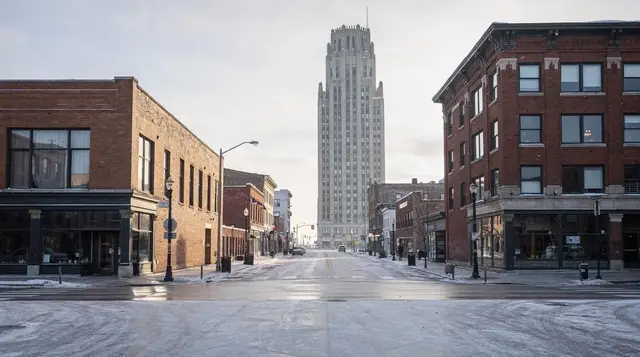
Buffalo City Hall, completed in 1931, is one of the country’s better-preserved art deco civic buildings — limestone exterior, a lobby with murals and mosaics worth a few minutes on its own, and, on the 28th floor, a public observation deck that’s free to visit during weekday business hours. The view takes in downtown, the waterfront, Lake Erie, and on a clear day the Canadian shoreline in the distance. It’s an easy, no-cost stop to pair with the AKG or a walk through downtown.
Canalside and the Buffalo Naval Park
Canalside, at the foot of downtown where the old Erie Canal terminus met Lake Erie, has been rebuilt into a public waterfront with a boardwalk, seasonal markets, an ice rink in winter, and views over the harbour. Right next to it, the Buffalo Naval Park (formally the Buffalo and Erie County Naval and Military Park) puts three retired warships on display, including the USS The Sullivans and the cruiser USS Little Rock, with self-guided access below deck; admission is roughly $15–20 USD for adults.
Between the two, it’s a solid two to three hours, and it’s the part of Buffalo that best rewards simply walking rather than driving between stops — a downtown walking tour is one way to string it together with the AKG and City Hall in a single loop.
Buffalo Museum of Science
The Buffalo Museum of Science, a bit north of downtown, is a family-oriented stop with a planetarium, a dinosaur hall, and rotating touring exhibitions. General admission is roughly $17–20 USD for adults with reduced pricing for children, and special exhibitions like touring dinosaur shows are usually ticketed separately on top of general admission. It’s a reasonable rainy-day option if the outdoor waterfront isn’t appealing, and it pairs easily with the drive back toward the falls since it sits close to the I-190 corridor.
Where the Buffalo wing was born
The dish most people associate with this city before they associate anything else with it started at the Anchor Bar, on Main Street in Buffalo, in 1964. The accepted version of the story credits owner Teressa Bellissimo with deep-frying leftover wing sections and tossing them in a butter-and-hot-sauce mixture as an off-menu late-night snack for her son and his friends; it became a permanent menu item and, eventually, a category of food that spread well past Buffalo.
The Anchor Bar still serves them, still leans into the origin story with memorabilia on the walls, and still gets a mix of genuine regulars and visitors who’ve come specifically to eat the thing at the place it started. It’s not the only place in the city to get good wings — plenty of Buffalo residents will tell you their neighbourhood spot does it better — but it’s the one with the history, and it’s worth doing at least once for that reason alone.
Game day: the Bills at Highmark Stadium
Highmark Stadium, home of the Buffalo Bills, is not in Buffalo proper. It’s in Orchard Park, a suburb about 25 km south of downtown and roughly 55 km (35 mi) from the falls — noticeably farther than the rest of what’s on this page. If a game lines up with your visit, it’s a legitimate reason to build a whole day around Buffalo rather than treating it as a quick side trip: traffic in and out of Orchard Park on a Sunday game day is heavy, parking lots open hours ahead of kickoff, and the tailgate culture around the stadium is part of the experience for a lot of fans. If football isn’t the draw, there’s no reason to route through Orchard Park at all — it adds real distance for no other payoff.
Planning a day in Buffalo
| Stop | Type | Typical cost (USD) | Time to allow |
|---|---|---|---|
| Buffalo AKG Art Museum | Museum | $20–25 | 1.5–2.5 hours |
| Buffalo City Hall observation deck | Free viewpoint | Free | 20–30 minutes |
| Canalside | Waterfront, free to walk | Free (paid activities extra) | 1–2 hours |
| Buffalo Naval Park | Museum ships | $15–20 | 1–1.5 hours |
| Darwin D. Martin House | Guided architecture tour | $20–45 | 1–2 hours |
| Graycliff | Guided architecture tour | $20–40 | 2 hours + drive |
| Buffalo Museum of Science | Museum | $17–20 | 1.5–2 hours |
| Anchor Bar | Meal | $15–25 per person | 1 hour |
Two workable ways to spend the day:
Downtown-and-waterfront loop (half day): AKG Art Museum, City Hall observation deck, a walk down to Canalside, wings at the Anchor Bar or a downtown spot on the way back. All within a short drive or walk of each other, and it comfortably fits into an afternoon.
Architecture day (full day): Darwin D. Martin House in the morning, lunch downtown, then either Graycliff in the afternoon if you’re not pressed for time, or the AKG and City Hall if you’d rather stay in the city. This version needs a full day once you factor in the drive back to the falls.
Either version works better with a guided angle if you’d rather not self-navigate: a walking and biking tour that pairs Buffalo’s food scene with its downtown architecture covers a lot of the same ground as the loop above with a local guide doing the narrating.
Families with kids leaning toward the Museum of Science can book straight in with a dinosaur-exhibition ticket to skip the line at the door. For the waterfront specifically, a bike tour along the Canalside harbourfront covers more ground than walking without needing a car downtown. And for something after dark, Buffalo’s downtown has a well-reviewed underground history and ghost-story walking tour that runs through the older parts of the city.
Whichever loop you pick, work the border crossing into your timing rather than around it if you’re coming from the Canadian side — see where to stay near the falls if you’re deciding which side to base on in the first place, and Canada vs. USA side for the broader comparison that a Buffalo add-on feeds into.
Buffalo day-trip questions
How far is Buffalo from Niagara Falls, and how do I get there?
From the American side, Buffalo is about 34 km (21 mi), roughly 30 minutes by car via I-190. From the Canadian side, add the border crossing at Rainbow Bridge or Peace Bridge, plus another 20 to 25 minutes of driving, so budget an hour or more each way depending on traffic and wait times.
Do I need a passport to visit Buffalo from the Canadian side?
Yes. A passport (or a passport card or NEXUS card, where eligible) is required in both directions at the Niagara-area border crossings. There is no exemption for a same-day trip, and land-crossing rules apply regardless of how short the visit is.
Is Buffalo’s airport (BUF) a good option for reaching Niagara Falls?
Often, yes. Buffalo Niagara International Airport (BUF) sits about 34 km (21 mi) from the American side of the falls and regularly prices lower than Toronto Pearson for travellers who don’t mind a border crossing to reach the Canadian side.
How much does it cost to visit the Darwin D. Martin House and Graycliff?
Both are ticketed, guided-tour-only sites, typically in the $20–45 USD range per person depending on the tour length; combined or extended tours cost more. Prices are set by the operating trusts and change by season, so check current tickets before you go.
Is the Buffalo City Hall observation deck really free?
Yes, on weekdays during business hours. The 28th-floor observation deck is open to the public at no charge and gives a wide view over downtown, Lake Erie and, on a clear day, toward the Canadian shoreline.
Can I see a Buffalo Bills game as part of a Niagara Falls trip?
Yes, but plan around it. Highmark Stadium is in Orchard Park, about 25 km south of downtown Buffalo and closer to 55 km (35 mi) from the falls, so a game day adds real driving time and, on Sundays, real traffic.
Where did the Buffalo wing actually come from?
The Anchor Bar on Main Street in Buffalo is the wing’s accepted birthplace, in 1964. The story credits owner Teressa Bellissimo with tossing deep-fried wing pieces in a hot sauce and butter mixture as a late-night bar snack, and the dish spread from there.
Is Buffalo worth it if I only have a half day?
A half day is enough for one focused loop: pick either the Wright architecture (Martin House, and Graycliff if time allows) or the downtown-and-waterfront combination (AKG Art Museum, City Hall observation deck, Canalside). Trying to fit both into a half day means rushing all of it.