The bridge that puts both countries in one photo
Built in 1941, the Rainbow Bridge is the crossing everybody pictures when they imagine walking from Canada to the United States at Niagara Falls: two arches over the gorge, the Horseshoe Falls on one side, the American Falls on the other, and both downtown cores close enough to see from the middle of the span. It carries pedestrians, cyclists, and vehicles, and it is the only one of the four Niagara-area bridges open to casual foot traffic — which is the main reason it matters to a first-time visitor more than the other three combined.
The bridge sits a short walk from Table Rock and Queen Victoria Park on the Canadian side, and from the Niagara Falls State Park entrances on the American side. That proximity is the whole appeal: you can be looking at the Horseshoe from the Canadian plaza and standing on Goat Island forty minutes later, no rental car and no tour bus required. It is also, for exactly that reason, the most crowded crossing on a summer afternoon, which is worth planning around rather than discovering in the line.
This page covers what actually happens at the bridge — the walk, the drive, the paperwork, and what to do if the queue is too long to bother with.
Walking across: what it actually takes
On foot, the Rainbow Bridge is genuinely quick outside peak hours. From the Canadian plaza near Table Rock, it is a five- to ten-minute walk over the gorge to the US Customs and Border Protection building on the New York side, and the same in reverse. There is a marked pedestrian walkway on each side of the roadway, separated from vehicle traffic, so the walk itself is comfortable even when the car lanes are backed up.
The toll is trivial: about CAD 1 to cross southbound into the United States, and about USD 1 to cross northbound back into Canada, payable in exact change or by token at some points. It is not a fee that changes anyone’s plans — it is mentioned here only because visitors sometimes assume a pedestrian crossing is free and are briefly annoyed to learn otherwise.
What does change plans is the line at the inspection booth on the far side. Outside of July and August, and outside of long weekends, a pedestrian typically clears US or Canadian customs in a few minutes. On a hot Saturday in August, or Victoria Day, Canada Day, or the American Independence Day and Labour Day weekends, the pedestrian queue can still stretch to twenty or thirty minutes, though it rarely approaches the delays drivers face in the same conditions. Early morning, after dinner, and shoulder-season visits (spring and fall) are consistently the fastest times to walk across.
One detail worth knowing before you go: there is no obvious midpoint marker or “Canada ends here” sign on the bridge deck. The border itself is unremarkable from the walkway — the real checkpoint, and the real formalities, happen at the booths on either end, not on the bridge itself.
Driving across: the real wait times
Cars have it worse. The Rainbow Bridge has a limited number of inspection lanes on each side, and because it is the crossing closest to both downtown cores, it absorbs a disproportionate share of tourist traffic, tour buses, and taxis in addition to daily commuters. In shoulder season and on weekday mornings, the wait is often under fifteen minutes. On a summer weekend afternoon or a holiday Monday, it is common to sit for forty-five minutes to an hour, and worse is not unheard of after fireworks nights on either side.
A few things make the drive faster or slower:
- Time of day. Late morning through late afternoon is consistently the worst window in summer; before 9 a.m. and after 8 p.m. is consistently the best.
- Which direction. Traffic headed into Canada tends to peak with day-trippers returning from Niagara Falls, New York, and Buffalo in the late afternoon; traffic headed into the US peaks with day-trippers leaving the Canadian side after lunch.
- NEXUS. Cars with NEXUS-enrolled drivers and passengers can use the dedicated NEXUS lane where available, which moves independently of the regular queue — but the Rainbow Bridge’s general lanes are open to everyone, unlike the Whirlpool Rapids Bridge described below.
If you are driving and the wait looks long, it is almost always faster to park on the side you are already on, walk across, do your sightseeing, and walk back for the car later — rather than sitting in a queue with the engine running.
| Crossing on the Rainbow Bridge | Typical time | Peak-season time |
|---|---|---|
| On foot | 5–10 minutes | 20–30 minutes |
| By car, off-peak | Under 15 minutes | — |
| By car, peak (summer weekends, holidays) | — | 45–60+ minutes |
Passport, ESTA, and AVE/eTA: what you actually need
This is the part visitors get wrong most often, so it is worth being direct about it.
A passport is required in both directions, whether you are walking or driving, and whether the trip lasts ten minutes or ten days. US citizens have two alternatives to a full passport at a land border: a passport card, or an enhanced driver’s licence from a participating state. NEXUS members can present their NEXUS card instead. There is no version of this crossing — on foot, by car, for a coffee run or a full day trip — where a government-issued photo ID alone is enough.
ESTA is the US Electronic System for Travel Authorization, and it applies to visa-exempt travellers flying into the United States. It has nothing to do with this bridge. If you are already in Canada and walking or driving across the Rainbow Bridge, ESTA is not the document you need — a passport is.
AVE/eTA, Canada’s Electronic Travel Authorization, works the same way in reverse: it is required for visa-exempt travellers flying into Canada, not for anyone crossing at a land border. This is the single most common piece of confused advice about this crossing — visitors who flew into Buffalo or New York and secured an eTA before their trip sometimes assume they need to show it again to walk into Canada over the Rainbow Bridge. They don’t. The eTA is tied to the flight, not the land crossing.
ArriveCAN is no longer required. The app-based pre-arrival declaration that Canada used during the pandemic-era border rules was discontinued in October 2022, and it does not apply to this or any other Niagara crossing today. If you read older trip reports or blog posts mentioning it, treat that instruction as out of date.
| Document | Applies to | Applies at the Rainbow Bridge? |
|---|---|---|
| Passport (or NEXUS / US passport card / enhanced licence) | Everyone, both directions | Yes, required |
| ESTA | Visa-exempt travellers flying into the US | No — land crossing only |
| AVE/eTA | Visa-exempt travellers flying into Canada | No — land crossing only |
| ArriveCAN | Discontinued October 2022 | No — not required |
None of this is meant to make the crossing sound complicated. It genuinely is not, once the passport is in hand: the whole point of walking the Rainbow Bridge is that it is the fastest, least bureaucratic way to see Niagara Falls, New York from the Canadian side and vice versa. But “bring your passport” is a real requirement, not a formality to skip, and travelling without one is the single most common reason someone gets turned back at the booth.
Renting a car? Check the contract first
Not every rental car is allowed to leave the country it was rented in. Most major agencies permit cross-border travel between Canada and the United States, but not all of them do by default, and the ones that do often require advance notice, a specific insurance rider, or both. Before driving a rental across the Rainbow Bridge in either direction:
- Confirm cross-border travel is explicitly permitted in the rental agreement, not assumed.
- Ask whether the agency requires a letter of authorization to present at the border — some do, and a border agent can ask to see it.
- Check that the insurance and roadside coverage extend to the other country; a policy that only covers Ontario is not much use if something goes wrong outside Buffalo.
This is easy to check in five minutes at the rental counter and genuinely inconvenient to discover at the customs booth, so it is worth asking explicitly rather than assuming a rental car works the same way a personal vehicle does.
If the line is long: the other three bridges
The Rainbow Bridge is the closest crossing to the falls, but it is not the only one, and knowing the alternatives is useful if the queue looks bad on a summer afternoon.
- Whirlpool Rapids Bridge, north of the falls near the Whirlpool State Park area, is NEXUS-enrolled travellers only — not an option without that pass, but worth knowing about if you have one, since it tends to move faster than the general lanes elsewhere.
- Queenston-Lewiston Bridge, north near Queenston, is open to everyone and is consistently the least congested of the four, in exchange for a roughly fifteen-minute drive from the falls in either direction.
- Peace Bridge, well south near Buffalo and Fort Erie, connects the two cities rather than the two Niagara Falls downtowns and is really only worth using if Buffalo, rather than the falls themselves, is the endpoint of your trip.
None of these three are pedestrian-friendly the way the Rainbow Bridge is, so they solve a driving delay, not a walking one. If you are on foot and the Rainbow Bridge queue is unusually long, the practical fix is almost always to wait it out or shift your timing rather than relocate to another crossing.
What’s actually on each side once you cross
Crossing the bridge is the easy part; knowing what is worth walking to on the other side is what makes the trip worthwhile. On the Canadian side, Clifton Hill and the Table Rock viewing area are both within easy walking distance of the plaza. On the American side, the entrances to Niagara Falls State Park and Goat Island are close enough that a determined walker can reach Prospect Point inside twenty minutes of clearing customs.
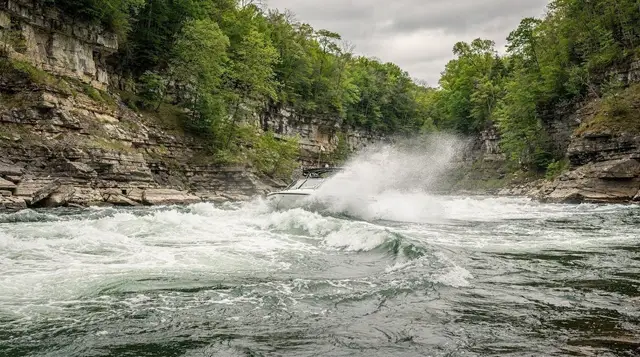
If you are crossing specifically to add a boat ride or a jet-boat run to your day, book it before you go rather than deciding at the dock — both sides sell out on peak afternoons. The USA-side jet boat run, the 45-minute jet boat ride on the Niagara River, departs a short walk from the American plaza and is a reasonable way to spend the first hour after crossing. Closer to the water on the same side, the Maid of the Mist boat and walking combination covers the classic boat approach to the base of the falls without needing to double back to the Canadian dock.
If your day runs the other direction — from the US side back into Canada for the evening — the Hornblower boat ride combined with Journey Behind the Falls pairs naturally with an early-evening walk back over the Rainbow Bridge before the illumination begins. For a longer day that treats the bridge as one stop among several, the one-day Niagara Falls and Washington combination tour is built around crossing the border as part of a wider loop rather than a there-and-back walk.
For the fuller picture of what to prioritize on each side once you have crossed, see which side has the better view versus the better access, and for parking specifically, the separate notes on parking on the American side and parking on the Canadian side are worth reading before you drive rather than after you’re circling for a spot.
Planning the rest of the crossing
If the Rainbow Bridge is one stop in a longer day rather than the whole point of the visit, a few related pages fill in the gaps: the general overview of crossing the border at Niagara covers all four bridges side by side, the dedicated notes on walking across the Rainbow Bridge go deeper on foot-traffic timing by season, and driving a rental car across the border expands on the contract and insurance questions above.
Travellers building a longer trip around both countries may also want the 48 hours on both sides itinerary, or the day-trip notes for continuing on to Buffalo or back to Toronto once the crossing is done.
Rainbow Bridge crossing: frequently asked questions
Is the Rainbow Bridge free to walk across?
No, but it is close to free. The pedestrian toll is roughly CAD 1 heading into the United States and roughly USD 1 heading back into Canada, payable in coins or by token depending on the booth. It has never been a fee substantial enough to affect anyone’s plans.
How long does it take to walk from the Canadian falls to the American falls?
Figure five to ten minutes of actual walking across the bridge itself outside busy periods, plus whatever time customs takes — usually a few minutes off-peak, up to twenty or thirty minutes on a summer weekend or holiday Monday. Add another ten to twenty minutes of walking on either end to reach Table Rock or Goat Island from the plazas.
Do I need ESTA to cross the Rainbow Bridge?
No. ESTA authorizes visa-exempt travellers to fly into the United States; it does not apply to land crossings. If you are walking or driving across the Rainbow Bridge, a valid passport is what’s required, not an ESTA.
Do I need Canada’s AVE or eTA to walk back into Canada?
No, for the same reason in reverse. The Electronic Travel Authorization applies to flights into Canada, not to land crossings. Crossing the Rainbow Bridge on foot or by car requires a passport (or NEXUS card), not an eTA.
Is ArriveCAN still required to cross into Canada?
No. ArriveCAN was discontinued in October 2022 and does not apply to any Niagara-area crossing today, including the Rainbow Bridge. Some older travel guides still mention it — that information is out of date.
Can I drive a rental car across the Rainbow Bridge?
Only if the rental agreement explicitly allows cross-border travel. Most major agencies do, but not all, and some require advance notice or a specific insurance rider. Confirm this at the rental counter before you drive to the bridge, since it is not something a border agent can waive on the spot.
What should I do if the car line at the Rainbow Bridge is too long?
If you are already parked nearby, park the car and walk instead — the pedestrian line is almost always shorter than the vehicle line, even at peak times. If you must drive, the Queenston-Lewiston Bridge to the north is usually the least congested alternative, at the cost of a roughly fifteen-minute detour from the falls.
Is the Rainbow Bridge the only place to cross near the falls?
It’s the only crossing that’s genuinely convenient on foot. Three other bridges exist — Whirlpool Rapids Bridge (NEXUS members only), Queenston-Lewiston Bridge, and the Peace Bridge near Buffalo — but none of them sit close enough to either downtown to make a casual walk practical the way the Rainbow Bridge does.