Where Goat Island sits, and why it’s the American side’s centrepiece
Goat Island is the piece of land that does the actual separating: it splits the American Falls from the Horseshoe Falls, and it’s entirely on the US side, inside Niagara Falls State Park. Unlike almost everything else worth doing at the falls, there’s no ticket at the gate. You can drive across the short bridge near the American Falls, park, and walk the island’s loop trail for free, any day of the year.
That free-entry point matters, because it’s easy to assume the good views cost money. They don’t. The paid attractions on this side — Cave of the Winds, the Maid of the Mist boarding dock — happen to be reached from Goat Island, but the island’s own viewpoints, including the best one, are free to stand at for as long as you like.
Geographically, Goat Island is bigger than most visitors expect: a loop road and a network of paths wrap around roughly 27 hectares of mostly wooded park, with the Three Sisters Islands branching off the upstream end into the rapids above the falls. Most people only walk the western third, between the parking areas and Terrapin Point, and that’s the right call if time is short — but it means the island reads smaller on a quick visit than it actually is.
Terrapin Point: the closest Horseshoe Falls view on the American side
Terrapin Point sits at the western tip of Goat Island, and it is the single reason most people come here. Every other American-side vantage — Prospect Point, the walkways along the American Falls — looks across the river at the Horseshoe. Terrapin Point looks straight down into it. The railing here is built out over the edge of the crest itself, close enough that the roar changes register and the mist reaches you even on a dry day.
It’s worth being precise about what Terrapin Point gives you and what it doesn’t. You get proximity to the Horseshoe’s edge that nothing else on the US side matches — closer, in a real sense, than the famous Canadian view from Table Rock, which looks at the Horseshoe from the front rather than from beside it. What you don’t get is the classic postcard framing of both falls together; for that panoramic angle, the Canadian side, or a boat, does the job better. Terrapin Point is about being in the water’s edge, not about composing the whole scene.
Go early or late in the day if photos matter. Midday sun sits behind the mist here and tends to flatten everything into a grey wash; the light is better an hour or two after sunrise or before sunset, and the crowds thin out at both ends of the day too.
a private guided walk that covers Goat Island’s viewpoints and Cave of the Winds together is a reasonable option if you’d rather have someone explain what you’re looking at and handle the Cave of the Winds queue, though the island itself needs no guide to enjoy.
Luna Island and the Three Sisters — don’t confuse them with Goat Island
This is where a lot of first-time visitors get their geography scrambled, so it’s worth being direct about it. Goat Island is the large island; Luna Island is a small outcrop reached on foot from Goat Island, sitting between the American Falls and the Bridal Veil Falls, separated by only a narrow footbridge. Luna Island has its own view — arguably the best angle on the Bridal Veil Falls — but it is not Goat Island, and directions or bookings that say “Goat Island” won’t necessarily land you there.
The full comparison of these three close-together viewpoints, including how to sequence them in one visit, is covered in our guide to Table Rock, Terrapin Point, and Luna Island rather than here.
The Three Sisters Islands sit at the opposite, upstream end of Goat Island, connected by a short chain of footbridges over the rapids that feed the falls. They’re a genuinely different kind of stop — moving water and rock rather than a falls view — and they get their own detailed page rather than a paragraph here. If your legs and your schedule allow it, walking out to them from Goat Island’s parking areas adds roughly 30 to 40 minutes round trip.
The Tesla statue and the Adams Power Plant connection
Partway around Goat Island stands a statue of Nikola Tesla, and it’s easy to walk past without knowing why it’s there. The answer sits just across the river, out of sight from the island: the Adams Power Plant, built in 1895, was the first large hydroelectric station to run on alternating current at scale — Tesla’s patents and George Westinghouse’s engineering, proven here before AC power spread across North America. The falls that draw people for the view were, at the same moment, becoming an industrial engine that reshaped how electricity got made everywhere else.
It’s a minor stop on the walk, not a destination in itself, but it’s the kind of detail that turns a scenery visit into something with more substance — and it connects directly to why the flow over the crest is a managed number rather than a wild one, a fact covered in more depth in our explainer on how the falls actually work. For the fuller Tesla and hydroelectric story, including the Canadian-side Power Station tunnel built into the old Rankine plant, see our guide to the Power Station’s Tesla history.
What the water is doing around you
Standing at the railing, it helps to know that the river you are looking at is being rationed. The 1950 treaty guarantees 2,832 cubic metres per second over the falls during daylight from 1 April to 31 October, and 1,416 cubic metres per second the rest of the year; the remainder is diverted to the power stations. The Niagara River runs 58 km from Lake Erie to Lake Ontario and drops 99 m along the way, and Goat Island sits right where that drop becomes spectacular. Our essay on why the flow is a treaty and not nature goes deeper into the arrangement.
The Horseshoe Falls drop about 57 m, and from Terrapin Point you are standing beside a crest that stretches roughly 670 m. The American Falls, by comparison, have a crest of about 260 m. The gorge below was cut over some 12,500 years as the falls retreated 11 km upstream, and the edge still moves back about 30 cm a year. That is why the rock under your feet feels permanent and is not: the island is a small piece of a very slow process.
Seasons on the island
Goat Island changes more through the year than most visitors expect. In summer the canopy is full, the paths are busy and the mist is a welcome cooling on a hot afternoon. In autumn the foliage frames the viewpoints, and the crowds ease once the school holidays are over; our notes on the falls in autumn cover what to expect. In winter the island stays open, but ice builds on the railings and the trees, and the walkways to some attractions close; see winter in Niagara Falls and when everything is closed before you plan a cold-weather visit.
Spring is quieter still. Paths can be wet, and some seasonal services have not yet started, so check what is open and closed by season rather than assuming. For a broader view of the calendar, the best time to visit Niagara Falls compares the months side by side.
Practical tips for a smoother visit
Wear shoes with grip. The paths near Terrapin Point and Luna Island stay damp from the mist even on a dry day, and a thin waterproof layer is more useful here than an umbrella, which the wind near the crest tends to ruin. A phone or camera needs protecting from the spray; our guide to what the mist does to your camera explains how to keep a lens usable.
Carry your passport if you came across from Ontario. Border rules apply in both directions, and our guide to crossing the border at Niagara sets out what to have in hand, including the ESTA requirement for visa-exempt travellers entering the United States. Currency matters too: on this side you pay in US dollars, and sales tax in Niagara County is about 8%, which is lower than the 13% HST you pay in Ontario.
If you are travelling with children, the loop is flat enough for strollers on the main paths, and our Niagara Falls with kids guide suggests how to pace a family day. For visitors with limited mobility, accessibility and mobility at Niagara Falls covers the practical details.
How Goat Island fits with the rest of the American side
Goat Island is the hinge of the US-side day. From the island you can reach the paid attractions already mentioned, and from the mainland you can continue to Niagara Gorge and its trails, or cross to the Canadian side for the lit view after dark. The fireworks over Niagara Falls and the illumination of the falls are best watched with the whole scene in front of you, which the island does not offer, so many visitors finish the evening on the other bank.
If you are staying overnight, where to stay in Niagara Falls compares both sides, and the two-day itinerary shows how a second morning can take in the island at a slower pace than a first rushed visit allows.
Parking: the real bottleneck, and why walking in beats hunting for a spot
Here’s the honest problem with Goat Island in summer: everyone has the same idea at the same time. The lots closest to Terrapin Point fill by mid-morning on a warm July or August day, and circling for a spot that opens up right by the viewpoint can eat 20 or 30 minutes that a five-minute walk would have saved.
The better move is to park in one of the larger lots nearer the state park’s main entrance or visitor centre, then walk in across the bridge. It’s flat, it’s a pleasant walk through the trees, and it sidesteps the worst of the lot-circling entirely. If you’re driving over from the Canadian side for the day, our guide to parking on the American side has the fuller breakdown of which lots fill first and what they cost.
Walking from Prospect Point or the main state park entrance takes 5 to 10 minutes to reach Goat Island’s bridge, and driving in from anywhere else in Niagara Falls, New York rarely takes more than 10 minutes given the compact size of the tourist core.
Getting to Goat Island and combining it with the rest of the day
Most visitors reach Goat Island as one stop inside a longer American-side loop that also takes in Prospect Point, Cave of the Winds, and the Maid of the Mist dock. If you’re coming from Ontario, that means crossing the Rainbow Bridge — allow extra time in summer, when the pedestrian and vehicle queues both lengthen.
From farther afield, Toronto sits about two and a half hours away by car via the QEW to the Rainbow Bridge crossing, and Buffalo is closer still, a 30-minute drive to the state park entrance — useful to know if you’re flying into Buffalo Niagara International rather than Toronto Pearson. Both crossing points and both airport routes are covered in more detail in our guide to getting from Toronto to Niagara Falls and our Buffalo to Niagara Falls route notes.
For a same-day comparison of what the island gives you against the Canadian side’s wider, front-on view, our Canada versus USA side guide walks through the trade-offs in more depth than fits here — in short, Goat Island wins on proximity and price, the Canadian side wins on the classic panorama.
| Getting to Goat Island | Approx. time | Cost |
|---|---|---|
| Walk from Prospect Point / visitor centre | 5–10 minutes | Free |
| Drive from elsewhere in Niagara Falls, NY | 5–10 minutes | Free entry; parking USD 10–20 |
| From Buffalo (car) | About 30 minutes | Free entry; parking as above |
| From Toronto via Rainbow Bridge | About 2.5 hours | Free entry; bridge toll a few dollars each way |
Boat and walking tours that include Goat Island
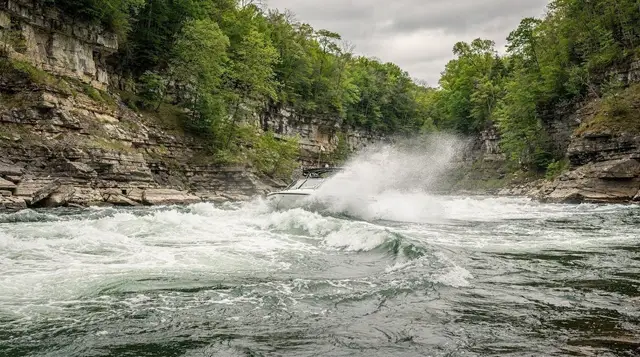
If you’d rather not plan the sequence yourself — parking, Terrapin Point, Cave of the Winds, and a boat — a bundled tour handles the logistics. a boat tour from the American side paired with a guided walk that takes in Goat Island’s viewpoints covers both the water-level view and the Terrapin Point vantage in one outing. For something with more movement on the water itself, a jet boat run on the Niagara River from the US side is a different, faster way to see the gorge below the falls, though it doesn’t stop on Goat Island itself.
Visitors trying to fit both the Canadian and American viewpoints, boats included, into a single day tend to book something broader. a full-day tour bundling a boat cruise with both sides of the falls is the option worth comparing against planning the day independently — it costs more than doing it yourself, but it removes the parking and queueing problem entirely, which on a peak summer day is worth something.
Whichever way you go, plan Goat Island as a 2- to 3-hour block rather than a quick photo stop. The free entry and the closeness of Terrapin Point are the whole appeal, and both reward slowing down rather than rushing the loop. For a full day that puts Goat Island alongside the rest of the American side in order, see our one-day Niagara Falls itinerary and our dedicated Goat Island and American side loop guide.