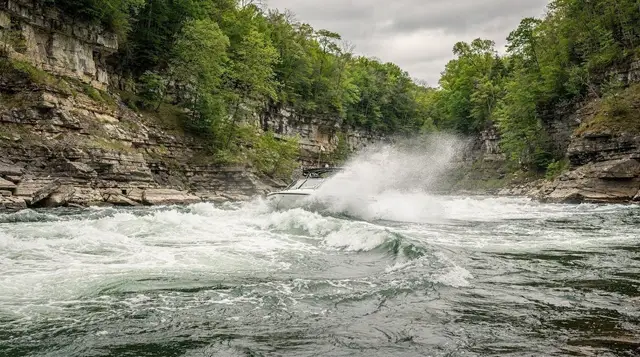
Getting soaked on purpose, a few metres from the water
Cave of the Winds is the closest a visitor can legally get to a section of the falls without being on the water itself. It’s inside Niagara Falls State Park on Goat Island, on the American side, and the whole idea of the attraction is simple: an elevator takes you down into the Niagara gorge, and a series of wooden boardwalks lead you out to a viewing platform called the Hurricane Deck, standing in the spray thrown off by the base of Bridal Veil Falls. You will get wet. That’s not a side effect, it’s the entire point, and the park hands out ponchos accordingly.
This page covers the mechanics of the attraction — the route, what to wear, when it’s actually open in its full form, and how it differs from Maid of the Mist. It doesn’t go into detail on Bridal Veil Falls itself, since that has its own page; here, Bridal Veil is simply the falls you’ll be standing next to.
The route: elevator, boardwalk, Hurricane Deck
The visit starts at an entrance building on Goat Island, where an elevator descends into the gorge — a drop of a few dozen metres from the level of the park above to the base of the falls. From there, a network of wooden boardwalks and stairways carries visitors out over the rocks at the foot of the gorge, following a path that gets progressively closer to the water.
The walk builds in stages. The lower sections run alongside the talus at the base of the cliff, where the mist is already noticeable on a busy day. The final stretch climbs a short flight of stairs onto the Hurricane Deck itself, a platform positioned just metres from where Bridal Veil Falls hits the rocks below. Standing on it, the water isn’t something you look at from across a gorge — it’s something that hits you directly, in gusts driven by the falling water displacing air as it drops. Conversation becomes difficult. Visibility comes and goes with the wind. It’s loud, chaotic, and for most visitors, the highlight of a day on the American side.
Unlike the descent to the water on Journey Behind the Falls on the Canadian side, where you view the Horseshoe Falls through portals cut into the rock, Cave of the Winds puts you out in the open, exposed to the spray with no barrier at all beyond a railing. It’s a wetter, rougher, more physical experience than most other paid attractions at the falls, and that’s exactly its appeal.
Ponchos, water shoes, and what actually gets soaked
Admission includes a poncho and a pair of rubber sandals, and both are worth using rather than skipping. The poncho keeps your torso and most of your clothing reasonably dry on the approach; it will not keep you dry on the Hurricane Deck itself, where the spray comes from below and from the side as much as from above.
The sandals matter more than they sound like they would. The boardwalks and stairs are wet, sometimes slick, and bare feet or regular shoes on soaked wood are a genuine slipping hazard, which is why park staff require the provided footwear (or a rental pair) rather than street shoes on the lower boardwalks. If you wear your own shoes anyway, expect them to be thoroughly soaked by the time you’re back at the elevator — there’s no dry path once you’re past a certain point on the route, and the water pools on the boardwalk itself.
Bring a dry change of clothes, or at least a towel, in the car or at the hotel for afterward. A phone or camera should go in a sealed bag or stay behind; several visitors a day realize too late that “a bit of spray” on the Hurricane Deck actually means a direct soaking. This isn’t the place to shoot with an exposed camera the way you might from a dry viewpoint like Terrapin Point or the Prospect Point observation tower.
a combined ticket pairing Cave of the Winds with a Maid of the Mist boat ride is the simplest way to book both of the American side’s signature wet experiences in a single admission, and it’s worth considering if you want to compare the two in one visit rather than choosing between them.
The boardwalks are seasonal — this is not a year-round attraction in full
This is the single most important thing to understand before planning around Cave of the Winds: the wooden boardwalks that lead to the Hurricane Deck are not permanent structures. Because ice, snow load, and the freeze-thaw cycle in the gorge would destroy wood left in place over winter, the boardwalks are dismantled every autumn and rebuilt from scratch every spring.
In practice, that means the Hurricane Deck experience described above only exists for part of the year — generally from spring, once the rebuild is complete, through the autumn, before the teardown begins. Exact opening and closing dates shift slightly year to year depending on construction schedules and weather, so it’s worth checking current dates before locking in a visit, especially at the shoulder edges of the season.
During the warmest stretch of that window — roughly June through August — the attraction runs at full capacity with long queues on sunny weekends, since it’s one of the most popular paid experiences in Niagara Falls State Park. Late spring and early autumn are quieter, and the water is often just as dramatic, though the air and spray will be noticeably colder against wet clothing than in midsummer. For a broader read on what’s running and what isn’t across the whole destination by month, see what’s open and closed by season.
Winter: the Ice Experience, and no Hurricane Deck
Once the boardwalks come down for the season, Cave of the Winds does not simply close. Instead, the park keeps the upper section — the observation area accessible without descending the full boardwalk route — open under a different name: the Ice Experience. It lets visitors take the elevator down and view the ice formations that build up at the base of the gorge over winter, without the wooden lower boardwalks or the Hurricane Deck itself in the picture.
This is a genuinely different attraction from the summer version, not a smaller version of the same one. There’s no walk out to the platform beside Bridal Veil Falls, no soaking, and no rubber sandals handed out at the door. What you get instead is a view of ice formations and frozen spray built up along the gorge wall, interesting in its own right but not a substitute for the boardwalk experience.
If getting close to the water on the Hurricane Deck is the specific thing you’re after, plan your trip for the warmer months — the falls themselves never fully freeze over (that’s covered in detail on our do the falls freeze page), but Cave of the Winds’ wet-weather route is simply not running in winter regardless of what the water is doing. For more on the broader case for and against a winter visit, see our winter in Niagara Falls guide.
Cave of the Winds vs Maid of the Mist: two different kinds of close
Visitors comparing the American side’s two signature wet attractions often assume they’re variations on the same idea. They aren’t. Maid of the Mist is a boat tour: you board at Prospect Point, sail up the river past the American Falls, and turn into the base of the Horseshoe Falls basin, taking in all three falls from the water at once, in motion, for around twenty minutes. Cave of the Winds is a fixed, on-foot route: no boat, no motion, and a much narrower field of view focused entirely on Bridal Veil Falls at close range, standing still on a platform rather than moving through the basin.
The practical difference matters when you’re choosing between them, or deciding whether to do both. Maid of the Mist gives you the classic wide shot — three falls, one sightline, the scale of the whole horseshoe. Cave of the Winds gives you texture and immersion at one specific, smaller fall, with a soaking that’s more intense and more localized than the boat’s spray.
Neither replaces the other, and a fuller side-by-side is covered in our Maid of the Mist versus Niagara City Cruises comparison, which also touches on the Canadian-side boat tour as a third option. If your time or budget only allows one wet experience, think about which sounds more appealing: a short cruise past all three falls, or a walk to the foot of one of them.
a guided highlights tour of the American side that bundles Cave of the Winds with a Maid of the Mist boat ride covers both in a single, organized outing, which removes the need to queue for tickets separately at the park.
Tickets, prices, and booking
Cave of the Winds is a paid, timed-entry attraction inside Niagara Falls State Park, which itself has free admission — you only pay for the specific things you do inside it. Adult tickets for Cave of the Winds run roughly in the USD 20–30 range as of the 2026 season, with reduced pricing for children; treat this as an order of magnitude rather than an exact figure, since prices are adjusted from year to year and it’s worth checking the current rate before you go.
| Way to book | What it covers | Rough price range (USD) |
|---|---|---|
| Cave of the Winds ticket only | Elevator, boardwalks, Hurricane Deck | Roughly 20–30 per adult |
| Cave of the Winds + Maid of the Mist combo | Both signature American-side wet experiences | Roughly 40–55 per adult |
| Guided highlights tour with boat and cave | Cave of the Winds plus a boat ride, with a guide | Varies by operator and inclusions |
On a busy summer day, same-day tickets can sell out or carry a long wait, and the queue for the elevator itself can add another twenty to thirty minutes at peak times. Booking ahead — either directly with the park or through a bundled tour — removes that uncertainty, particularly if Cave of the Winds is the one thing you’ve built your day around. For a wider view of how it stacks up cost-wise against the rest of a day at the falls, see our day trip budget for two and attraction pass value comparison guides.
a full day covering both sides of the falls with a boat cruise included is a reasonable option if Cave of the Winds is only one stop on a longer itinerary that also takes in the Canadian viewpoints.
Planning your visit
Arrive early if you can — the elevator queue is shortest in the first couple of hours after opening, before tour groups and the midday crowd build up. Wear clothes you don’t mind getting wet under the poncho (synthetic fabrics dry faster than cotton), and bring a dry bag or leave valuables in the car. If you’re combining Cave of the Winds with other stops on Goat Island — Three Sisters Islands and the walk out toward American Falls — doing the wet attraction first means you’re not carrying soaked shoes around for the rest of the day.
Cave of the Winds fits comfortably into a single morning or afternoon and pairs naturally with a broader first day at the falls; see our one-day Niagara Falls itinerary for how it slots in alongside the rest of the American side. If you’re weighing up which free viewpoints to combine it with before or after, our free viewpoints, American side guide covers Prospect Point, Terrapin Point, and Luna Island, all within easy walking distance and at no extra cost.
a jet boat ride further up the Niagara River is worth considering as a different kind of wet, high-adrenaline experience on the same trip, though it’s a separate operation from Cave of the Winds and departs from a different point on the river.
Cave of the Winds: frequently asked questions
Is Cave of the Winds open all year?
No. The full experience, including the wooden boardwalks and the Hurricane Deck, runs only from spring through early autumn, roughly late May to early September at its busiest, with the exact opening and closing dates shifting slightly year to year. Once the boardwalks are dismantled for winter, only the upper section stays open, rebranded as the Ice Experience.
What is the Ice Experience, and can I still reach the Hurricane Deck in winter?
The Ice Experience is the winter version of the attraction: the elevator descent and an upper viewing area looking out over the ice formations in the gorge, without the wooden lower boardwalks. The Hurricane Deck itself, beside Bridal Veil Falls, is not accessible in winter — that part of the route is taken down each autumn along with the boardwalks that lead to it.
Will I actually get soaked, or is that an exaggeration?
You will get genuinely wet, not lightly misted. On the Hurricane Deck, wind-driven spray from the base of Bridal Veil Falls hits from multiple directions at once. The provided poncho protects your torso reasonably well; your lower legs, and any shoes other than the provided or rented water sandals, should be expected to end the visit soaked through.
Do I need my own water shoes, or are they provided?
Rubber sandals are included with admission (or available to rent), and wearing them rather than your own shoes on the wet boardwalks is required for safety on the lower, slicker sections. If you wear your own footwear anyway, plan on it being thoroughly wet by the end of the route.
How is Cave of the Winds different from Maid of the Mist?
Maid of the Mist is a boat tour that sails past all three falls, including into the basin at the foot of the Horseshoe Falls, giving a wide view from the water. Cave of the Winds is an on-foot boardwalk route with no boat involved, focused entirely on a close-range platform beside Bridal Veil Falls. They’re complementary experiences, not substitutes for each other, and several combo tickets let you book both together.
How much time should I budget for the visit?
Plan for 45 minutes to an hour for the elevator, boardwalks, and Hurricane Deck itself. On a busy summer day, add another 20 to 30 minutes for the queue at the elevator, longer still on holiday weekends without a pre-booked timed ticket.
Is Cave of the Winds suitable for young children or visitors with mobility limits?
The route involves an elevator, several flights of stairs, and wet, sometimes slippery wooden boardwalks, which makes it manageable for most older children but demanding for very young kids, strollers, or visitors with limited mobility. There is no accessible alternate route to the Hurricane Deck itself, since the stairs are unavoidable on the final approach.
Where exactly is Cave of the Winds located?
It’s inside Niagara Falls State Park on Goat Island, on the American side of the falls in Niagara Falls, New York, a short walk from other Goat Island viewpoints and a few minutes by park shuttle or on foot from the main visitor centre.