The third falls nobody names first
Ask someone what they saw at Niagara and they’ll usually say “the falls” as if there’s one. There are three, and Bridal Veil Falls is the one most people never learn the name of, even after they’ve stood right next to it. It’s the smallest of the trio, tucked against the American side of the Niagara River between Goat Island and Luna Island, and it’s the one you can get closest to on foot — closer than the Horseshoe Falls, closer than the American Falls, close enough that a poncho stops being optional.
This page is about that falls specifically: how big it actually is, where it sits relative to its two larger neighbours, where to see it, and why the immersive experience it offers gets skipped by visitors who don’t know it exists.
How big is Bridal Veil Falls, really
Numbers make the contrast concrete. The Horseshoe Falls, on the Canadian side, has a crest around 670 metres wide and an average drop of about 57 metres, carrying roughly 90 percent of the water that goes over Niagara at any given moment. The American Falls, next in line, have a crest of about 260 metres and drop 21 to 34 metres to a jumble of fallen rock at the base, with the full height down to the river running closer to 57 metres. Bridal Veil Falls is smaller than both by a wide margin — a narrow ribbon of water, not a wall of it. It’s separated from the American Falls by Luna Island, a small strip of land you can walk onto from Goat Island, and the gap between the two falls is real and visible, not a technicality.
That size difference matters for how you plan a visit. If you’re chasing scale — the widest curtain, the loudest roar, the deepest mist — the Horseshoe Falls delivers that and Bridal Veil Falls doesn’t try to compete. If you’re chasing proximity and detail, the equation flips, and Bridal Veil Falls becomes the most rewarding of the three.
The misconception worth correcting before you go
A lot of visitors arrive expecting one continuous sheet of falling water stretching across the whole river, and photos from a distance don’t do much to correct that impression — from Table Rock or the Skylon Tower, the American Falls and Bridal Veil Falls can blur into a single white smear beyond the Horseshoe. They aren’t one thing.
There are two distinct gaps in the crest line: the Niagara Gorge itself separates the Horseshoe Falls (Canadian side) from the American Falls, and Luna Island separates the American Falls from Bridal Veil Falls. Stand on Goat Island or Luna Island and the separation is obvious — you can see clear rock and tree cover between the two American-side falls, not a seam in a single sheet.
Getting this straight before you go changes what you look for. When you’re on the Niagara Falls Observation Tower at Prospect Point, or walking Goat Island’s perimeter path, you’ll be looking at three separate drops with two visible breaks, not one falls with three names for convenience. It also explains why Bridal Veil Falls is so often the one people photograph without realizing what they’ve photographed — it’s the thin cascade just past the main event, easy to mistake for spray off the American Falls rather than a falls in its own right.
Where people actually see it, from a distance
Most visitors see Bridal Veil Falls only from afar, and mostly by accident, while their attention is on its bigger neighbours.
From the American side, Goat Island’s perimeter walk and the short bridge onto Luna Island put you directly across from it, close enough to make out individual sheets of falling water rather than a blur. This is also where the free viewpoints cluster — see our guide to the free viewpoints on the American side for a route that takes in Bridal Veil Falls along with the American Falls and a distant look at the Horseshoe.
From the Canadian side, it’s a much smaller presence in the frame. Table Rock, Queen Victoria Park, and the Skylon Tower all face the Horseshoe Falls primarily, with the American Falls and Bridal Veil Falls visible off to the side, more than a kilometre away across the Niagara River. It reads as a pale streak next to its larger neighbour rather than a falls with its own identity. If a close look at Bridal Veil Falls specifically is the goal, a same-day trip across the Rainbow Bridge to the American side is worth the wait in line.
Getting close: Cave of the Winds and the Hurricane Deck
The one experience that turns Bridal Veil Falls from background scenery into the main event is Cave of the Winds, on the American side of Goat Island. An elevator takes you down into the gorge, and a series of wooden boardwalks lead out to the Hurricane Deck, a viewing platform that sits just a few metres from the base of Bridal Veil Falls itself. You don’t watch this waterfall from across a river here — you stand close enough to feel the wind it generates and get thoroughly soaked by the spray, poncho or not. It’s the single closest approach to any of Niagara’s three falls that’s open to the general public, and it happens to be built around the smallest of the three, not the biggest.
a combined boat-and-walking ticket that pairs the Maid of the Mist crossing with the Cave of the Winds boardwalks is the efficient way to do both American-side signature experiences in one outing, rather than queuing twice.
We keep the ticketing details, seasonal hours, and what-to-wear specifics on a dedicated page rather than repeating them here — see Cave of the Winds and the Hurricane Deck explained before you go. The short version worth knowing on this page: the boardwalks are a seasonal structure, dismantled every autumn and rebuilt every spring, so the close-up walk to the Hurricane Deck isn’t available year-round. Check our season-by-season guide to what’s open if you’re planning outside summer.
Why it’s the most overlooked and the most immersive
There’s a real tension here worth naming plainly: Bridal Veil Falls is simultaneously the least photographed of Niagara’s three falls and the one that offers the most physically immersive experience. Most day-trip itineraries build around the Horseshoe Falls — the Maid of the Mist or Niagara City Cruises boat, the big overlooks, the illumination at night — and treat the American side as a stop for the American Falls view from Goat Island or Prospect Point. Bridal Veil Falls gets a glance in passing, if that, because it doesn’t have the visual scale to draw the eye from a distance the way its neighbours do.
That’s exactly what makes Cave of the Winds worth the detour. Scale isn’t what it offers; contact is. Standing on the Hurricane Deck, spray coming sideways in gusts, the roar close enough to feel through your feet, is a different category of experience than any distant overlook of the Horseshoe Falls, however impressive that view is in its own right. If you only have time for one close-up encounter with falling water on this trip, it’s worth knowing this option exists and that it centres on the falls almost nobody names first.
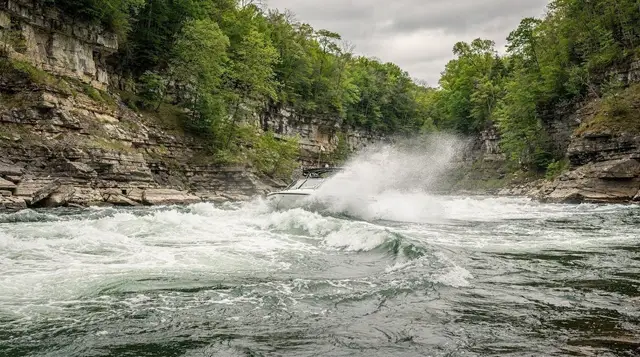
a jet boat run further up the Niagara River is a different kind of close encounter — fast water rather than falling water — and pairs well with a Cave of the Winds morning if you want two contrasting ways to get wet on the American side in one day.
Photographing Bridal Veil Falls
Because it’s narrow and tucked beside a much larger falls, Bridal Veil Falls is easy to lose in a wide shot of the American Falls. A few practical notes: shoot it from Luna Island or the Goat Island perimeter path for a straight-on angle that separates it clearly from its neighbour; expect spray on the lens if you’re anywhere near the Cave of the Winds boardwalks, so a lens cloth is not optional gear here; and morning light tends to favour the American side generally, since the sun rises behind it relative to the Horseshoe.
Our guides on the best times to photograph the falls and what the mist does to your camera go into more detail if photography is a priority for the visit.
Getting there and combining it with the rest of your day
Bridal Veil Falls sits within Niagara Falls State Park, on the American side, reachable on foot from central Niagara Falls, New York or via the Rainbow Bridge crossing from Niagara Falls, Ontario — budget 15 to 20 minutes for the walk across plus whatever the border queue adds, which can run well over an hour on a busy summer day. Parking on the American side is more straightforward and generally cheaper than the Canadian side, though it fills early in peak season.
Because it’s a short walk from the American Falls viewpoints and Goat Island’s loop path, most visitors fold Bridal Veil Falls into a broader American-side morning or afternoon rather than visiting it as a standalone stop. A natural pairing: the free Goat Island loop, a stop on Three Sisters Islands in the rapids above the falls, Cave of the Winds for the close-up, and the Niagara Falls Observation Tower at Prospect Point for a wider view before heading back.
If you’re weighing which side of the border deserves more of your time, our Canada versus USA side comparison lays out the trade-offs, and our one-day itinerary or both-sides-in-48-hours plan show where this stop fits into a longer schedule.
a guided day that covers both the American and Canadian viewpoints with a boat cruise included is worth considering if border logistics are the part of the day you’d rather not manage yourself — it removes the crossing-and-parking puzzle at the cost of a fixed schedule.
When to visit
Late spring through fall is the practical window for seeing Bridal Veil Falls at its best and getting close to it. The Cave of the Winds boardwalks typically run from spring through the end of October or so, weather dependent, with the Hurricane Deck fully open during that stretch.
Summer brings the heaviest crowds and the longest queues for the elevator down into the gorge; a September or October visit trades a little water volume — flow is administered under a 1950 treaty and tapers outside daytime tourist hours from mid-September — for noticeably shorter lines and cooler, more comfortable walking conditions on the boardwalks. Winter closes the boardwalks entirely, leaving only the upper platform (branded Ice Experience) and distant views of the falls itself, which never fully freezes but does build dramatic ice formations along its edges in cold snaps.
Bridal Veil Falls: the practical case for a short detour
If your Niagara itinerary has room for exactly one close-up encounter with moving water, it’s worth being honest about the choice in front of you. The Horseshoe Falls wins on scale and drama from a distance. Bridal Veil Falls wins on proximity — it’s the one place at Niagara where you’re not looking at a waterfall so much as standing inside its edge. It takes less than an hour, it’s inexpensive relative to the bigger-ticket boat tours, and it corrects a misconception most first-time visitors carry without realizing it: that Niagara is one falls, not three, and that the smallest one isn’t worth naming.
a fuller day that combines the boat cruise with the major viewpoints on both sides is the option to look at if you’d rather have Bridal Veil Falls folded into a single well-organized day than plan the American-side details yourself.