Ask most visitors what they paid to get into Niagara Falls State Park and you’ll get a confused look, because the honest answer is nothing. The park has been free to enter since it opened in 1885, and that hasn’t changed in almost a century and a half. What confuses people isn’t the admission — it’s that the park is stitched together from several small islands connected by bridges, and it holds three or four separately ticketed attractions inside a boundary that costs nothing to cross.
The park that isn’t the same as its attractions
This distinction matters enough to state plainly: Niagara Falls State Park is free. What you pay for are specific things inside it — a boat ride on the Maid of the Mist, a walk down to the Cave of the Winds platforms, a ticket up the Prospect Point observation tower, and parking. Cross the entrance, walk to any of the free viewpoints on Goat Island or Prospect Point, look at the American Falls or the Bridal Veil Falls, and you’ve spent nothing beyond getting there.
This is worth knowing before you arrive because plenty of visitors budget for the park itself, the way they might budget for a national park entrance fee, and then either overspend on attractions they don’t need or underspend and miss the two or three that are genuinely worth the money. See our guide to what’s open and closed by season before you commit to a specific attraction, since several close for the winter.
Frederick Law Olmsted’s park, and why it exists at all
The park’s official birth date is 1885, when New York State created the Niagara Reservation — the name it carried before it became Niagara Falls State Park. It is, by a wide margin, the oldest state park in the country, and its creation wasn’t really about conservation in the abstract. By the 1870s, the American side of the falls had been fenced, built up, and rented out piece by piece: mills, factories, and private operators charged admission to viewpoints that a generation earlier had been open to anyone. A public campaign, led by figures including the painter Frederic Edwin Church and the landscape architect Frederick Law Olmsted, pushed the state to buy back the land and guarantee free public access to the falls in perpetuity.
Olmsted is the same man who designed Central Park in New York City with Calvert Vaux, and the Niagara commission gave him a very different problem to solve: how do you lay out a park around a natural feature people are visiting specifically to look at, without the paths and buildings getting in the way of the view.
His plan tore down the mills and toll booths, replanted the riverbanks, and organized the site around a sequence of viewpoints rather than a single grand entrance. That basic structure — walk from viewpoint to viewpoint along the river, with the water always doing the work — is still how the park reads today, even though almost everything built since 1885 (the observation tower, the modern visitor centre, the paved paths) postdates Olmsted’s original design.
How the park is laid out
The park occupies the American riverbank and the islands just above and around the crest of the falls, split loosely into a handful of named pieces:
- Prospect Point — the mainland promontory closest to the American Falls, and the site of the observation tower and the boarding point for Maid of the Mist. It’s the part of the park most visitors reach first.
- Goat Island — the island separating the American Falls from the Canadian Horseshoe Falls, reached by a short bridge from the mainland. It has its own loop of paths and viewpoints, detailed in our Goat Island and the American side loop guide.
- Luna Island — a small island off Goat Island, wedged between the American Falls and the Bridal Veil Falls, connected by its own footbridge.
- Three Sisters Islands — a chain of three small islands further upstream from Goat Island, sitting out in the rapids above the crest rather than near the falls themselves.
We’re deliberately not re-describing each of these in detail here, since each one has its own page covering what you’ll actually see and do there. What matters on this page is the shape of the whole: it’s not one continuous riverside promenade, it’s a set of islands, connected by bridges, arranged around the falls from several angles. That layout is exactly what Olmsted intended — different islands give you different relationships to the water — but it’s also the thing that trips people up on timing, which is worth its own section.
Walking takes longer than the map suggests
The single most common planning mistake at Niagara Falls State Park is treating it like a compact viewing platform you can see in twenty minutes. It isn’t. Because the park is built across several islands joined by bridges, getting from Prospect Point to the far end of Goat Island, out to the Three Sisters Islands, and back involves real walking — easily 45 minutes to an hour at an unhurried pace, before you’ve stopped to look at anything or queued for an attraction.
A few things slow people down specifically:
- The bridges are narrow and can bottleneck in peak summer crowds.
- Goat Island’s loop road and paths are longer than they look on a phone map — walking the full perimeter is roughly 2.5 kilometres (1.5 miles).
- The mist off the American Falls and Bridal Veil Falls genuinely soaks the paths and railings near Luna Island; people slow down here, understandably.
- There’s very little shade, which matters more in July and August than most visitors expect.
If you’re trying to see Prospect Point, walk Goat Island, and reach the Three Sisters Islands in one visit, treat it as a half-day commitment on foot, not a stop on the way to somewhere else. Our free viewpoints on the American side guide lays out a sensible order to do this in without doubling back.
What actually costs money
Because the park entry itself is free, the paid list is short and specific. Prices below are typical ranges in US dollars — this is the American side, so USD is the currency you’ll see on signage and tickets, not Canadian dollars.
| Inside the park | Typical cost (USD) | Season |
|---|---|---|
| Maid of the Mist boat ride | ~28–32 | April–November |
| Cave of the Winds (Hurricane Deck) | ~22–26 | May–October; upper deck only (“Ice Experience”) in winter |
| Prospect Point observation tower | ~2–5 | Year-round |
| Parking (state park lots) | ~10–20 | Year-round, higher in summer |
These are approximate and change season to season, so treat them as a planning range rather than a quoted price — check current tickets before you go, and see our guide on booking ahead versus buying on site if you’re visiting in July or August, when same-day lines for Maid of the Mist can run long. For a fuller sense of what a day here actually costs once food, parking, and one or two attractions are added up, our day-trip budget guide breaks it down for two people.
a combined ticket covering both Maid of the Mist and Cave of the Winds is the most efficient way to do the two headline paid attractions without buying separately at each entrance, particularly in peak season when lines for individual tickets run longest.
An easy comparison: viewpoints versus attractions
It helps to separate what’s free from what’s paid before you arrive, rather than working it out at each ticket booth:
Free inside the park:
- Prospect Point itself and its railings looking straight at the American Falls
- The full walk around Goat Island
- Luna Island, right at the edge of the Bridal Veil Falls
- The Three Sisters Islands and the rapids above the crest
- The Niagara Gorge Trail access points along the gorge rim
Paid, inside the park boundary:
- Maid of the Mist
- Cave of the Winds
- The Prospect Point observation tower elevator
- Parking
If your budget is tight, you can have a genuinely full day here on the free half alone — plenty of visitors do, particularly on the budget itinerary side of trip planning. The paid attractions add proximity to the water rather than a fundamentally different experience: Cave of the Winds gets you soaked a few metres from Bridal Veil Falls, Maid of the Mist puts you on the water at the foot of the Horseshoe, and the tower gives you height. None of them is required to say you’ve seen the falls from the American side.
The Niagara Gorge Trail: the park’s free extension
South of the main park area, the Niagara Gorge Trail runs along the gorge cut by the river below the falls, and it’s worth flagging here even though it has its own dedicated page, because people often don’t realize it’s connected to the same park system and just as free. Where the park proper is about looking across at the falls, the gorge trail takes you down into the river’s own cut, past rapids and along a landscape shaped by 12,500 years of the falls eroding upstream.
It’s a genuinely different experience — more hiking, fewer crowds, no admission — and it pairs naturally with a state park visit if you have the legs and the time for it. Full route detail, access points, and what to expect underfoot are in our Niagara Gorge Trail guide for the American side.
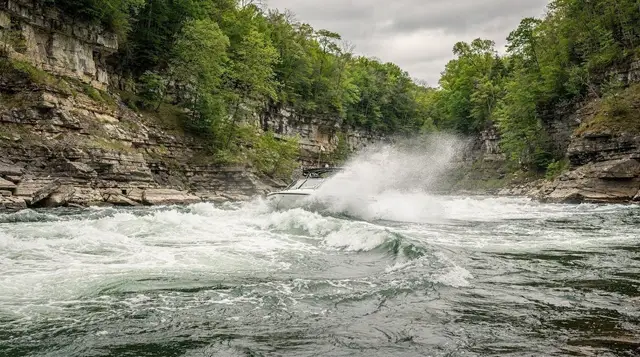
a jet-boat run through the rapids on the Niagara River is a paid option for people who want to be on the water below the gorge rather than walking above it — a different angle on the same stretch of river the gorge trail follows on foot.
Getting there and getting around
Niagara Falls State Park sits inside the city of Niagara Falls, New York, a short walk or drive from the Rainbow Bridge border crossing to the Canadian side. From central Buffalo, it’s about 34 kilometres (21 miles), roughly 30 minutes by car; from Lewiston, closer to 12 kilometres (7 miles). If you’re crossing from Canada for the day, remember a passport is required in both directions — see our border-crossing guide before you go, and expect longer waits at Rainbow Bridge on summer weekends.
Once you’re there, the Niagara Scenic Trolley loops between the main areas in season — it is a paid ride, included with the Discovery Pass — though most of the park is entirely walkable. Parking is the main friction point: state park lots near Prospect Point fill early on summer days, and prices climb accordingly. Our parking guide for the American side covers the specific lots, typical costs, and which ones tend to have space later in the day.
Comparing sides, and why the park matters to that decision
Anyone deciding between the Canadian and American sides for a first visit should know that Niagara Falls State Park is a large part of the case for the American side. The Canadian side has the more famous view — looking across at the Horseshoe Falls face-on — but it charges for nearly everything beyond the free Table Rock viewpoint. The American side’s central asset is that its entire park is free, and the paid attractions inside it get you close to the water rather than replacing a free view with a paid one.
Neither side is objectively better; they answer different questions. Our full Canada versus USA side comparison goes through this trade-off point by point, and if you have more than a single day, our one-day itinerary shows how to work both sides into a single trip without wasting hours at the border.
a guided day covering both the American and Canadian sides with a boat cruise included handles the border crossing and transport for you, which is worth considering if you don’t want to manage the Rainbow Bridge crossing yourself, or if you’re short on time and want both perspectives in one day rather than choosing.
Practical notes before you go
A short list of things that catch first-time visitors off guard:
- The park never closes for the season, even though individual attractions do. Prospect Point and Goat Island are open and free year-round, including winter, when the paid boat and cave attractions are shut.
- Bring layers regardless of season. The mist off Bridal Veil Falls and the American Falls reaches Luna Island and parts of Goat Island even on a dry day.
- Wheelchair and stroller access is reasonable at Prospect Point and on the main Goat Island loop, less so on Luna Island’s footbridge in wet or icy conditions.
- Photography works best early or late, before the crowds build at Prospect Point and while the light is lower and more even across the water.
- The falls never freeze over. In winter you’ll see spectacular ice formations along the banks and mist-frozen trees, but the water itself keeps moving; only once, in March 1848, did an ice jam upstream briefly stop the flow.
None of this requires an admission fee to experience. That’s the point of the park Olmsted designed, and it’s still the one thing about Niagara Falls State Park that’s worth repeating to anyone planning a visit: walk in, look at the falls, and pay only for what you specifically choose to add.