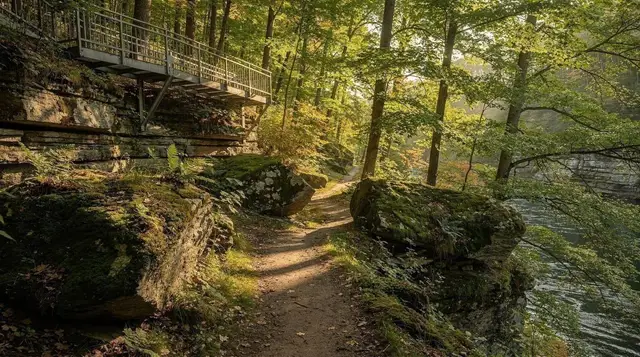
Niagara Gorge trails: hiking the American side for free
Where do you hike the Niagara Gorge on the American side?
Whirlpool State Park and Devil's Hole State Park, two separate New York State parks north of Niagara Falls State Park, both free to enter. Trails drop steeply into the gorge to river level, with no lifeguards or rescue staff posted, unlike the ticketed attractions closer to the falls.
Most visitors to the American side see the Niagara Gorge from a paved path at the top, poncho still damp from Cave of the Winds. A smaller number keep walking north, past the crowds, and drop into the gorge itself on trails that cost nothing and answer to nobody’s ticket booth. This page covers those trails: the free hiking network reached from Whirlpool State Park and Devil’s Hole State Park, two distinct New York State parks just north of the main falls complex.
It is not the same thing as Niagara Falls State Park itself — that park, its overlooks, and its ticketed attractions are covered on a different page of this site. This one is about what happens once you leave the manicured part of the park behind and go down into the gorge on your own feet.
Two state parks, two trailheads, one river below
Whirlpool State Park and Devil’s Hole State Park sit a few kilometres apart along the Niagara Parkway’s American counterpart, the Robert Moses State Parkway corridor north of downtown Niagara Falls, New York. Both are administered by New York State Parks, both are free to enter, and both exist mainly because of what happens in the gorge beneath them: the Niagara River narrows and turns sharply, throwing itself through the Whirlpool Rapids before slowing into the whirlpool basin.
Whirlpool State Park has the more direct relationship with that feature — its main trail descends close to the rapids and the northern edge of the whirlpool itself. Devil’s Hole State Park, a short drive further north, follows an older gorge route along a tributary ravine and opens onto views across the river toward the Canadian bank, roughly opposite where the Whirlpool Aero Car crosses on the other side.
Neither park has the infrastructure of the attractions closer to the falls. There’s no elevator, no boardwalk, no staff stationed along the trail. What you get instead is a real gorge hike: a rim trail along the top, connector trails that switchback down through exposed rock and mixed forest, and a lower trail that runs along or near the river itself.
Devil’s Hole State Park
Devil’s Hole’s main descent follows a series of stairs and a rock stairway cut into the gorge wall, dropping through a side ravine before meeting the river-level trail. The upper rim trail is flat and easy, suitable for a short walk with a view; the descent itself is the harder part, on uneven stone steps that get slippery when wet or icy. Once at the bottom, the trail runs south along the water toward Whirlpool State Park, connecting the two parks for hikers willing to do the out-and-back or arrange a car shuttle between the two lots.
The payoff at Devil’s Hole is a gorge view without the crowds of Goat Island or the falls overlooks — just moving water, exposed shale and limestone layers in the gorge wall, and, on a clear day, a look across to the Canadian side.
Whirlpool State Park and the rapids
The Whirlpool State Park trailhead sits closer to town and gets more foot traffic, though “more” is relative — it’s still a fraction of what the falls themselves see. From the parking area, a rim trail leads to a series of overlooks above the Whirlpool Rapids, where the river runs green-white through a narrow channel before opening into the whirlpool basin.
A steep descent trail — stairs and switchbacks losing roughly 60 to 90 metres (200 to 300 feet) of elevation — drops to river level near the rapids. From there, trails run both north toward Devil’s Hole and south along the gorge, eventually connecting toward the Niagara Gorge Trail system that continues down to the base of Niagara Falls State Park itself, though that lower connection is a serious undertaking and not a casual add-on to an afternoon walk.
This is also the best free vantage on the American side for watching the rapids that feed the whirlpool — the same stretch of white water that whirlpool jet boats run through further downstream, and the same current that makes the whirlpool itself unsafe for anything but viewing.
One whirlpool, two shores
It’s worth saying plainly, because the geography invites confusion: there is one whirlpool, not two. The basin — roughly 500 metres across — sits where the Niagara River makes its sharp turn, and it straddles the line between Ontario and New York. What differs is only the vantage point.
From the Canadian side, the whirlpool is viewed from the Whirlpool Aero Car, a cable car strung across the gorge since 1916, and from trails in the Niagara Glen that descend to river level with a metal staircase and marked route. From the American side, covered here, there’s no cable car and no staircase system — just the rim trails and steep descents of Whirlpool State Park and Devil’s Hole, looking at the same water from the opposite bank. Neither side is hiking to “the American whirlpool” or “the Canadian whirlpool.” It’s the same whirlpool, seen from wherever you happen to be standing.
Elevation, footing, and why there’s no lifeguard here
The single most important thing to understand about these trails is what they aren’t: they aren’t a managed attraction. Cave of the Winds and the Maid of the Mist operate with staff, schedules, and safety systems built around moving large numbers of people through a controlled environment. The gorge trails at Whirlpool and Devil’s Hole are ordinary state park hiking trails, maintained but not staffed, and nobody is posted along them to help if something goes wrong.
The descents lose 60 to 90 metres (200 to 300 feet) in a short horizontal distance, on stairs and switchbacks over exposed shale, sandstone, and loose talus. Wet weather, morning dew, and winter ice all make the footing worse, and the climb back out is where most people find the hike harder than expected — it’s a sustained uphill after already having worked to get down. Cell coverage is inconsistent in the lower gorge. There’s no shuttle to the trailheads from the main tourist area, so most people arrive by car, bike, or rideshare and need to allow real time, not a quick stop between attractions.
None of this makes the trails dangerous for a reasonably fit, prepared hiker. It does mean treating them as a hike, not a photo op: proper shoes, water, a charged phone, and a plan for turning back if the weather or your energy turns.
| Trail access | Elevation change | Surface | Staffed? | Fee |
|---|---|---|---|---|
| Whirlpool State Park descent | ~60–90 m (200–300 ft) | stairs, switchbacks, exposed rock | No | Free |
| Devil’s Hole State Park descent | ~60–90 m (200–300 ft) | stone stairway, uneven rock | No | Free |
| Niagara Glen, Canadian side (for comparison) | ~60 m (200 ft) | metal staircase, marked trail | No | Free |
| Cave of the Winds, American side (for comparison) | ~53 m (175 ft) by elevator | boardwalk platforms | Yes | Ticketed |
What to bring, and when to go
Fall is the best season for this hike: cooler temperatures, drier footing, and the gorge walls turning colour along the escarpment vegetation. Summer works too, but midday heat in an exposed rock gorge is harder than the shaded trails on the Niagara Glen side. Spring brings the highest water and the most dramatic rapids, along with the least predictable footing. Winter access is possible but the stairs ice over, and without staff on site, that’s a real hazard rather than a scenic bonus — check conditions before committing.
Bring proper footwear with grip, not sandals or smooth-soled sneakers. Bring water; there are no concessions at either trailhead. A phone with an offline map is worth having given the patchy coverage. And build in more time than the trail distance suggests — the climb out of the gorge is the part that takes longer than people plan for.
Getting there
Both trailheads sit along the Niagara Scenic Parkway north of downtown Niagara Falls, New York, a roughly 10 to 15 minute drive from the Niagara Falls State Park area, and about the same distance south of Lewiston. There’s no shuttle connection from the American side’s park shuttle system, and the trailheads aren’t served by the Canadian WEGO network either, since they’re across the border. Driving, cycling, or a short rideshare from downtown are the practical options.
Visitors coming from Buffalo can reach either park directly without going through the busier falls-area traffic first, which is worth knowing if the gorge trails are the main destination for the day rather than an add-on. Those without a car and staying close to the falls should weigh the cost of a taxi or rideshare against simply spending that time on the free viewpoints closer to town — the gorge trails reward a dedicated visit, not a rushed one squeezed between other stops.
If a more guided, lower-effort way to see the gorge and river islands appeals more than a self-directed hike, an e-bike tour that covers the islands and gorge trails on the American side takes in similar terrain without the same climb.
There’s also an e-bike tour through the Niagara Falls area for a broader loop that includes gorge viewpoints along with the main falls sights, and for visitors who’d rather sit than pedal or hike, a half-day tour covering the American side’s main sights typically includes a stop near the gorge overlooks as part of a wider itinerary.
How this fits into a longer visit
For anyone comparing the American and Canadian approaches to the gorge and the whirlpool, it’s worth reading how the two sides differ overall before choosing where to spend limited time — see Canada vs. USA side of Niagara Falls and, for the free options specifically, free viewpoints on the American side. Travellers wanting the Canadian equivalent of this hike, with its staircase and marked loop, should read Niagara Glen gorge trails on the Canadian side rather than expecting the same infrastructure here.
Because both state parks are seasonal in how comfortable they are to hike, checking what’s open and closed by season before planning a trip built around the gorge trails saves a wasted drive. And for visitors splitting time between both sides of the border, a 48 hours covering both sides itinerary gives a sense of how a gorge hike like this one slots in alongside the ticketed attractions and a stop in Niagara-on-the-Lake or Buffalo.
Niagara Gorge trails on the American side: your questions
Is the Niagara Gorge Trail the same as the Niagara Glen on the Canadian side?
No. The Niagara Glen is a Niagara Parks property on the Canadian bank with its own metal staircase and marked loop. The American gorge trails covered here are a separate New York State Parks system, reached from Whirlpool State Park and Devil’s Hole State Park, and they are rougher and less signed.
Are there two whirlpools, one on each side of the border?
No, there is one whirlpool. It’s a single basin in the river where the current makes a sharp bend, and it sits on the international boundary. You can watch the same water from the American gorge rim or, on the Canadian side, from the Whirlpool Aero Car and the Niagara Glen — two viewpoints on one feature, not two whirlpools.
How hard is the hike down to the river?
Harder than it looks on a map. The main descents drop roughly 60 to 90 metres (200 to 300 feet) over loose rock and wooden or metal stairs that can be slick after rain. Figure on the climb back up taking longer than the way down, especially for anyone unused to scrambling.
Is there a fee to hike Whirlpool State Park or Devil’s Hole State Park?
No. Both are free New York State parks with no admission gate, unlike the ticketed Niagara Falls State Park attractions such as Cave of the Winds or the Maid of the Mist. Parking areas are small and can fill on summer weekends.
Is it safe to hike alone in the gorge?
It’s legal and common, but there’s no lifeguard, no cell coverage in the lower gorge in places, and rescues from the river-level trail take time. Tell someone your plan, carry water, and turn back before dusk — this isn’t a supervised attraction.
Can you swim in the whirlpool or the rapids below it?
No. The current through the Whirlpool Rapids and around the whirlpool basin is extremely fast and cold year-round, and people have drowned attempting to swim or wade there. Viewing only.
What’s the difference between Whirlpool State Park and Devil’s Hole State Park?
They’re adjacent but separate parks with their own trailheads. Whirlpool State Park sits closer to the rapids and the whirlpool itself; Devil’s Hole State Park is a short drive north and its trail follows an old gorge route with views toward the Canadian Whirlpool Aero Car.
Do I need a car to reach these trailheads?
Practically, yes. Neither park sits on the American shuttle route that serves Niagara Falls State Park, so most visitors drive, cycle, or arrange a taxi or rideshare from the falls.
Gorge trails and guided walks on GetYourGuide
Verified deep-linked GetYourGuide tours. Book through these links and we earn a small commission at no cost to you.
GetYourGuide does not provide a product photo for this activity — the image shows the meeting point, photographed by us.