The one hike on the Canadian side that isn’t a boardwalk
Every other Canadian-side attraction near the falls does the walking for you: an elevator at Journey Behind the Falls, a paved boardwalk at the White Water Walk, a cable car over the Whirlpool. Niagara Glen Nature Reserve is the exception. It is a genuine, unreserved forest hike — free to enter, about 4 km of connected trails, and a 60-metre metal staircase that drops you into the Niagara Gorge instead of lowering you there in a box. If your idea of a good travel day includes actual exertion and no ticket queue, this is the stop the glossier attractions don’t advertise.
It sits on the Niagara Parkway, about 7 km (4.3 mi) north of the falls themselves — roughly a 10 to 15 minute drive, longer if you’re relying on WEGO, which doesn’t serve this stretch as directly as it serves Fallsview and Clifton Hill. That distance from the crowds is part of the appeal: most visitors never make it here, because it takes a car or a bike and a willingness to sweat.
Getting there and what it actually costs
There’s no admission booth, no online reservation, and no seasonal closure of the site itself — Niagara Glen is open every day of the year, dawn to dusk. The only line item is parking: a modest lot right on the Parkway, priced somewhere in the CAD 10 to 20 range for the day depending on the season and how Niagara Parks is running rates that year. There’s no USD figure to quote here, because this is a Canadian-side-only reserve with no equivalent crossing point from New York.
Pack for a hike, not a photo stop. Sturdy closed shoes with real tread, a bottle of water, and a phone with some charge — cell service is patchy once you’re down in the gorge. There are no washrooms, vending machines, or staff stationed along the trails; the amenities are back at the parking lot, and that’s it.
The descent: 60 metres, straight down a metal staircase
The defining feature of Niagara Glen is the staircase. It’s a switchbacked metal structure bolted into the gorge wall that takes you down about 60 metres from the clifftop parking area to the boulder field and trail network below. It’s sturdy and well maintained, but it is stairs the whole way — no ramp, no elevator, no shortcut. Going down is the easy half.
Coming back up is the part nobody mentions in the brochure copy. Climbing 60 metres of stairs after already having walked several kilometres of uneven forest trail is a real physical task, and Niagara Glen doesn’t soften it the way Journey Behind the Falls or the Niagara Parks Power Station do with their elevators. Expect to stop partway up. Older visitors, anyone with knee, hip, or breathing limitations, and families with small children in tow should think hard before starting down — there’s no way to call for a lift back up if the stairs turn out to be too much.
What’s down there: carolinian forest and glacial boulders
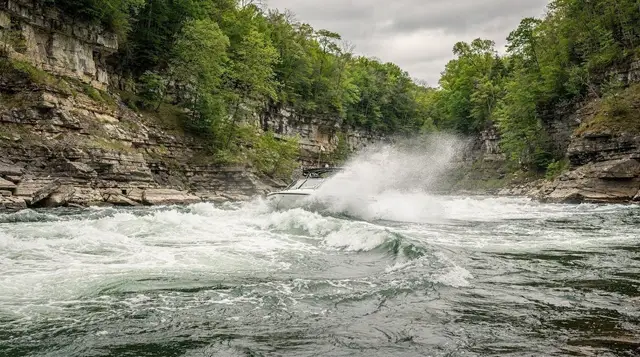
The reward for the climb is a landscape that looks nothing like the manicured lawns of Queen Victoria Park or the observation decks up top. The gorge floor at Niagara Glen is a carolinian forest — the northernmost pocket of a forest type more typical of areas well south of the border, with tree species that don’t grow in most of the rest of Ontario. Scattered through it are glacial erratics: house-sized boulders dropped here by retreating ice sheets, left behind long after the glaciers that carried them were gone.
This stretch of gorge is also part of the same geological story that produced the Whirlpool and Whirlpool State Park a little further downstream — the river cut this entire channel as the falls themselves retreated roughly 11 km over roughly 12,500 years. Walking the boulder field at Niagara Glen puts you inside that older, abandoned riverbed rather than looking at the current one from above. It’s the closest most visitors get to standing on the historical floor the falls have been carving through for millennia.
The trail network: about 4 km, several loops
Once you’re down the staircase, the reserve’s trails braid through the forest and along the base of the gorge wall, adding up to roughly 4 km if you cover the network. You don’t have to do it all. Shorter loops close to the bottom of the stairs let you sample the boulder field and forest without committing to the full distance, which matters given that every metre you walk down here is a metre you’ll walk — and then climb — on the way back.
The paths are natural surface: dirt, root, and rock, not pavement. Expect some scrambling over boulders in places. This is a genuine nature trail, not an accessible path, and it should be treated with the same respect as any moderate forest hike — appropriate footwear, some fitness, and an honest sense of how far you’re willing to go before turning around.
Niagara Glen vs. the White Water Walk vs. the Niagara Gorge Trail
These three get confused constantly, partly because they all involve the word “gorge” and partly because two of them are on different sides of the river. They are not the same experience, and mixing them up is the single most common planning mistake for this part of the trip.
| Feature | Niagara Glen (Canada) | White Water Walk (Canada) | Niagara Gorge Trail (USA) |
|---|---|---|---|
| Cost | Free | Paid attraction | Free (state park) |
| How you get down | 60 m metal staircase | Elevator | Trail descent, varies by access point |
| Surface | Natural forest trail, boulders | Paved boardwalk | Natural trail, some paved sections |
| Location | Upstream of the falls | Downstream of the falls | American side of the river |
| Reservation | None | Ticket required | None |
| Physical demand | High (stairs both ways) | Low | Moderate to high |
The White Water Walk is the polished version of “walk near the rapids” — an elevator down, a boardwalk at river level, a ticket to buy, and none of the climbing. The Niagara Gorge Trail network is its own separate system entirely, on American soil across the border, run by New York State Parks rather than Niagara Parks — a genuinely different reserve that happens to share the word “gorge” and the general geography. Niagara Glen is the one that’s free, unpaved, and makes you work for it in both directions.
When to go: season by season
Niagara Glen stays open every day of the year — there’s no gate that closes for winter the way Journey Behind the Falls partly does, and no ticket booth with seasonal hours to check ahead of time. But “open” and “sensible to visit” aren’t always the same thing here.
From roughly May through October, the trails and staircase are typically dry and manageable, and this is by far the best window for the hike. Fall adds the bonus of colour through the carolinian canopy, with the crowds well down from summer peaks. Summer works too, though the forest holds humidity and the climb back up the stairs feels harder in the heat.
Winter is the season to think twice about. Roughly December through March, the metal staircase and the rock-and-root trail surfaces can ice over, and there’s no maintenance crew clearing them the way there might be on a paved city sidewalk. If you do go in winter, proper winter boots with real grip are not optional, and it’s worth checking conditions or asking locally before committing to the descent. For a lot of visitors, a winter trip is better spent on an indoor or assisted attraction — see what’s actually running in the cold months before you plan around this one.
What to bring and how to do it safely
Treat this like a moderate hike, because it is one. Closed shoes with grip, not sandals or fashion sneakers. A bottle of water, since there’s nowhere to refill once you’re past the parking lot. A charged phone, understanding that reception thins out in the gorge. And a realistic sense of your own fitness — the climb back up is 60 metres of stairs on top of however far you’ve already walked, and there’s no bailout partway other than continuing to climb.
This is not the outing for very young children who tire quickly, for anyone using a cane or walker, or for anyone managing a heart or breathing condition that stairs would aggravate. None of that makes Niagara Glen a bad attraction — it makes it the wrong attraction for some visitors, and the honest answer is to send those visitors to the White Water Walk instead, where the same general idea comes with an elevator.
Pairing it with the rest of your day
Because Niagara Glen takes only two to three hours and costs nothing beyond parking, it slots naturally into a day that also includes a paid attraction closer to the falls themselves. A boat tour is the classic pairing — after a morning working up an appetite on the stairs, something like the Niagara City Cruises boat ride behind the falls gets you back to water level without any climbing at all.
If you’d rather see the falls from above after the forest below, the Skylon Tower observation deck paired with a boat cruise covers both height and water in one booking. And if the boulder scrambling at Niagara Glen leaves you wanting more adrenaline rather than less, the jet boat run on the Niagara River takes the whitewater theme and adds a motor.
None of that is required — Niagara Glen stands on its own as a free half-day out. But it pairs cleanly with a single paid activity if you want to round out the day, and doing the hike first, before you’re carrying tickets and timed entries to worry about, is usually the more relaxed order.
Getting oriented on the rest of the trip
For a broader sense of how this fits into a day near the falls, see how to order your day at the falls or a ready-made one-day Niagara Falls itinerary. If you’re cycling the Parkway rather than driving, cycling the wine route and the Parkway covers the same stretch of road Niagara Glen sits on. And for the free-viewpoint-minded traveller, free viewpoints on the Canadian side rounds out Niagara Glen with the other no-cost stops nearby.
If you’re weighing whether to add the American-side gorge trails to the same trip, the guide to Niagara Gorge Trail on the USA side explains how that separate network compares — useful reading before you find yourself expecting one and arriving at the other. And before locking in a date, check what’s open and closed by season, since the staircase conditions here shift with the calendar even though the reserve technically never closes.
More broadly on hiking options around the falls, the hiking trails category and the general things to do in Niagara Falls, Ontario page both list Niagara Glen alongside its nearest alternatives, including Niagara Falls, New York across the river for comparison.
Questions about hiking Niagara Glen
Is Niagara Glen free?
Yes. There is no admission fee and no ticket to book. The only cost is parking at the small lot on the Niagara Parkway, which runs roughly CAD 10 to 20 for the day depending on the season.
How hard is the Niagara Glen hike?
The trails themselves are short, but the descent is 60 metres down a steep metal staircase, and the return climb is the same 60 metres straight back up with no elevator. Expect to stop and catch your breath; it is a real hike, not a stroll.
Is Niagara Glen the same as the White Water Walk?
No, and they get mixed up constantly. Niagara Glen is a free, unpaved forest reserve you descend on foot. The White Water Walk is a separate, paid Niagara Parks attraction downstream, reached by elevator, with a boardwalk right at river level.
Is Niagara Glen the same as the Niagara Gorge Trail?
No. The Niagara Gorge Trail is a different trail system on the American side of the river, run by New York State Parks. Niagara Glen is entirely on the Canadian side and has its own separate stairs, trails, and parking.
Can you do Niagara Glen in winter?
The reserve stays open year-round and there is no gate, but the metal staircase and trail surfaces can ice over between roughly December and March. Winter visits need proper winter boots and caution, or are best skipped in favour of a paid, maintained attraction.
How long is the Niagara Glen trail?
The full network adds up to about 4 km, but you are not obliged to walk all of it. Shorter loops closer to the base of the staircase let you turn back sooner if the climb is proving tougher than expected.
Are there washrooms or food at Niagara Glen?
No. There are no facilities down in the gorge and only basic ones at the parking area. Bring water and use a washroom before you start down the stairs.
Do I need to book anything for Niagara Glen?
No booking exists for Niagara Glen itself. If you want to pair the visit with a boat tour or another paid attraction the same day, those need their own separate tickets.