Inside the gorge, downstream from the falls
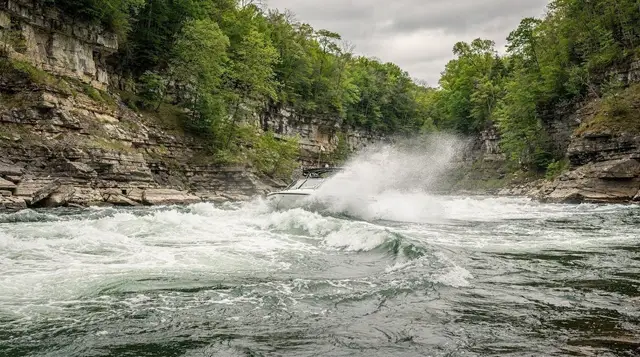
Most people photograph Niagara Falls from above: the crest, the mist, the drop. The White Water Walk shows you the same river a few minutes later, after it has fallen and turned into something else entirely. This is a Niagara Parks attraction on the Canadian side, about 4 km north of the falls along the Niagara Parkway, where an elevator takes you 70 m down into the Niagara gorge and a boardwalk runs roughly 300 m along the edge of the river at the point where it is running fastest and angriest.
This stretch of the Niagara River is rated Class VI whitewater, the top of the international scale, and it’s not runnable by kayak or raft. The White Water Walk is the only place ordinary visitors get to stand at its edge.
It’s easy to confuse this attraction with two others nearby, and the confusion causes real disappointment if you don’t sort it out before you go. It is not Journey Behind the Falls, which tunnels into the rock behind the Horseshoe Falls itself and stays open all year.
And it is not the Niagara Glen Nature Reserve, a free site a little further along the parkway with actual forest trails and a steep metal staircase rather than a boardwalk. All three sit in the same general stretch of gorge, all three involve going down toward the river, and all three get lumped together in trip-planning conversations. They are different tickets, different infrastructure, and in the White Water Walk’s case, a different calendar.
What the rapids actually look like
The river through this section of the gorge is doing something specific: it’s being squeezed through a narrower channel than the wide crest of the falls, dropping in a series of standing waves rather than a single sheet, and moving at a pace that’s hard to convey in a photo until you’re standing next to it. The water is a churned white-green rather than the blue-grey of the calmer stretches near Whirlpool State Park further downstream. On a breezy day you’ll feel spray reach the boardwalk, though nowhere near what you get from the boat tours or from Cave of the Winds on the American side — this is closer to a windy riverside walk than a soaking.
The boardwalk itself is built along the shoreline rather than out over the water, with railings and interpretive panels explaining the geology of the gorge and the hydraulics of the rapids. It’s flat and accessible once you’re down, which makes the elevator the only real physical barrier to entry. The descent is about 70 m, roughly the height of the Horseshoe Falls themselves, which is a detail worth mentioning to anyone who wants a sense of scale before committing to the ticket.
Seasonal, and that matters more than it sounds
This is the detail that trips up the most visitors: the White Water Walk is a seasonal attraction, typically running from mid-April to late October, and it is closed through the winter. That’s a real contrast with Journey Behind the Falls two paragraphs above should read as a link but isn’t repeated here — the point stands regardless of season, since the tunnels and the upper platform at Journey Behind the Falls stay open all year, with only the lower platform closing in winter. If your Niagara trip falls in December, January, February, or early March, don’t build the White Water Walk into your plan; it simply won’t be open, and there’s no indoor alternative on this particular stretch of parkway.
The reason is straightforward: the boardwalk sits close to river level, and ice buildup, spray freeze, and general winter maintenance on a structure that close to Class VI rapids isn’t something Niagara Parks keeps running through the cold months. Compare that with attractions further up the escarpment, away from the water, which have less exposure to the same conditions.
| Attraction | Where | Season | What you actually see |
|---|---|---|---|
| White Water Walk | Gorge, downstream of the falls | Mid-April to late October | Class VI rapids at river level, via boardwalk |
| Journey Behind the Falls | Behind the Horseshoe Falls | Year-round (lower platform closed in winter) | Tunnels and a platform at the base of the falls |
| Niagara Glen Nature Reserve | Gorge, further downstream | Year-round, weather permitting | Forest trails, real hiking, free entry |
| Niagara Gorge Trail (USA side) | Gorge, American side | Year-round, weather permitting | Free hiking trail network along the gorge |
Cost and how to fit it into a ticket plan
Expect an adult ticket to run roughly 20 to 25 CAD on its own, though Niagara Parks periodically adjusts pricing, so treat that as a working range rather than a fixed number. The more useful thing to know is that the White Water Walk is one of the attractions bundled into the Adventure Pass Classic, alongside Journey Behind the Falls, the Butterfly Conservatory, and a couple of days of WEGO transportation.
If you’re already planning to buy that pass, the White Water Walk effectively becomes a free add-on rather than a separate line item, which changes the “is it worth it” calculation considerably. Read which Niagara Parks pass you should buy before purchasing anything individually — bundled pricing at Niagara Falls almost always beats paying attraction by attraction if you’re doing three or more stops.
None of the bookable tours on this site sell tickets specifically to the White Water Walk itself; it’s a walk-up Niagara Parks attraction rather than a guided excursion. What is worth booking ahead, especially in July and August, are the boat and combination tours that cover the falls from the water and behind them. A combined walking and cruise tour that pairs a boat trip with a look behind the Horseshoe Falls is a reasonable way to bracket a gorge-level visit like the White Water Walk with a falls-level one on the same day.
Travellers based in Toronto who want the whole circuit handled for them often book a day tour from Toronto that bundles the boat cruise with a falls-tower stop, which removes the driving and parking questions entirely, though it does mean less time at any single stop, including this one.
Getting there and getting down
The White Water Walk sits on the Niagara Parkway, north of the main Table Rock and Clifton Hill cluster, close to the Whirlpool Rapids Bridge crossing. If you’re staying in the Fallsview or Clifton Hill area, it’s a short WEGO ride or about a 10-minute drive; there’s parking on site, though it fills up on busy summer weekends before some of the closer-in lots do, simply because fewer people think to look for it. Walking from Table Rock is possible along the riverside path but takes closer to 45 minutes each way, which for most visitors turns it into a driving or WEGO stop rather than a walking one.
Once you’re at the entrance, the visit itself is short and simple: buy tickets, take the elevator down, walk the boardwalk at your own pace, and take the elevator back up. There’s no timed-entry pressure the way there sometimes is at the boat tours, and the boardwalk is wide enough that even when a tour bus group arrives, it clears reasonably quickly.
What to wear and what to skip
Closed shoes are the practical call — the boardwalk can be damp from spray, and there’s nothing about this attraction that rewards sandals. A light layer is enough; this isn’t the poncho territory of the Hornblower cruise or Cave of the Winds, but a stiff wind funnelling through the gorge can make even a warm day feel cooler at river level. Cameras do well here: the light is often better in the gorge than up at the falls themselves in mid-afternoon, since the walls provide some shade, and the contrast between white water and dark rock photographs cleanly.
Leave the extra time cushion for the elevator queue rather than the walk itself. On a quiet weekday morning you might wait no time at all; on a July Saturday afternoon, after a tour bus or two has arrived, the elevator line can run 15 to 20 minutes each direction. That’s the main variable in how long the whole stop actually takes.
Pairing it with the rest of the gorge
Because the White Water Walk, the Whirlpool Aero Car, and the Niagara Glen all sit along the same short stretch of parkway, it’s genuinely efficient to do two or even three of them in a single half-day, especially if you’re not trying to also fit in the boat tours or Journey Behind the Falls on the same visit. A rough order that works for most people: Table Rock and the crest views first thing, then the White Water Walk mid-morning, then either the Aero Car for the tourist-attraction version of the Whirlpool or the Niagara Glen if you’d rather have a real hike and don’t mind the free option taking longer.
Evening visitors sometimes swap the daytime boat tour for something after dark instead — a night tour that combines the illuminated falls with a look behind the Horseshoe Falls covers ground the White Water Walk doesn’t touch at all, since the gorge attraction itself closes with regular Niagara Parks hours and isn’t part of any evening program.
If you’re building a longer itinerary rather than a single day, the one-day Niagara Falls plan is a reasonable starting template, with the White Water Walk slotted in as one of two or three gorge-adjacent stops rather than the centrepiece of the day. For travellers who want to understand how the falls, the gorge, and the whirlpool all connect geologically — useful context before any of these stops, including this one — see Niagara Falls explained.
The honest verdict
The White Water Walk is not the must-do stop of a Niagara trip, and nobody should feel they’ve missed the point of the falls by skipping it. What it does well is show a genuinely different kind of water than anything visible from Table Rock or the boats: fast, channelled, and loud in a way the wide crest of the Horseshoe Falls isn’t. If the season is right, if you’re not pressed for time, and especially if you’re already holding a pass that includes it, it’s worth the 45 minutes.
If you’re visiting between November and March, skip the planning entirely — it won’t be open, and your gorge-level options narrow to the Niagara Gorge Trail on the American side or a colder walk through the Niagara Glen, both of which run largely regardless of weather.
Check current hours and admission before you go, since Niagara Parks adjusts both by season; see what’s open and closed by season for the broader picture across every attraction on both sides of the falls, and how to order your day at the falls for where a stop like this fits against Journey Behind the Falls, the boat tours, and everything else competing for the same afternoon.
Frequently asked questions about the White Water Walk
Is the White Water Walk open in winter?
No. It’s a seasonal attraction, generally open from mid-April to late October. The boardwalk sits close to the river and isn’t maintained through the winter months, so plan on visiting between spring and fall.
How is this different from Journey Behind the Falls?
Journey Behind the Falls puts you in tunnels and on a platform right at the base of the Horseshoe Falls, and it’s open all year. The White Water Walk is about 4 km downstream, at river level rather than at the falls, and it closes for winter. They’re separate tickets and separate experiences.
Is the White Water Walk the same as the Niagara Glen?
No, and mixing them up is a common planning mistake. The White Water Walk is a paid Niagara Parks attraction with an elevator and a built boardwalk. The Niagara Glen Nature Reserve is a few kilometres further along the Niagara Parkway, is free, and involves real forest trails and a metal staircase rather than a boardwalk.
Does the White Water Walk get you wet?
You’ll feel spray from the rapids on a windy day, but nowhere near the soaking you get on the Hornblower boat tours or Cave of the Winds. Dress for a breezy walk, not for a poncho.
How long do you need at the White Water Walk?
Budget 45 minutes to an hour: a few minutes for the elevator down, 15 to 20 minutes to walk the roughly 300 m boardwalk and read the panels, and time to wait if a tour bus has just unloaded.
Is there an American-side equivalent?
Not quite the same thing. The Niagara Gorge Trail system on the New York side, including Whirlpool State Park and Devil’s Hole State Park, gets you into the same gorge on foot and it’s free, but it’s a hiking trail network rather than a single elevator-and-boardwalk attraction.
Can I combine the White Water Walk with other attractions in one day?
Yes. It sits on the Niagara Parkway between the falls and the Whirlpool Aero Car, so many visitors do Table Rock in the morning, the White Water Walk mid-morning, and the Aero Car or Niagara Glen after lunch, all connected by WEGO or a short drive.
Is the White Water Walk worth it if I’ve already done Journey Behind the Falls?
It depends on what you want. Journey Behind the Falls is about the falls themselves; the White Water Walk is about the river below them, and the rapids there are genuinely different water to look at. If you have the extra 45 minutes and the season is right, most visitors find it worth adding rather than skipping.