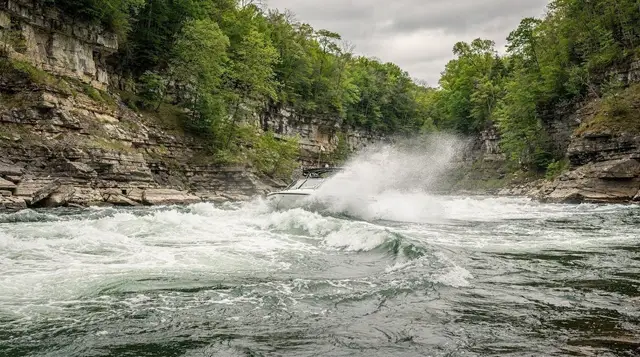
Every visitor to Niagara sees the falls. Very few see the reason the river behaves the way it does two kilometres downstream, where it slams into an ancient buried valley and is forced into a hairpin turn so violent it carved out a basin 518 m by 365 m wide and up to 38 m deep. That basin is the Whirlpool, and Whirlpool State Park, on the American side, is where you go to look down into it — for free, from solid ground, without a boat ticket or a cable car ride.
This is not a polished attraction. There’s no gift shop at the rim, no illuminated sign, no ticket booth. It’s a state park in the plainest sense: a parking lot, a few marked overlooks, and a trail system that drops into the gorge for people willing to earn the view. That’s exactly what makes it worth the ten-minute drive from the falls — and exactly why it’s easy to get wrong. The overlooks are safe and easy. The gorge below them is not a place to wander toward the water expecting a shoreline.
Where the whirlpool actually comes from
The Niagara River doesn’t slow down after the falls — it accelerates. Below the plunge pool, it runs through an 11 km gorge, and about 2 km downstream of the falls it meets a buried, ice-age river channel that forces it into a near-right-angle bend. The water piles up against the far wall, spins, and has carved out the basin now known as the Whirlpool.
The numbers explain what you’re looking at from the rim. The basin itself measures roughly 518 m by 365 m and reaches 38 m deep in places. Feeding it are the rapids just upstream — about 1.6 km of whitewater that drop 15 m in elevation and hit speeds around 9 m/s, among the fastest moving water on the Niagara River. None of that water is calm. What looks, from a distance, like a lazy circular current is actually a high-volume collision of river against rock, still carrying a share of the more than 168,000 cubic metres a minute that pass over the falls upstream.
This is also part of why the Niagara Gorge is worth treating as its own destination rather than scenery you glimpse from a bridge. The gorge has been retreating for 12,500 years, and the Whirlpool is one of the clearest places to see that geology is still doing something, not just sitting there looking dramatic.
What you actually see from the New York side
Whirlpool State Park sits on the clifftop, on the American side of the river, roughly across from where the Canadian side runs its cable car. The main overlooks are a short, mostly level walk from the parking area — nothing technical, no descent required to get the headline view. From up there, you’re looking down onto the full sweep of the basin: the incoming rapids on one side, the slow spin of the pool itself, and the gorge walls rising on both banks.
It’s a different kind of view from anything else in Niagara Falls, New York. Most of the American-side attractions put you close to moving water — Cave of the Winds gets you soaked at the base of the Bridal Veil Falls, Goat Island puts you at the edge of the rapids above the drop. Whirlpool State Park does the opposite: it puts distance and height between you and the river, which is exactly what lets you see the whirlpool as a whole shape rather than a rush of water past your feet.
There’s no boat here, no elevator, no tunnel. If your idea of Niagara is Maid of the Mist and Cave of the Winds, this will feel quiet by comparison — and it is. That’s the trade.
| What you get | What you don’t get |
|---|---|
| Free, unhurried clifftop views of the full whirlpool basin | Proximity to the water’s surface |
| A real hiking trail into the gorge | A boat ride or cable car crossing |
| Quiet, low-crowd overlooks even in summer | Restrooms, food, or a visitor centre at the rim |
| A close-up look at the rapids feeding the whirlpool | Safe, casual access down to the shoreline |
The trail down — and why most people should stay on top
A staircase cuts down through the gorge wall from the overlooks to the river’s edge. It exists mainly for a specific audience: expert whitewater kayakers, who use it to reach the class VI rapids and eddy lines around the whirlpool that have made this stretch of the Niagara internationally known in that sport. For everyone else, it’s a legitimate but demanding hike — steep, uneven, with no shade and no services, and a climb back up that’s noticeably harder than the walk down.
This is the point worth being blunt about. Going down the stairs does not put you at the edge of the whirlpool in any meaningful sense — the river at the bottom is fast, cold, and dangerous to approach closely, and the stairs meet the gorge well away from anywhere you’d want to stand near the current. If your goal is “see the whirlpool,” the overlooks already deliver that. If your goal is “hike a real trail in the Niagara Gorge,” the descent delivers that too, as part of the wider Niagara Gorge Trail system on the American side — but treat it as a hike, with proper shoes and water, not as a shortcut to the waterline.
Anyone with mobility limitations, small children in tow, or limited time should plan to stay at the top. The overlooks are the destination; the trail is a bonus for people specifically after the exercise and the closer look at the rock walls.
Two ways to see the same water
There’s exactly one other place built specifically around this stretch of river, and it’s on the opposite bank. The Whirlpool Aero Car, running since 1916 on cables designed by the Spanish engineer Leonardo Torres Quevedo, carries passengers in a cable car directly out over the whirlpool on the Canadian side — a slow, suspended crossing above the same water you’re looking down at from the New York cliffs.
The two experiences aren’t competing versions of the same thing; they’re genuinely different angles on one feature. From New York, you get a wide, elevated view of the whole basin and the option of a real trail. From the Aero Car, you get suspended directly over the spin of the water itself, but only from inside the car, on a fixed round trip, and only in season.
Neither replaces the other, and if you’re spending time on both sides of the border anyway, seeing the Whirlpool from New York in the morning and from the Aero Car in the afternoon (or vice versa) gives you a more complete picture than either one alone. For the Canadian-side trail equivalent — a similarly free, similarly steep option — Niagara Glen across the river covers roughly the same idea on the other bank.
Getting there and what’s nearby
The park sits off the Robert Moses Parkway, about 8 km (5 miles) north of downtown Niagara Falls, NY — roughly a 10-minute drive. There’s no transit route built specifically for it, so a car or taxi/rideshare is the practical option; it isn’t a stop most visitors reach on foot from the main tourist core the way they might reach Niagara Falls State Park.
It pairs naturally with the rest of the gorge system. Devil’s Hole State Park and the wider Niagara Gorge Trail network continue north along the same clifftop, and together they form the real hiking backbone of the American side — free the entire way, unlike almost everything closer to the falls. If you’re driving that direction anyway, Lewiston is another 10–15 minutes further north, a small village at the base of the escarpment with its own historic pull.
For a day that treats this stretch properly rather than as a five-minute detour, plan roughly:
| Stop | Time from Whirlpool State Park | What it adds |
|---|---|---|
| Niagara Falls State Park | ~10 min drive | The main overlooks, Maid of the Mist, Cave of the Winds |
| Devil’s Hole State Park | ~5 min drive | More gorge trail, quieter still than Whirlpool |
| Lewiston | ~10–15 min drive | Village core, Artpark, jet boat departures |
| Whirlpool Aero Car (Canada) | Across the border, ~15 min | The suspended view of the same whirlpool |
If you’d rather be on the water than above it
Looking down at fast water from a clifftop is one way to experience this stretch of the Niagara. Riding through it is another. Jet boats depart from the American side and run out into the rapids leading toward the Whirlpool — a way to feel the current the overlooks only let you watch.
A 45-minute jet boat run on the Niagara River gets you into the same rapids you’ll have just looked down on from the trail, without the steep climb back out. It’s a completely different way to spend the time this park offers, and for visitors who found the clifftop view frustratingly distant, it’s the obvious next step — covered in more detail in this guide to whirlpool jet boat tours.
For visitors building a wider day around the falls rather than the gorge specifically, the more conventional options are still close by. The Maid of the Mist boat and walking tour on the American side covers the plunge pool itself, while a combined USA and Canada tour with a boat cruise is a reasonable way to see both sides of the falls in one organized day if you’re short on time and don’t want to plan the crossing yourself. None of these substitute for the whirlpool overlooks — they’re the rest of the itinerary the overlooks slot into.
Best time to visit
Late spring through fall is the practical window. The trail down into the gorge is manageable underfoot, the overlooks are unobstructed, and the park stays open its full hours. Summer brings heat with no shade at the rim and none on the descent, so an early start beats a midday one. Fall adds the same colour along the escarpment that makes the whole Niagara wine region worth visiting in September and October, and the crowds thin out compared to July and August.
Winter is the season to treat carefully. The overlooks generally stay reachable, but the gorge trail turns icy, sections close for safety, and the stairs down to the river are not something to attempt in snow or ice. If you’re visiting between December and March, plan on the clifftop views only and skip the descent — a decision that costs you little, since the overlooks were always the main event here.
Compare that against the wider seasonal picture for the falls if you’re still deciding which side of the border to prioritize on a short trip, or look at how this fits into a longer two-day plan covering both sides of the river.
For a broader read on where else to get a free, uncrowded look at the Niagara River beyond the main tourist strip, the guide to free viewpoints on the American side rounds up the rest of the no-cost options — and if you want the fuller argument for why the gorge trail beats the tabletop overlooks for some visitors, that case is made directly in this piece on the gorge versus the tabletop.
Whirlpool State Park: what visitors ask before they go
Can you get down to the water at Whirlpool State Park?
Not easily, and not casually. A steep staircase drops from the clifftop into the gorge, but it’s used mainly by experienced whitewater kayakers reaching the rapids, and the climb back out is long with no shade. Most visitors are meant to see the whirlpool from the overlooks above, not from the shoreline.
Is Whirlpool State Park free?
Yes. There’s no admission fee and no parking fee, which makes it one of the few genuinely free ways to see the whirlpool up close from the American side.
How is this different from the Whirlpool Aero Car?
The Aero Car is on the Canadian side and carries passengers in a cable car directly over the whirlpool, running since 1916. Whirlpool State Park is on the American side and offers only clifftop overlooks — you look down at the basin from above rather than crossing over it.
How long does the hike into the gorge take?
Budget 45 minutes to an hour round trip if you go down and back up, more if you continue along the wider Niagara Gorge Trail system toward Devil’s Hole. The descent is short in distance but steep and uneven underfoot.
Can you swim or kayak in the whirlpool?
Swimming isn’t something this park is set up for or that anyone should attempt — the rapids feeding the whirlpool reach roughly 9 m/s. The whirlpool itself is a known destination for expert whitewater kayakers only, entering and exiting through the rapids, not from a beach.
Is Whirlpool State Park open in winter?
The park stays accessible, but the gorge trail is often icy, some sections close, and the descent to the river isn’t advisable in winter conditions. The overlooks remain the more reliable option that time of year.
Where do you park, and is it busy?
There’s a free lot at the park entrance off the Robert Moses Parkway. It’s far less crowded than Niagara Falls State Park, and even in summer you’re unlikely to have trouble finding a spot.