Gorge versus tabletop: two ways to see the water
I’d been to Niagara Falls twice before I understood that I’d only ever seen it once.
Both earlier trips were the same trip, really. Stand at Table Rock, look at Horseshoe Falls, feel the scale of it, take a photo that undersells the scale of it, move on. It’s a good experience — genuinely, not as a hedge before I criticize it — but it’s one experience, repeated. It wasn’t until a rainy Tuesday in the gorge, soaked through a poncho that wasn’t doing much, that I realized the falls have at least two lives, and I’d been ignoring one of them entirely.
What the tabletop view actually gives you
Table Rock sits right at the crest of Horseshoe Falls, close enough that you could, in theory, put a hand in the water above the drop. But what it gives you isn’t proximity — it’s composition. You see the whole curve of the falls at once: the long arc of the crest, the green water going white, the mist rising off the plunge pool. The Skylon Tower, 160 metres up, does the same thing from further back and higher up, turning both the Horseshoe and the American Falls into a single readable shape, the way a map turns a city into something you can hold in your head.
This is the falls as an object. You can understand it. You can point at where the water comes from and trace where it goes. The 168,000 cubic metres a minute that cross the crest at peak times reads, from up here, as a smooth and almost gentle curtain — an abstraction of the actual violence involved, because from a distance, and from above, violence tends to flatten into something that just looks like beauty. That flattening isn’t a flaw in the view. It’s what makes it comprehensible. I don’t think you can understand the shape of Niagara Falls without seeing it from Table Rock or from up on the tower, and shape is worth understanding.
But shape is also, deliberately, a step removed from sensation. Standing at the rail, I could hear the falls, feel a little spray on a windy day, watch the water — and still be, essentially, comfortable. Dry-ish. Steady on my feet. Having a nice time. It’s the version of the falls you could describe accurately to someone else afterward, because you had the distance and the calm to actually look at it.
What the gorge takes away from you
The White Water Walk is not a view of Niagara Falls. That’s the first thing worth saying plainly, because it surprises people. You take an elevator seventy metres down into the Niagara Gorge, and the boardwalk that follows puts you beside class VI rapids — water that has already gone over Horseshoe Falls and is now being forced through a narrow stone channel a few minutes downstream. You cannot see the falls from here. What you get instead is what the falls become once nobody’s watching from above.
And it’s a completely different register of experience. The water isn’t a shape anymore — it’s a weight, and a sound, and something that seems to physically press on you even though you’re standing on solid ground behind a rail. Waves stand up mid-river and hold their position instead of moving forward, which is not how I expected water to behave and unsettled me more than the size of the falls ever did. The noise is close and continuous rather than distant and ambient. There’s no frame around it, no vantage point that turns it into a picture. You’re just at the same level as several hundred thousand litres a second, and your body registers that differently than your eyes do at Table Rock.
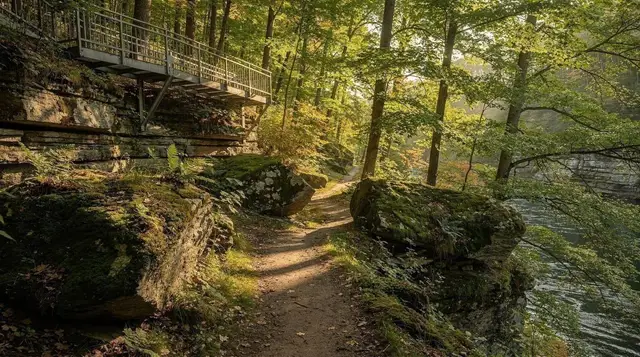
The Niagara Gorge Trail network on the American side, and the Niagara Glen on the Canadian side, do something related but slower — you’re walking, sweating a little on the way back up, hearing the rapids come and go through the trees rather than facing them head-on the whole time. It’s less immersive than the boardwalk directly beside the White Water Walk, but it’s the same basic shift: proximity instead of composition, duration instead of a single held moment.
Why I think most people only get half of this
Time pressure is the obvious answer, and it’s mostly right. If you have an afternoon at the falls, Table Rock or the Skylon Tower is the efficient choice — it’s the version everyone recognizes from photographs, it’s close to everything else, and it delivers the falls in a form you can process quickly. The gorge asks for more: an elevator down, a walk, wet shoes, a walk back up, and a stretch of time where you’re not looking at anything you’d call a landmark. It’s easy to skip when you’re triaging a single day.
But I don’t think the two views are redundant with each other, the way, say, two overlooks of the same skyline might be. They’re not offering the same information from different angles. The tabletop view tells you what the Horseshoe Falls is. The gorge tells you what the water is doing to the land, second by second, once it’s past the part everyone photographs.
One is about scale; the other is about force. I’d go further and say the gorge is the more honest of the two, if only because it doesn’t let you stay comfortable while you take it in — but I’d never tell someone to skip Table Rock to get there. You need the overview to make sense of the close-up, and I suspect you need the close-up to stop treating the overview as the whole story.
If you’re weighing how to spend limited time, it’s worth reading about free viewpoints on the Canadian side and free viewpoints on the American side before you commit to one register over the other, or looking at a 48-hour, both-sides itinerary if you want room for both without rushing either.
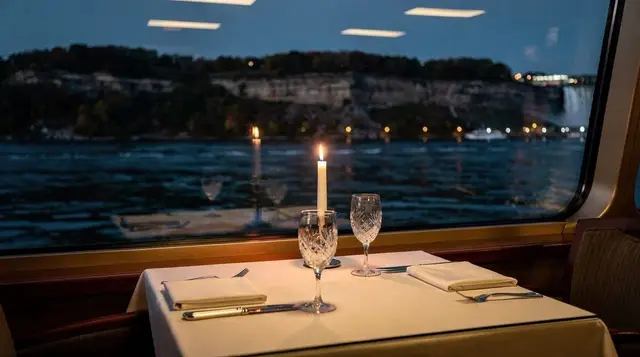
A guided eco tour into the gorge with a boat ride included is a reasonable way to get the proximity and the water at once without working out the logistics yourself, and if what you want on a single day is the tabletop version plus the classic boat ride up to the base of the falls, an all-in tour that pairs both falls with a boat cruise covers the composition side well.
For the view from directly behind the curtain of water — a third register again, neither tabletop nor gorge — there’s the Hornblower boat trip combined with the Journey Behind the Falls.
None of this is really about efficiency, though. It’s about admitting that “seeing Niagara Falls” isn’t one experience with one correct vantage point. Comparing the Canadian side to the American side, as I’ve done elsewhere, is a question about logistics and geography. This is a different question: do you want the falls to look calm, or do you want them to feel exactly as violent as they are? I’d take both, every time, and I no longer think of the second one as optional.
FAQ: choosing between the tabletop view and the gorge
What’s the real difference between the tabletop view of Niagara Falls and the gorge-level view?
The tabletop view, from places like Table Rock and Skylon Tower, shows you the whole shape of Horseshoe Falls from above and a comfortable distance. The gorge-level view, from the White Water Walk or the Niagara Gorge Trail, puts you a few metres from class VI rapids at eye level, with no vantage point at all — just noise, spray, and moving water. They’re opposite sensory experiences of the same river, not competing versions of the same view.
Is the White Water Walk actually at the falls?
No, and that’s the point. It’s downstream, in the Niagara Gorge, where the river narrows and speeds up into class VI rapids after dropping over Horseshoe Falls. You’re not looking at the falls at all — you’re standing beside what the falls turned into a few minutes earlier.
Which view is better for photographs?
The tabletop view is easier to photograph well, because you can see the whole curve of Horseshoe Falls and hold the camera steady. In the gorge, the spray gets on the lens fast and the rapids move too quickly to frame the way you’d expect, which is its own kind of honest picture.
Can I do both in one visit?
Yes, and I’d argue you should if you have more than a few hours. Table Rock or Skylon Tower takes thirty to sixty minutes including queues; the White Water Walk or a stretch of the Niagara Gorge Trail takes about the same. They’re on opposite sides of the border, though, so factor in a border crossing if you want to do the Canadian tabletop view and the American gorge trail in the same day.
Is the gorge-level walk safe?
The White Water Walk uses a fenced boardwalk right at river level, and the Niagara Gorge Trail on the American side runs along the rim and down into the gorge on maintained paths. Neither puts you in the water. The rapids look and sound more dangerous than the walkway actually is, which is part of why the experience is so physical.
Why does the tabletop view feel calmer than it should, given how much water is moving?
Distance and elevation flatten sound and motion. From Table Rock or the Skylon Tower observation deck, 168,000 cubic metres a minute reads as a single steady curtain rather than as individual water. Scale replaces sensation. Up close in the gorge, the same river reads as chaos, because you’re seeing the parts instead of the whole.
Does one side of the border own one kind of view?
Roughly, yes, though not absolutely. The best tabletop views — Table Rock, Skylon Tower — are Canadian. The clearest gorge-level walking, the White Water Walk and the longer Niagara Gorge Trail network, leans American, alongside Whirlpool State Park. Neither side has a monopoly, but the emphasis is real.
Gorge trails and guided walks on GetYourGuide
Verified deep-linked GetYourGuide tours. Book through these links and we earn a small commission at no cost to you.
GetYourGuide does not provide a product photo for this activity — the image shows the meeting point, photographed by us.