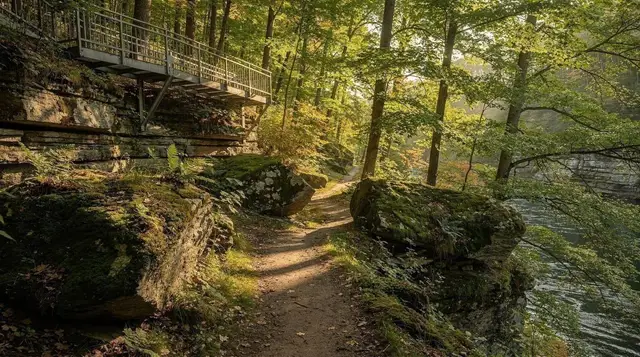
Niagara Glen: the Canadian side's only real hiking trail
What is the Niagara Glen Nature Reserve and is it worth the climb?
It's a free, roughly 4-kilometre trail network in the Niagara gorge, reached by a 60-metre metal staircase through carolinian forest and glacial erratics. It's worth it if you're reasonably fit and want the only genuine hike on the Canadian side, but the stairway back up is steep and there is no accessible alternative.
A gorge trail, not a viewpoint
Most things to do on the Canadian side put you in front of the water: a railing, a boat, a platform behind the falls. The Niagara Glen Nature Reserve is different. It puts you inside the Niagara Gorge itself, on a network of unpaved trails through forest and rock, several kilometres downstream from the falls near the crossing point of the Whirlpool Aero Car.
It’s the one place on the Canadian side that asks something of your legs and lungs rather than your wallet, and it’s the only genuine hiking on this side of the Niagara River — the symmetric trails on the American side, around Whirlpool State Park and Devil’s Hole, are covered separately and aren’t duplicated here.
It’s also the site most visitors skip, because it doesn’t show up on the Clifton Hill attraction boards and it isn’t included in most bus tours. That’s a shame, because it costs nothing and rewards anyone willing to do the work of getting down and back up.
Getting there and what it costs: nothing
The Glen sits along the Niagara Parkway, a short drive or cycle north of the main Niagara Falls, Ontario tourist core, close to the Whirlpool Aero Car crossing. There’s a small parking area off the parkway; it isn’t large, and on a warm summer weekend it fills before noon. Arrive early or plan to circle back.
There’s no admission fee, no ticket booth, and no Niagara Parks pass required — this is one of the genuinely free things to do on the Canadian side, alongside Table Rock itself. You pay only for parking, if the lot isn’t free that day, and for whatever you bring to eat. There’s no WEGO bus stop directly at the entrance, so getting here without a car usually means cycling the parkway, taking a taxi, or joining a tour that includes it, such as a guided e-bike route through the gorge.
a private e-bike tour that threads the islands and the gorge along the Niagara Parkway, which is a reasonable way to see the Glen’s surroundings and the river corridor without driving yourself.
The descent: 60 metres of metal stairs
There’s exactly one way in and one way out of the Glen from the parkway side: a steel staircase that drops roughly 60 metres from the rim down to the gorge floor. It’s built with landings and switchbacks rather than a single straight run, but make no mistake — it’s a real staircase, not a ramp or a gentle path, and it’s the entire descent in one go.
Going down is the easy part. It’s the climb back up that visitors underestimate. There’s no alternate route, no elevator, and no shortcut once you’ve committed to the trails below. Anyone with knee problems, breathing conditions, or simply low fitness should think hard before starting down, because the only way out is the same staircase, now working against gravity. Bring water, wear real shoes, and don’t attempt it in flip-flops or dress shoes — the footing at the bottom is uneven well before you reach any trail junction.
What you’ll see: carolinian forest and glacial erratics
Once you’re down, the trail network totals roughly 4 kilometres across several interlinking loops, so you can walk a short loop or string a few together depending on your energy and the time you’ve budgeted. The forest here is carolinian — the same warm-climate mix of deciduous species found in pockets across southernmost Ontario, distinct from the boreal forest most visitors associate with Canada.
The signature feature is the glacial erratics: enormous boulders, some the size of small houses, deposited by the retreating glaciers of the last ice age and left stranded as the gorge cut its way through the rock beneath them. Many are covered in moss and lichen, and the trail winds directly among them rather than around at a distance.
Along the way, exposed rock faces in the gorge walls show the layered sedimentary rock that the Niagara River has been cutting through for thousands of years — a quieter, closer version of the geology explained more broadly on the page about how the falls themselves work. Closer to the river, the trail runs along fast-moving rapids rather than the calm water most visitors picture — this stretch of the Niagara River is anything but placid.
The Whirlpool, glimpsed from the trail
From certain points along the trail, particularly the sections nearer the river and the upper approaches, you get partial views down toward the Whirlpool basin — the roughly 518-by-365-metre pool where the river makes its sharp turn — and the cable line of the Whirlpool Aero Car crossing overhead.
The trail doesn’t lead directly to the Whirlpool itself, which sits a short distance downstream and is better appreciated from the Aero Car crossing or the dedicated viewpoints there; treat the glimpses from the Glen as a bonus rather than the destination. If the Whirlpool is what you’re actually after, the Whirlpool Aero Car page covers how the crossing itself works, and a jet-boat trip through the rapids gets you onto that water directly rather than viewing it from above.
How hard is the climb back up, really
Worth stating plainly, since it’s the detail most trip planners leave out: this is not a casual stroll. Between the descent, the uneven forest floor, and the climb back out, expect a real hike — not an extreme one, but enough that visitors in poor shape, travelling with very young children who need to be carried, or managing mobility limitations should choose something else. There is no accessible route into the Glen.
The staircase and the rocky, root-crossed trail surface rule out wheelchairs and strollers entirely; don’t plan around it for anyone who needs one. If accessibility is a factor for your trip, the paved routes around Queen Victoria Park and Table Rock are the better comparison, and the accessibility guide covers what’s actually manageable at the falls themselves.
Take breaks on the way up. The staircase has landings for a reason.
When to go, and when parts of it close
The trail surface itself is often walkable across a good stretch of the year for hikers who come prepared, but conditions change with the season and shouldn’t be assumed. Rain turns the carolinian forest floor slick within the hour. Ice on the staircase or the exposed rock in colder months is a genuine hazard, not a minor inconvenience, and some seasonal amenities at the site — washrooms, staffed information points — operate on a shorter calendar than the trail itself. Check current conditions before a late-autumn or winter visit rather than assuming the Glen is open the way it is in July; the general seasonal opening guide is a useful cross-check before you drive out.
Spring brings mud and high water in the gorge below; fall gives the carolinian canopy real colour and thinner crowds, and is arguably the best single window if you can time it. Summer is busiest and hottest, and the climb back up in humid heat is noticeably harder than the same staircase in October.
Who should skip this — and what to do instead
Be honest with yourself before driving out. Skip the Glen if you’re travelling with a stroller, using a wheelchair, have significant mobility or breathing limitations, or simply don’t want a real physical hike on your itinerary. None of that is a failure of planning — it just means this specific site isn’t for you, and there’s no shame in choosing the paved, flat routes along the parkway and at Table Rock instead.
If what draws you is the idea of getting close to the gorge and its rapids without the staircase, a jet-boat trip covers the water itself, and a guided cycling route along the parkway covers the corridor above without the descent:
the White Water Walk, a boardwalk right at the edge of the gorge rapids that needs no staircase at all is the closest comparable experience that stays fully accessible and paved.
Niagara Glen at a glance
| Detail | What to know |
|---|---|
| Cost | Free entry; parking may be paid |
| Trail length | Roughly 4 km across interlinking loops |
| Descent/ascent | About 60 m via metal staircase, no alternate route |
| Difficulty | Moderate to hard because of the stairs, not the distance |
| Accessibility | Not wheelchair or stroller accessible |
| Best season | Fall for colour and crowds; summer busiest and hottest |
| Nearest landmark | Whirlpool Aero Car crossing |
| Transit | No WEGO stop; car, bike, or taxi |
Pairing it with the rest of the gorge
The Glen sits naturally alongside a half-day built around the gorge rather than the falls themselves. A common pairing: cycle or drive the parkway between Niagara-on-the-Lake and wine country on one end and the Glen on the other, stopping at the Whirlpool Aero Car in between. If you’d rather stay on two wheels for the whole stretch, the dedicated cycling guide to the Niagara Parkway by bike lays out a fuller route.
For visitors who want the gorge but not the stairs, or who are stuck with a rainy forecast on the day they’d planned to hike, both the White Water Walk and a short e-bike loop of the islands are reasonable substitutes:
a half-day tour bundling several Canadian-side stops into one afternoon works if you want the gorge covered alongside the main viewpoints without planning each stop yourself. And if the legs need a rest after the climb out, a chauffeured wine tasting nearby is the sensible next stop rather than another hike:
If the weather turns or the staircase simply isn’t for you today, the rainy-day guide and the list of free Canadian-side viewpoints both cover ground you can reach without a single flight of stairs, and a first one-day itinerary shows where the Glen fits if you’re only in town for a single day. For the full category of step-heavy and trail-based things to do, the hiking and trails hub rounds up the rest.
FAQ about the Niagara Glen Nature Reserve
Is the Niagara Glen Nature Reserve free?
Yes. There’s no admission fee and no Niagara Parks pass required. You pay only if you park in the small lot off the Niagara Parkway, and even that fills early on summer weekends.
How long is the Niagara Glen trail?
The marked network totals roughly 4 kilometres across several interlinking loops. Most visitors walk 1.5 to 2.5 kilometres depending on which loops they combine, plus the staircase at each end.
Is the Niagara Glen wheelchair or stroller accessible?
No. The only way in or out is a steel staircase dropping about 60 metres, and the trails themselves cross rocky, uneven, root-covered ground. There is no accessible route into the gorge at this location.
How hard is the climb back up from the Niagara Glen?
Harder than most visitors expect. It’s a sustained metal staircase with landings, not a gentle path, and there’s no shortcut once you’ve committed to the descent. Budget real recovery time and expect to be out of breath.
Can you see the Whirlpool from the Niagara Glen trails?
From some of the upper and river-edge sections, yes, you get partial views down to the Whirlpool basin and the cable line of the Whirlpool Aero Car overhead. The trail doesn’t approach the Whirlpool itself, which sits further downstream.
Is the Niagara Glen open in winter?
The trail itself is often walkable much of the year for prepared hikers, but the staircase and rocky footing get genuinely hazardous with ice and snow, and some seasonal amenities close. Check current conditions before a cold-weather visit rather than assuming it’s open.
How do I get to the Niagara Glen from the Falls?
It’s a short drive or cycle north along the Niagara Parkway from the main Falls area, close to where the Whirlpool Aero Car crosses the gorge. There’s no WEGO bus stop directly at the Glen, so you’ll need a car, bike, or taxi.
What will I actually see there?
Carolinian forest, moss-covered boulders called glacial erratics left behind by retreating ice, exposed rock walls showing the gorge’s sedimentary layers, and the Niagara River running fast through the gorge below.
Gorge trails and guided walks on GetYourGuide
Verified deep-linked GetYourGuide tours. Book through these links and we earn a small commission at no cost to you.
GetYourGuide does not provide a product photo for this activity — the image shows the meeting point, photographed by us.