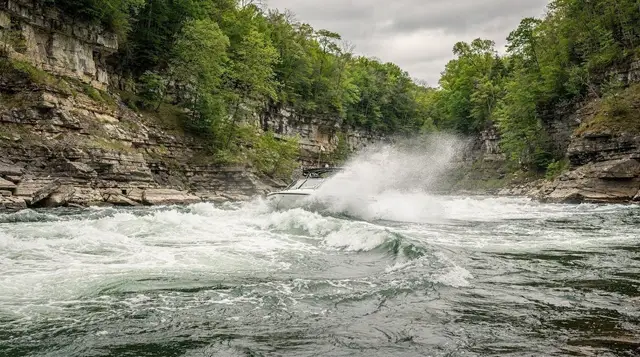
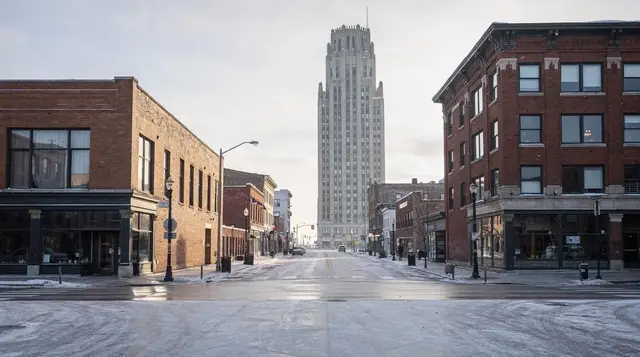
Niagara Falls, New York, is a city of about 48,000 people, and most visitors never see more of it than the few blocks around Niagara Falls State Park. That is not a criticism of the place so much as a description of how it works: the park is the reason the city exists as a destination, and everything else downtown is arranged to serve people walking to and from it.
The state park is the whole point
Founded in 1885 as the Niagara Reservation, this is the oldest state park in the United States, laid out by Frederick Law Olmsted, the same landscape architect behind Central Park in New York City. Entry costs nothing. You pay for parking, and you pay for what you do once you are inside, but simply walking to the edge of the gorge and standing over the water is free in a way that has no real equivalent on the Canadian side.
That closeness is the whole appeal of this side of the falls. From Goat Island, the wooded island that splits the American Falls from the Horseshoe, you can reach Terrapin Point, which sits closer to the lip of the Horseshoe Falls than any spot in Canada.
Luna Island puts you between the American Falls and the smaller Bridal Veil Falls, close enough that the spray reaches you on a breezy day. Upstream, the Three Sisters Islands sit right in the rapids feeding the falls, a five-minute walk from the main paths and skipped by most day-trippers, which makes them worth the detour.
Two paid attractions do the rest of the work. Maid of the Mist, running since 1846, takes you by boat into the basin below the Horseshoe Falls, now on two fully electric vessels. Cave of the Winds does the opposite: an elevator into the gorge, then wooden walkways built fresh each spring, ending at the Hurricane Deck a few metres from Bridal Veil Falls. Both guides cover ticketing, timing, and what to expect in more detail than belongs here; this page is the map, not the manual.
The Niagara Falls Observation Tower at Prospect Point is the one platform on this side that actually cantilevers out over the gorge, and its elevator also carries passengers down to the Maid of the Mist dock. It is a smaller, plainer structure than the Skylon Tower across the river, and it does one job rather than several, which is honestly fine for what most people need.
Old Falls Street and downtown
Old Falls Street is the pedestrian corridor connecting the park entrance to the hotel strip, lined with restaurants, a handful of gift shops, and, in summer, evening entertainment and occasional fountains and lights. It is a fraction of the size of Clifton Hill on the Canadian side, and that is mostly a compliment: fewer wax museums, less flashing signage, easier to walk through without feeling sold to at every step.
Downtown proper, a few blocks further back, is a working American city with the usual mix of chain hotels, older housing stock, and visible economic hardship in places. Visitors who expect a resort town from end to end are sometimes thrown by this; it is worth knowing in advance rather than discovering it on foot after dark.
The Niagara Falls Underground Railroad Heritage Center sits downtown and tells a piece of history the falls themselves rarely get credit for: the river as one of the last physical barriers freedom seekers crossed on the way to Canada. It is a serious, well-run museum and a reasonable use of an hour if the weather turns.
Where to stay
Hotels cluster in three rough zones, and the difference between them matters more than most travellers assume before booking.
| Zone | Distance to the park | What you get |
|---|---|---|
| Fallsview strip (Old Falls Street) | Walking distance, 5 to 10 minutes | Higher rates, some rooms with falls or gorge views, easiest access |
| Downtown / off Third Street | 10 to 20 minute walk | Cheaper, mixed neighbourhood quality, still walkable |
| Off the interstate near I-190 | Drive required | Chain hotels, lowest rates, no walking to the park |
Rates run roughly USD 120 to 300 a night depending on season and view, with summer weekends at the top of that range and winter weekdays well below it. A room with an actual falls view costs a real premium and, on the American side, there are fewer of them than the marketing suggests; most “falls view” listings mean a partial glimpse of the gorge rather than the Horseshoe itself. The Canadian side has considerably more high-rise hotel inventory directly overlooking the water, priced in Canadian dollars, which is one more reason some visitors choose to sleep in Canada and spend their days on both sides.
Getting here
Buffalo is the practical gateway: 34 kilometres away, about a 30-minute drive on the Robert Moses Parkway or I-190, and home to Buffalo Niagara International Airport (BUF), consistently the cheapest airport for reaching either side of the falls. A rental car from BUF is the simplest way in if you are not already staying in Canada.
Crossing from the Canadian side takes you over the Rainbow Bridge, the pedestrian and vehicle crossing closest to the falls themselves. On foot it is roughly a 10-minute walk plus a small toll each way, and outside peak season it is often faster than driving, since summer afternoons and holiday weekends can back up the vehicle lanes for well over an hour. A passport, a passport card, or an enhanced driver’s licence is required in both directions; a standard driver’s licence alone will not get you across. If you are renting a car in Canada and plan to drive it into the United States, confirm the rental contract actually allows a border crossing before you rely on it.
Lewiston, a quieter village downriver, and Old Fort Niagara at the mouth of the river on Lake Ontario both make reasonable half-day additions if you have a car and a second day on this side.
American side or Canadian side
This is the question nearly every visitor asks, and the honest answer is that the two sides do different jobs.
| American side (New York) | Canadian side (Ontario) | |
|---|---|---|
| Signature view | Standing over and beside the water, extremely close | Facing the Horseshoe Falls head-on, the postcard shot |
| Entry cost | Free park, pay per attraction | Table Rock viewpoint is also free |
| Currency | US dollars | Canadian dollars |
| Best for | Gorge trails, proximity, budget days | The wide, iconic panorama |
| Crowd feel | Quieter, more park-like | Busier, more built up around Clifton Hill |
Neither side is objectively better, whatever either tourism board implies. If you have limited time and want the view that ends up in every photograph of Niagara Falls, that is the Canadian side, looking across at the Horseshoe. If you want to stand close enough to feel the spray on your face and would rather spend nothing to walk around for a full day, that is here. Most people who can manage the border crossing end up glad they did both; our guide to comparing the two sides goes through the trade-offs in more depth than fits on a hub page.
What actually closes for winter
It is easy to assume a major tourist destination runs everything year-round. This one does not. Maid of the Mist shuts down completely for winter, typically from late November into early April, when ice makes the basin below the falls unsafe for boats. Cave of the Winds switches over to a stripped-down Ice Experience: the wooden walkways to Hurricane Deck are dismantled each autumn and rebuilt each spring, so the summer version of that attraction simply does not exist between roughly November and April.
The park itself, Goat Island, and the gorge trails at Whirlpool State Park stay open through winter, and the ice formations that build up along the shoreline are genuinely worth seeing, but do not book a winter trip assuming the boat tour will be running. Check current dates before you plan around either attraction; our season-by-season breakdown tracks what is open month to month on both sides of the river.
Beyond the falls: the gorge and the river
The water you see at the state park has travelled 58 kilometres from Lake Erie to Lake Ontario, dropping 99 metres along the way, and the gorge below the falls is where that history is easiest to read. It is 11 kilometres long, and the falls cut it by retreating upstream over some 12,500 years; today the edge still recedes by about 30 centimetres a year. Standing at Prospect Point, you are looking at the newest stretch of a very old excavation.
For anyone who wants more than an overlook, the Niagara Gorge trails are the best reason to give this side a second day. The paths drop below the rim and follow the river downstream toward Whirlpool State Park, and they feel nothing like the paved loops of the state park above. Wear proper shoes, take water, and read the gorge trails guide for the American side before you set out, because some routes are steep and rocky and not suited to every visitor.
The Niagara River itself is part of the story. Under the 1950 treaty, at least 2,832 cubic metres of water per second must pass over the falls during daytime hours from 1 April to 31 October, and 1,416 cubic metres per second the rest of the year; the remainder is diverted to the power stations. The flow you see is, in other words, a managed one, which the blog explains well in the flow is a treaty, not nature.
Practical tips for a day on this side
- Start early. The park is at its quietest in the first hour after opening, and the light on the spray is better for photographs before the crowds arrive.
- Dress for the mist. Near Terrapin Point and on the boat or Hurricane Deck you will get wet even on a dry day; a light waterproof layer and a bag cover are worth carrying. Our note on what the mist does to your camera is useful before you pack.
- Keep your passport handy if there is any chance you will cross into Canada, even on a whim in the afternoon.
- Eat off the main strip. Prices near the park entrance are higher than a few blocks away; see where to eat in Niagara Falls, New York for options by budget.
- Check the calendar. Hours and attractions shift with the seasons, so confirm what is running before you go; a visit in the warmer months, June to August, is the busiest and most fully open.
Remember that this is the northern hemisphere: summer runs roughly June to August and winter December to March, so the shoulder months of late September and October remain the most comfortable balance of weather, light, and open attractions.
A note on prices
Every price on this page, and on the American-side pages linked below, is in US dollars. The Canadian side prices everything in Canadian dollars, and the exchange rate moves. If you are pricing out a multi-day trip that crosses the border, keep the two currencies separate in your own budgeting rather than treating a CAD figure and a USD figure as roughly the same number, because they are not.
Getting the most from a booked tour
If you would rather not sort out timed tickets, parking, and the border crossing yourself, a handful of guided options bundle the American-side highlights, and a few also cross into Canada in the same day. The Niagara Falls USA: Maid of the Mist Cave Adventure pairs the boat ride with Cave of the Winds in a single booking, which is a reasonable shortcut on a hot summer day when both attractions have long lines. In winter, when the Hurricane Deck walkways are down, the Niagara: USA Cave of the Winds Adventure Winter Tour covers the scaled-back version along with the rest of the state park.
Travellers based in Canada or arriving without a car sometimes prefer a guide to handle the crossing logistics entirely: the Niagara Falls USA and Canada Tour with Boat Cruise covers both sides and both boat tours in one day, which removes the guesswork around bridge wait times. For an evening on this side once the day-trippers have thinned out, the Niagara Falls USA: Night Lights Dinner combines a meal with the falls illuminated after dark, a genuinely different experience from the daytime crowds.
Where to go from here
This page is the overview; the detail lives in the linked guides and destination pages. Start with Niagara Falls State Park for the layout of the park itself, then Goat Island and the American-side loop for a suggested walking order that covers Terrapin Point, Luna Island, and the Three Sisters without backtracking. Maid of the Mist: what to expect and the Cave of the Winds Hurricane Deck guide cover ticketing, timing, and what to bring for each.
If you are planning where to sleep, our lodging guide weighs the American-side hotel strip against staying in Canada instead, and parking on the American side breaks down the lot options and realistic costs. For the crossing itself, read crossing the border at Niagara before you go, not after you are standing in a line you did not expect.
If you are building a longer trip, both sides in 48 hours is the itinerary most first-time visitors end up wanting anyway, even if they did not plan for it going in.