Cave of the Winds and the Hurricane Deck
What is the Cave of the Winds at Niagara Falls?
It's a Niagara Falls State Park attraction on Goat Island, New York: an elevator drops you into the gorge, then wooden walkways lead to the Hurricane Deck, a platform a few metres from the base of Bridal Veil Falls where the spray soaks you on purpose. The walkways are seasonal — built each spring and taken down each autumn — and only the top-level Ice Experience stays open in winter.
Getting as close to Bridal Veil Falls as the gorge allows
Of the handful of attractions that put you close enough to Niagara Falls to feel it rather than just look at it, Cave of the Winds is the one that puts you closest. It sits inside Niagara Falls State Park on Goat Island, on the New York side, and it ends at a wooden platform called the Hurricane Deck, positioned a few metres from the base of Bridal Veil Falls — the smallest of the three falls but, from that distance, the loudest and wettest one you’ll ever stand next to.
This guide covers what the visit actually involves: the elevator and walkway route, what the Hurricane Deck feels like once you’re on it, what to wear, and — the detail most visitors miss when they’re planning around a winter trip — that the full walkway experience is seasonal. It comes down every autumn and goes back up every spring. What replaces it in the cold months is a different, more limited attraction called the Ice Experience, and confusing the two leads to disappointment at the ticket counter.
What Cave of the Winds actually is today
The name is a bit of a fossil. There was once an actual cave here, a hollow behind the falling water, but it collapsed in 1920 after a rockfall and was closed for safety. What Niagara Falls State Park built afterward, and has refined since, is a system of stairs, an elevator, and wooden walkways that bring visitors down into the gorge and along the base of the American Falls toward Bridal Veil Falls, without any cave involved. The name outlived the geology.
The modern route starts at an entrance building on Goat Island, where you’re issued a thin plastic poncho — yellow at Cave of the Winds, distinct from the blue ponchos on the Maid of the Mist and the red ones used on the Canadian Niagara City Cruises boats. From there, an elevator descends about 175 feet through the rock of the gorge wall, landing you at river level, well below the tabletop where most of the park sits.
The walk: wooden stairs, boardwalks, and the Hurricane Deck
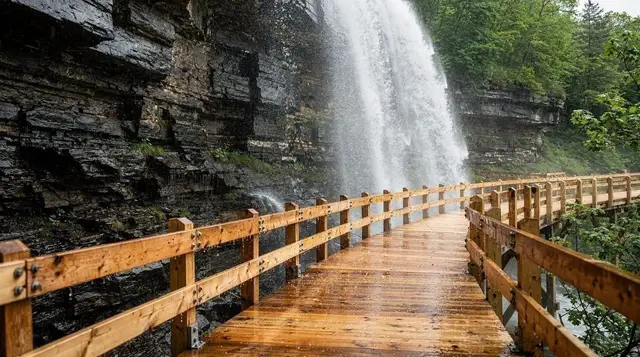
Once the elevator doors open, the route becomes a series of wooden boardwalks bolted into the gorge rock, threading between the base of the cliffs and the edge of the river. Handrails line the walkways the whole way, which matters, because the surface underfoot is wet from the first few steps and only gets wetter. This isn’t incidental spray — the closer the boardwalk gets to Bridal Veil Falls, the more it’s genuinely raining sideways.
The walk climbs a short flight of wooden stairs to the named viewpoints along the way — the Cataract, the Cyclone, the Aero, the Whirlwind, the Great Circle Vista — before ending at the Hurricane Deck, the platform positioned at the closest legal approach to the base of Bridal Veil Falls anywhere in the park. Visitors describe the sound at this point less as noise and more as a physical pressure; conversation at normal volume mostly doesn’t work, and the water isn’t falling so much as exploding off the rocks a few metres away. It’s a short walk in total distance, but people tend to move slowly on the last stretch, partly from the incline of the stairs and partly because everyone wants a minute standing at the rail before turning back.
Guided options exist alongside the self-guided walk, usually paired with narration on the geology and history of the site and sometimes bundled with time on one of the boat tours. If a full guided day appeals more than working it out yourself, a walking tour that pairs Cave of the Winds with the boat crossing is one way to do both without planning the logistics — a guided walking tour combining Maid of the Mist and Cave of the Winds covers both attractions with a guide handling the timing.
What to wear — and the detail people get wrong
The poncho handed out at the entrance covers the torso, shoulders, and arms reasonably well. It does nothing for feet, and it does very little for legs below the knee. By the time you reach the Hurricane Deck, shoes are soaked through regardless of the poncho, and most visitors’ clothing underneath is damp at minimum. This isn’t a maybe — treat it as a certainty and dress for it.
Practical choices: sandals, water shoes, or old runners you don’t mind getting wet, rather than anything leather or anything you’d be annoyed to walk around in damp for the rest of the day. A swimsuit or quick-dry layer under the poncho works well for people planning to change afterward; changing rooms and lockers are available near the entrance for stashing dry clothes and electronics.
Phones and cameras survive if bagged or cased; carried loose, they don’t. This is the same trade the Maid of the Mist and Niagara City Cruises boats make with their ponchos, but the Cave of the Winds walkway puts you even closer to the falling water than either boat does, and the ponchos are correspondingly less adequate.
The seasonal reality: built every spring, taken down every autumn
This is the detail that matters most for anyone booking around a specific date. The wooden walkway system down to the Hurricane Deck is a seasonal structure, not a permanent one. Every autumn, park staff dismantle the boardwalks before winter ice and freeze-thaw cycles can damage them; every spring, the walkways go back up before the season reopens, usually as the weather stabilizes. The rebuild is a real construction job, not a formality, and the reopening date shifts a little year to year depending on conditions in the gorge.
From late autumn through winter, while the boardwalks are down, the attraction doesn’t fully close — it becomes something narrower called the Ice Experience. Visitors still take the same elevator down into the gorge, but instead of the full walkway loop to the Hurricane Deck, access is limited to the upper platform area. There’s no walk out to the base of Bridal Veil Falls in winter, because the structure that would carry you there simply isn’t in place.
The view from the upper platform in winter — ice formations built up along the cliff face and the edge of the falls, the Bridal Veil still running behind a curtain of frozen spray — is worth seeing in its own right, but it is a different, shorter visit than the summer or fall walkway experience, and it shouldn’t be booked expecting the Hurricane Deck.
The practical upshot: if reaching the Hurricane Deck itself is the goal, plan the visit for the open season — spring through autumn is the safe window, and exact opening and closing dates are published by Niagara Falls State Park each year rather than fixed to the calendar. If a winter trip is set already, go in with the expectation of the Ice Experience rather than the full walk, and pair it with other things that are actually open in winter — see what’s open and closed by season for the fuller list, since several signature Niagara attractions on both sides of the border close for the cold months.
Tours built specifically around the full walkway season, sometimes combined with the boat ride for a single close-up day on the water and in the gorge, are worth booking ahead in the busiest summer weeks — a combined Maid of the Mist boat ride and Cave of the Winds walk covers both wet, close-up attractions on the American side in one outing.
Booking, timing, and avoiding the worst of the line
Tickets are sold at the Cave of the Winds entrance and online in advance; buying ahead matters more in July and August, when midday lines for the elevator can run long, and matters far less on a quiet weekday morning in September or October. Early in the day, before tour groups arrive in numbers, is consistently the calmer option — the elevator has a fixed capacity per trip, and the wait scales with how many people are trying to go down at once, not with how far the walkways extend.
For a first-time visit that wants to see the highlights of the American side without piecing together each stop separately, a guided tour bundling Cave of the Winds with other nearby attractions removes the planning — a Niagara Falls USA highlights tour including Cave of the Winds works through the main American-side stops with a guide handling the order and the timing, which is useful on a first visit when it isn’t obvious how the pieces of Niagara Falls State Park fit together.
Evening options exist too: on nights when fireworks are scheduled over the falls, a Cave of the Winds visit timed around dusk lets you finish on the boardwalk as the sky show starts, rather than treating them as two separate trips out to the park.
Cave of the Winds versus the Canadian equivalent
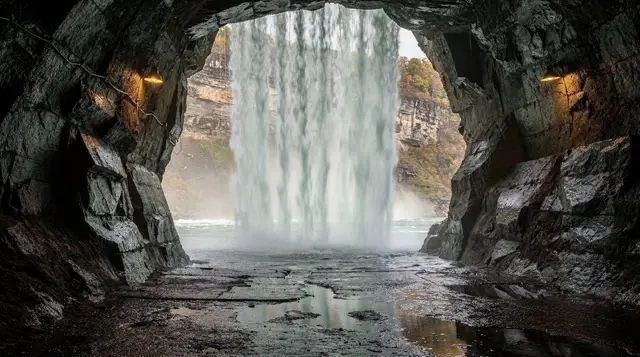
It’s worth being direct about a comparison visitors bring up constantly: Cave of the Winds is not the same attraction as Journey Behind the Falls on the Canadian side, even though both get lumped together as “the tunnel-and-platform thing.” Journey Behind the Falls uses an elevator and tunnels cut into the rock behind the Horseshoe Falls, ending at an outdoor platform at its base — an experience built around enclosed passages with a reveal at the end. Cave of the Winds, by contrast, is entirely outdoors once you leave the elevator, threading open wooden walkways along the gorge to Bridal Veil Falls rather than tunnelling behind anything.
Neither is a substitute for the other, and if a trip covers both sides of the border, they’re worth treating as two separate items on the list rather than picking one. For a fuller side-by-side on which experiences live where, Canada versus USA side at Niagara Falls breaks down the split attraction by attraction.
What to pair it with
Cave of the Winds sits on Goat Island, which makes it easy to combine with the rest of the American-side loop in a single outing: Three Sisters Islands upstream in the rapids, Terrapin Point for the closest American-side view of the Horseshoe, and the Niagara Falls Observation Tower for an elevated view before or after getting soaked at river level. The full loop, on foot, fits comfortably into a half-day — see the Goat Island and American side loop for a suggested order.
Photographers should note the mist problem before it becomes a ruined memory card: the same spray that makes the Hurricane Deck worth visiting will fog a lens or soak an unprotected camera within seconds at close range — what the mist does to your camera covers the workarounds.
And for anyone deciding how much time the whole Niagara Falls State Park side deserves against everything on the Canadian side and beyond, how many days to spend at Niagara Falls and the one-day Niagara Falls itinerary both work Cave of the Winds into a realistic schedule rather than treating it as an afternoon that swallows the whole day.
Anyone building toward a winter Ice Experience visit instead of the full season should check do the falls freeze and Niagara Falls ice formations first — the ice buildup around Bridal Veil Falls in a cold snap is genuinely striking even from the upper platform, but it is a different, colder, shorter visit than the one described above, and worth booking with that expectation set correctly from the start.
For visitors set on the full experience specifically during the coldest months, when the standard walkway is down, a dedicated winter-format tour built around what’s actually accessible avoids the mismatch between what’s advertised and what’s open — a Niagara USA Cave of the Winds adventure sized for the winter season is built around the Ice Experience rather than the full boardwalk, which keeps expectations lined up with what’s actually running that week.
Tunnels and decks behind the falls on GetYourGuide
Verified deep-linked GetYourGuide tours. Book through these links and we earn a small commission at no cost to you.
GetYourGuide does not provide a product photo for this activity — the image shows the meeting point, photographed by us.