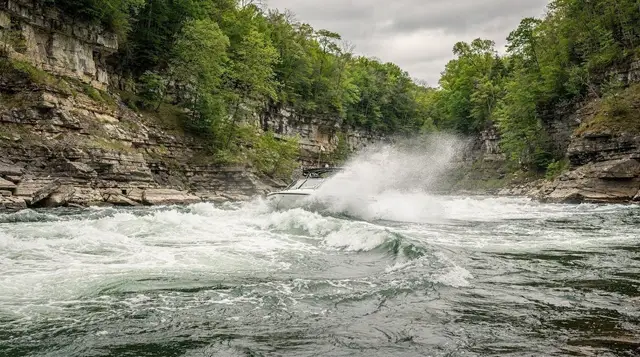
A quiet stop upstream of the falls
Every other page in this guide points you toward a place to look at the falls. This one doesn’t. The Three Sisters Islands sit upstream on Goat Island, in Niagara Falls, New York, where the Niagara River is still a river — wide, shallow in places, and picking up speed as it funnels toward the drop you’ll see later (or already saw) from Terrapin Point. Here you watch the acceleration, not the fall. It’s a different kind of view, and it asks something different of you: patience, and a willingness to stand still and watch moving water instead of chasing a photo of the horseshoe.
The three islands — unnamed individually on most maps, just First, Second and Third Sister — are connected to each other and to Goat Island by short wooden and stone footbridges, built low over channels of the rapids. You walk from one to the next in a few minutes each. There’s no admission gate, no gift shop, and on a weekday morning you can have long stretches of the path to yourself, which is unusual anywhere within sight of Niagara Falls State Park in summer.
Getting there
The Three Sisters Islands are at the upstream end of Goat Island, past the Three Sisters parking area, roughly a 15- to 20-minute walk from Prospect Point if you’re coming on foot through the park. If you’re driving in from the Rainbow Bridge area or from downtown Niagara Falls, New York, there’s a small parking lot right at the island’s access point — it’s part of the free Goat Island loop road, and it fills up on summer afternoons the same as every other lot in the park. Arriving before mid-morning, or later in the afternoon, is the easiest way to get a spot without circling.
There’s no separate entrance and no separate ticket. The islands are simply the far end of the Goat Island network, so most visitors reach them on foot as an extension of a longer walk that also takes in Luna Island and the paths toward Terrapin Point. If you’re planning your day around a single free loop, this is one of the better places to fold it in — see our Goat Island and American side loop guide for a route that links it all together without backtracking.
What you’ll actually see
This is the honest part: you will not see a waterfall from the Three Sisters Islands. What you’ll see is the Niagara River doing the thing that makes the falls possible in the first place — accelerating over a shallow, rocky bed, breaking into whitewater, splitting around small rock islands, and picking up the speed that eventually sends more than 168,000 cubic metres of water over the Horseshoe Falls crest every minute at peak flow. The rapids here are part of the same run of water that becomes the falls a short distance downstream, and on the Sisters you’re standing close enough to hear them properly, without a rail of tourists between you and the water.
The channels between the islands are narrow enough that in places the water is only a few metres from the path. It moves fast — this stretch of river is losing elevation quickly on its way to the crest, and the current here is genuinely dangerous, not scenic-dangerous. There are railings along the bridges and the main paths, and it’s worth using them: rocks near the water are frequently wet from spray and splash-back, and wet rock next to fast current is not a place to test your footing for a photo. Niagara Parks and the New York State Parks system both post warning signage for a reason — people have gone into this water and not come back. Enjoy the view from the path and the bridges; don’t climb down to the water’s edge.
Because the setting is more about texture and motion than about a single dramatic sightline, this is a good spot for photographers who already have their falls shot and want something different: long-exposure whitewater, close-up rock and current, or wide shots of the channels between the islands with the tree cover on each one. Morning light tends to be softer here than the midday glare that hits the open viewing platforms closer to the falls.
How it compares to the main viewpoints
It’s worth being direct about where the Three Sisters Islands sit in a Niagara itinerary: they are not a substitute for Terrapin Point or the Prospect Point Observation Tower, and they shouldn’t be sold to you as one. Those two spots deliver the money shot — the close, loud, misty view of falling water that most people come to Niagara for. The Sisters deliver something quieter and, frankly, more optional: a calm walk with moving water and almost none of the crowd.
If your time at the falls is limited to a single day, put Terrapin Point, the Maid of the Mist boat ride, and Cave of the Winds ahead of this stop. If you have a second day, or you’re the kind of traveller who likes to see a place fully rather than just its highlight reel, the Sisters are a pleasant hour that costs nothing and asks nothing of your budget. Treat this page as a “yes, if you have the time” recommendation rather than a “don’t miss it” one — the honest version of this place doesn’t oversell it.
| Viewpoint | What you see | Crowd level | Cost |
|---|---|---|---|
| Terrapin Point | Horseshoe Falls, close and head-on | Very high, especially midday | Free |
| Prospect Point Observation Tower | American Falls and the gorge below | High | Small fee for the tower elevator |
| Three Sisters Islands | Upper rapids, before the drop | Low to moderate | Free |
| Luna Island | American and Bridal Veil Falls, close | High | Free |
Who this stop suits — and who can skip it
The Three Sisters Islands work well for repeat visitors returning to Niagara who’ve already photographed the falls from every angle and want to see a part of the river most first-timers never reach. They also suit hikers who want a short, flat, easy walk without paying for a passerway or a boat ticket, and travellers on a tight budget who are stacking up free things to do — see our free viewpoints on the American side guide for the fuller list. Photographers who want texture and motion rather than another wide shot of the horseshoe will get more out of ten minutes here than a lot of visitors expect.
They suit families with young kids less well, mainly because of the open water and unfenced rock edges in places — supervise closely if you bring children. And if you’re on a first visit with only a few hours at the falls, this is one of the first things to cut from your plan; it’s a complement, not a headline. Our one-day Niagara Falls itinerary doesn’t build in time for it, and that’s deliberate.
When to go
The islands and their footbridges are generally accessible whenever Goat Island is open, but conditions change a lot with the season. In summer, the paths are shaded in places by mature trees, which makes this one of the more comfortable short walks in the park on a hot, humid afternoon — see summer in Niagara Falls for what to expect from the weather generally. In fall, the tree cover on the islands turns with the rest of the Niagara Gorge corridor, and the lower crowds make it one of the better fall walks in the park.
In winter, spray from the rapids and general ice buildup can make sections of the paths and bridges slick or temporarily closed — check current conditions before you go, and don’t assume every part of the loop is open the way it is from May through October. Spring brings the highest flow of the year as snowmelt feeds the river, which means the rapids here are at their most dramatic, but paths can also be wet and the crowds thinner than summer, which suits an early-season visit well. For a season-by-season breakdown of what’s open where, see what’s open and closed by season.
Pair it with the rest of the American side
Because the Three Sisters Islands sit at the far end of Goat Island, they’re easy to combine with a longer loop rather than visiting on their own. A natural route starts near Prospect Point, crosses onto Goat Island, takes in Luna Island and the American Falls views, continues to Terrapin Point for the Horseshoe Falls, and finishes with the walk out to the Sisters before doubling back — all of it free, all of it on foot, and all of it covered in more detail in our Niagara Gorge trails guide for the USA side.
If you want to feel the speed of this same stretch of river from the water rather than the bank, a jet boat tour on the Niagara River takes you into rapids downstream of the falls rather than above them — a different, rougher section of the same system, and a good complement if the calm upper rapids at the Sisters leave you wanting more.
a 45-minute jet boat tour into the Niagara River rapidsFor visitors who’d rather get close to the falls themselves after their quiet stop on the Sisters, the classic boat ride from the American side still runs seasonally from near Prospect Point.
the Maid of the Mist boat and walking tour from the USA sideIf a wetter, closer perspective on the falls interests you more than the boat deck, the boardwalks at Cave of the Winds put you within a few metres of Bridal Veil Falls.
the Cave of the Winds cave adventure and Hurricane Deck walkAnd if you’re planning to see both the American and Canadian sides in one trip, a combined walking and cruise tour covers ground on both sides of the border in a single booking.
a combined Beyond the Falls walking tour and cruisePractical notes
Stick to marked paths and bridges — the rocks along the channels look stable and often aren’t, especially when wet from spray or rain. There are no food or drink vendors on the islands themselves, so bring water if you’re doing the full Goat Island loop on a warm day; the nearest concessions are back near the main Goat Island facilities. Cell signal can be patchy in spots along the river, which is one more reason to tell someone your rough plan if you’re walking here alone early or late in the day. Restrooms are available at the main Goat Island facilities, not on the Sisters themselves, so plan accordingly before you set out on the walk.
Because everything here is outdoors and unticketed, there’s no booking, no queue, and no fee to budget for — a rare thing at Niagara. That also means there’s no shelter if the weather turns; check the forecast, and treat a sudden thunderstorm the way you would anywhere near open water — head back toward Goat Island’s main paths rather than sheltering under the trees on a small island.
Questions about visiting the Three Sisters Islands
Is there an entrance fee for the Three Sisters Islands?
No. They’re part of Niagara Falls State Park on the American side, and access is free, the same as the rest of Goat Island.
How long does it take to walk to and around the islands?
Budget 15 to 20 minutes to walk there from Prospect Point, and another 30 to 45 minutes to explore the three islands and their footbridges at an unhurried pace.
Can you see the actual waterfalls from the Three Sisters Islands?
No. The islands sit upstream of the falls, so what you see is the river accelerating through rapids before it reaches the drop — not the falls themselves. For falls views, head to Terrapin Point or Luna Island.
Is it safe to walk on the rocks near the water?
Stay on the marked paths and bridges. The current in the rapids around the islands is fast and dangerous, and rocks near the water are often wet and slippery from spray. This isn’t a place to climb down for a closer look.
Is this a good spot to visit with young children?
It can be, with close supervision, since parts of the path run near open water without continuous fencing. Families with very young children may prefer the more contained viewpoints closer to the falls.
When are the islands closed?
Sections can close temporarily in winter due to ice and spray, and occasionally during periods of very high water flow. Check current park conditions before making it part of your plan in the colder months.
Should first-time visitors prioritize the Three Sisters Islands?
Not over the main viewpoints. If you have limited time, see Terrapin Point, the American Falls, and a boat tour first. The Sisters are a good add-on for a second day or for visitors who’ve already covered the highlights.
What’s the best time of day to visit for photos?
Morning generally offers softer light than the midday sun on the open sections of the path, and crowds are lighter earlier in the day, especially in summer.