Goat Island and the American side loop
What is Goat Island and how do you get there?
Goat Island is the wooded island inside Niagara Falls State Park that separates the Horseshoe Falls from the American and Bridal Veil Falls. It is reached by a short road bridge over the upper rapids, not by boat, and the loop around it is free and open to both cars and pedestrians.
The bridge, not the boat
The name causes more confusion than it should. Goat Island is not a remote outcrop you paddle to, and nobody needs a boat to reach it. It is the large, forested piece of land inside Niagara Falls State Park that physically separates the American Falls and Bridal Veil Falls from the Horseshoe.
A short road bridge crosses the upper rapids from the mainland side of the park, and that bridge carries cars, cyclists and pedestrians alike. If you drove into Niagara Falls, New York and parked in one of the park’s main lots, you can be standing on Goat Island in under ten minutes without buying a ticket for anything.
This matters because a fair number of visitors skip Goat Island by accident, assuming it is part of a paid boat tour or a separate excursion that needs planning. It is not. It is a free loop, open every day the park is open, and it is arguably the best single stretch of walking on the American side. This guide covers the loop itself: how to drive or walk it, what you see at each stop, and where the Three Sisters Islands and the Tesla statue fit in. For the detailed mechanics of the two closest viewpoints, Terrapin Point and Luna Island, see the dedicated Terrapin Point and Luna Island guide — it covers the same ground the Canadian side’s Table Rock does, from the American shore.
Walking or driving the loop
Goat Island has a one-way loop road that circles the island, with parking lots at several points along it, plus a paved multi-use path that runs the same circuit for anyone on foot or on a bike. You can do this loop three ways, and none of them is wrong:
- Drive it. Enter from the mainland, follow the one-way loop road counter-clockwise, and pull into the lots near Terrapin Point and the Three Sisters Islands. This is the fastest way to see the highlights if you are short on time or have mobility limits, and it takes 20 to 30 minutes without getting out of the car, longer with stops.
- Walk it. The full perimeter path, with stops at every viewpoint, runs roughly 60 to 90 minutes at an unhurried pace. This is the only way to actually hear the difference in sound between the Horseshoe’s roar at Terrapin Point and the quieter rush past Luna Island, and it is the way most guides on this site assume you are doing it.
- Cycle it. The loop road and path are flat and paved for most of their length, which makes Goat Island a natural stop on a wider ride along the American Rapids and gorge trails. A guided version of this exists if you would rather not navigate the route yourself:
a private e-bike tour that covers Goat Island and the gorge trails together, useful if you want the loop plus the wider Niagara Gorge Trail system in one outing without driving between lots yourself.
Whichever way you go, the loop is genuinely a loop: start at any point, keep going the same direction, and you end up back where you began, having passed the American Rapids, the Horseshoe viewpoint, and the upstream islands in some order.
Terrapin Point: the closest American view of the Horseshoe
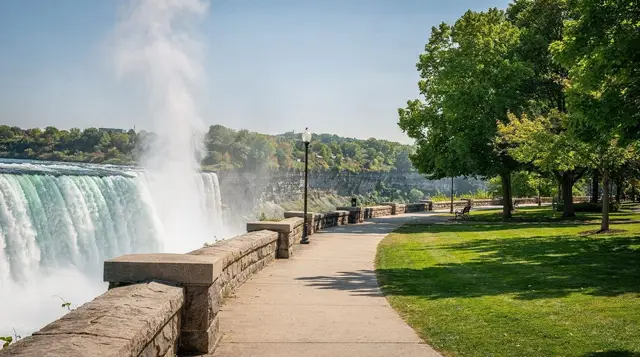
At the southwest tip of Goat Island, a stone-walled viewpoint called Terrapin Point puts you closer to the Horseshoe Falls than anywhere else on the American side. You are looking almost straight down the crest line from the American shore, watching the bulk of the Niagara River’s flow curve over the edge and disappear into the mist.
On the Canadian side, the equivalent close-in view is Table Rock; on this side, it is Terrapin Point, and the two views are different enough — one from the outside curve, one from the American bank — that seeing both, if your trip includes both countries, is worth the border crossing on its own. The full comparison of what each side actually shows you is in the Canada versus USA side guide.
Terrapin Point gets crowded at peak summer hours and around sunset, when the light does something to the mist that photographers chase. It is paved and railed, and it is one of the more accessible viewpoints on this side of the falls — a genuine advantage if Table Rock’s crowds or the Cave of the Winds stairs are not workable for everyone in your group. More on accessibility across the whole area is in the Niagara Falls accessibility guide.
Luna Island: small, separate, and easy to miss
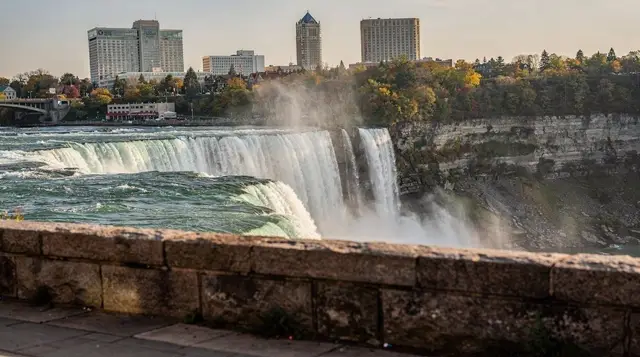
Between the American Falls and the smaller Bridal Veil Falls sits Luna Island, a small island of its own, reached by a short pedestrian bridge from Goat Island. It is not the Three Sisters Islands — those are a different cluster entirely, further upstream — and it is not Terrapin Point, which faces the opposite direction. Luna Island’s whole appeal is proximity: it puts you directly between two of the three falls, close enough that the spray from the American Falls regularly reaches the railings.
On a still day with the wind blowing the wrong way, you will get wet here even without setting foot on a paid attraction. The detailed walk-through of Luna Island alongside Terrapin Point, including which times of day keep the crowds down, is in the Terrapin Point and Luna Island guide.
The Three Sisters Islands, upstream in the rapids
Keep following the loop road or path past Terrapin Point in the other direction, upstream along the island’s southern edge, and a series of short footbridges lead out to the Three Sisters Islands — three small islands strung across the American Rapids above the brink of the falls.
This is the part of the Goat Island loop most day-trippers skip, and it shouldn’t be skipped, because the view here is nothing like the falls themselves. You are standing in the middle of the rapids that feed the Horseshoe and the American Falls, with white water churning on both sides of narrow footbridges, well upstream of where any of it goes over the edge. There is no admission fee and, on most days, a fraction of the crowd at Terrapin Point.
Do not confuse the Three Sisters Islands with Luna Island. They sit on opposite sides of Goat Island and show completely different things: Luna Island puts you between two waterfalls, and the Three Sisters put you in the middle of the rapids that haven’t gone anywhere yet. Both are part of the same free loop, and both are easy to fold into one visit if you walk rather than drive straight through.
The Tesla statue
Near the main parking area on Goat Island stands a bronze statue of Nikola Tesla, seated, with a small plaza around it. It marks Tesla’s alternating-current patents, the same system George Westinghouse used to build the Adams Power Plant on the American side in 1895 — the first large AC hydroelectric station anywhere and the reason the region became an early centre of industrial power.
It is a quick stop, a few minutes at most, but it connects the island’s rapids and falls to the industrial history running underneath the whole area. The fuller story of Tesla, Westinghouse and the region’s power stations is in the Niagara Parks Power Station and Tesla history guide and in the Tesla and Westinghouse blog piece, which covers both sides of the border.
What’s next door but not part of this loop
Cave of the Winds shares the same general area as Goat Island — the access road and parking lots overlap — but it is a separate, paid attraction, not part of the free loop described here. Cave of the Winds takes you down an elevator into the gorge and out onto wooden platforms beside Bridal Veil Falls, close enough to get properly soaked. It has its own hours, its own ticket, and its own seasonal platform teardown and rebuild each year. If that is what you are planning, the walk-through is in the Cave of the Winds and Hurricane Deck guide; this page covers only the free walk or drive around Goat Island itself, above the gorge, not the descent into it.
A guided option exists that combines both in one outing, useful if you would rather not sequence the ticket and the walk yourself:
a private walking tour that pairs the Goat Island loop with a Cave of the Winds ticket, which removes the guesswork of timing the two together on a single visit.
Practical loop notes
Parking on the American side gets tight by mid-morning in summer, particularly at the lots closest to Terrapin Point. Arriving before 10 a.m. or after 4 p.m. makes a real difference. Parking rates vary by lot and season, so treat any figure as a rough guide and check current signage on arrival rather than a fixed number. Details on getting around the American side more broadly are in the things to do on the American side hub.
Time of year changes what the loop looks like more than almost anywhere else on the American side. In summer, expect full lots, humidity, and a steady crowd at Terrapin Point from late morning on. In fall, the maple cover on Goat Island turns the walk into one of the better photography stretches on this side of the falls. In winter, the loop road may have sections closed or reduced, ice builds along the railings at Terrapin Point, and the footbridges to the Three Sisters Islands can be closed outright in bad weather — check current conditions before counting on the full loop being open. What closes and reopens by season across the whole area is covered in the seasonal guide.
Photography works best early morning or close to sunset at Terrapin Point, when the light angle cuts through the mist rather than washing it out. The general timing advice for the falls overall applies here too, in the best times to photograph the falls guide.
With kids, the loop’s flat paths and the Three Sisters’ obvious “look at the rapids” factor tend to hold attention better than a straight photo stop at a railing. Notes on pacing a visit with children are in the Niagara Falls with kids guide.
A guided way to see the island and beyond
If you would rather not manage parking, timing and the loop sequence yourself, a few tour options build the Goat Island stretch into a wider day on the American side. A guided golf cart route through the park covers more ground with less walking, useful for anyone who wants the viewpoints without the full loop on foot:
a guided golf cart tour of Niagara Falls State Park that takes in Goat Island’s main stops alongside the rest of the American side park.
For a longer day that folds Goat Island into a broader American-side itinerary — the state park, downtown Niagara Falls, and the boat and gorge attractions — there is a half-day option built around exactly that scope:
a half-day tour covering the American side of the falls, including the state park and Goat Island, which suits a first visit where you’d rather have someone else sequence the stops.
None of these are required to see Goat Island; the loop is free, well signed, and manageable without a guide. They exist for visitors who are short on time, travelling with mobility constraints the golf cart route accommodates better than the full walk, or who simply prefer not to plan logistics on a first visit. For a wider sense of how Goat Island fits into a full day or multi-day American-side plan, see the one-day Niagara Falls itinerary and the things to do on the American side hub.
Goat Island and the American side loop: FAQ
Is Goat Island actually an island you have to reach by boat?
No. Goat Island sits inside Niagara Falls State Park and is connected to the mainland by a road bridge crossing the upper rapids. You can drive onto it, cycle onto it, or walk across on foot; no boat is involved.
What is the difference between Goat Island, Luna Island and the Three Sisters Islands?
They are three separate pieces of the same island chain. Goat Island is the large main island. Luna Island is a small island off its northwest corner, between the American and Bridal Veil Falls. The Three Sisters Islands are a separate cluster further upstream, reached by footbridges over the rapids well above the brink.
Do you need a ticket to walk the Goat Island loop?
No. Entry to Niagara Falls State Park and the paths around Goat Island, including Terrapin Point and the Three Sisters Islands, are free. You only pay for attractions that leave from the same area, such as Cave of the Winds and the Maid of the Mist.
Can you see the Horseshoe Falls from Goat Island?
Yes, and this is the main reason to come. Terrapin Point, at the southwest tip of Goat Island, is the closest view of the Horseshoe Falls from the American side, looking almost straight down onto the crest where roughly 90 percent of the river’s flow goes over.
Is the Goat Island loop worth doing if you are also going to Cave of the Winds?
Yes, and doing both makes sense since they share the same parking and access road. Cave of the Winds is a separate paid attraction that descends into the gorge; the Goat Island loop is the free walk or drive around the island above it, with different viewpoints.
How long does the Goat Island loop take?
Walking the full perimeter path with stops at Terrapin Point, Luna Island and the Three Sisters Islands takes roughly 60 to 90 minutes at an unhurried pace. Driving the loop and stopping at the main lots takes 20 to 30 minutes without the walking.
Is Goat Island wheelchair and stroller accessible?
Most of the paved loop road and the main viewpoints, including Terrapin Point, are accessible. The footbridges to the Three Sisters Islands are narrower and unpaved in sections, and can be uneven underfoot.
Where is the Tesla statue on Goat Island?
A bronze statue of Nikola Tesla stands in a small plaza on Goat Island, a short walk from the main parking area, marking his role in the alternating-current systems that powered the region’s early hydroelectric stations.
Viewpoints, towers and observation decks on GetYourGuide
Verified deep-linked GetYourGuide tours. Book through these links and we earn a small commission at no cost to you.
GetYourGuide does not provide a product photo for this activity — the image shows the meeting point, photographed by us.