Youngstown, New York: a village that overlooks a much older story
Youngstown sits at the exact point where the Niagara River finishes its 58-kilometre run from Lake Erie and empties into Lake Ontario. It’s a small, quiet village — a marina, a handful of restaurants, a main street you can walk in ten minutes — and on its own it isn’t a reason to drive up from Niagara Falls, New York. The reason to come is what sits at the tip of the point: Old Fort Niagara, a fortification that has been fought over by three nations and that still holds the oldest building for a long way in any direction.
This is a destination that gets underestimated on distance. It sits about 20 km (12 miles) north of the falls, roughly 30 minutes by car — noticeably farther than Lewiston, which sits about halfway between the falls and the fort. Visitors who plan a quick add-on to a Lewiston stop are usually surprised by how much longer the drive actually takes. Give the fort its own half-day, not a tacked-on hour.
The French Castle: one of the oldest buildings in the Great Lakes region
The centrepiece of Old Fort Niagara is the French Castle, a stone building completed in 1726 and usually described as the oldest standing building in the Great Lakes region. Its official name at the time was the “Maison à Machicoulis,” or House of Peace, and the name was deliberate: French officials told the Seneca, on whose land it stood, that they were building a trading house, not a fort. The machicolations — the projecting stone galleries over the entrance, designed for dropping objects on anyone trying to force the door — say otherwise. The building did double duty from the start: fur-trading post on the ground floor, barracks and chapel above, and a fortified strongpoint controlling the mouth of the Niagara River the whole time.
Inside, the rooms are furnished to different points in the fort’s long life — the trading room, the officers’ quarters, the chapel where Catholic mass was said for the French garrison. The building’s stone walls and steep roof were built to survive winters off Lake Ontario, and they have: nearly three centuries on, the French Castle is still the anchor that the rest of the fort is arranged around.
Three flags over one point of land
Control of this stretch of the Niagara River mattered because whoever held it controlled the portage around the falls and the trade route between Lake Ontario and the upper Great Lakes. That’s why the fort changed hands three times.
France built it in 1726 and held it until 1759, when a British and colonial force took it after a nineteen-day siege during the French and Indian War (the North American theatre of the Seven Years’ War). Britain then held the fort through the American Revolution, using it as a base for raids into New York’s frontier settlements even after the war officially ended in 1783 — British troops didn’t actually hand the fort to the United States until 1796, under the terms of the Jay Treaty, more than a decade after the peace.
American control lasted until December 1813, deep into the War of 1812, when British forces crossed the river and captured the fort in retaliation after American troops had burned the town of Newark — today’s Niagara-on-the-Lake — and abandoned Fort George on the Canadian side.
The British held Old Fort Niagara for the rest of the war and used it to stage further raids along the American shore before returning it to the United States under the Treaty of Ghent in 1815. After that, the fort settled into a long career as a US Army post, garrisoned on and off through the nineteenth and twentieth centuries, including training use in both world wars, before closing as an active post in 1963 and reopening as a historic site.
Old Fort Niagara and Fort George: two forts, two stories
It’s easy to blur Old Fort Niagara together with the Canadian sites across the river, so it’s worth being precise. Fort George and the Brock monument at Queenston Heights sit on the Canadian side and tell the story of the same war from the other bank — Fort George was the American target in 1813, and Queenston Heights was the battlefield where Major-General Isaac Brock was killed in October 1812.
Old Fort Niagara is a different site with a longer history: it predates the War of 1812 by nearly a century, and its most dramatic 1812-era moment is the one where it was captured, not defended. A side-by-side guide and a closer look at Queenston Heights and the war cover those Canadian sites in full; this page stays on the American shore.
One more mix-up to avoid: Old Fort Niagara is not Fort Erie. Fort Erie is a separate British-built fortification far upriver near Buffalo, on the Canadian side at the point where the Niagara River leaves Lake Erie. The two forts guard opposite ends of the river and have unrelated histories — don’t let the shared “Fort Niagara”-adjacent naming and general War of 1812 setting merge them in your head.
What’s actually inside today
Beyond the French Castle, the fort grounds include the reconstructed South Redoubt and North Redoubt blockhouses, an active hot shot furnace, powder magazines, and the “Gate of the Five Nations,” a nod to the Haudenosaunee (Iroquois) diplomacy that shaped whether and how the fort could be built in the first place.
Costumed interpreters run musket and cannon demonstrations regularly through the season, and living-history weekends — typically several times between June and August — bring out larger encampments representing the French, British, and American garrisons in turn. A fishing pier below the fort and the 1872 lighthouse at the point are worth the extra few minutes; on a clear day the view across Lake Ontario stretches far enough to pick out the Toronto skyline on the horizon.
Fair warning on scale: this is a compact historic site, not a sprawling theme park. Most visitors are through in two to three hours, including the French Castle tour and a walk around the ramparts. That’s the right amount of time to budget — arriving expecting a full-day attraction will leave you disappointed, and arriving expecting a quick fifteen-minute photo stop will leave you rushed.
Getting there and getting your bearings
| From | Distance | Drive time |
|---|---|---|
| Niagara Falls, New York (Niagara Falls State Park) | ~20 km (12 miles) | ~30 minutes |
| Lewiston | ~10 km (6 miles) | ~15 minutes |
| Buffalo (BUF) | ~50 km (31 miles) | ~50 minutes |
| Niagara Falls, Ontario (via the Lewiston-Queenston Bridge) | ~25 km (16 miles) | ~35–45 minutes with the border crossing |
A car is effectively required — there’s no meaningful transit link, and the drive itself is part of the appeal, running along the river past Lewiston on the Robert Moses Parkway or the riverside NY-18F. Parking is on-site; expect a modest per-vehicle fee at the state park gate in addition to fort admission, which are billed separately. Coming from the Canadian side, the most direct route uses the Lewiston-Queenston Bridge rather than doubling back to the Rainbow Bridge in town — but budget real time for the crossing itself, and confirm a rental contract permits driving across the border before you commit to this as a loop.
Youngstown itself: modest, and that’s fine
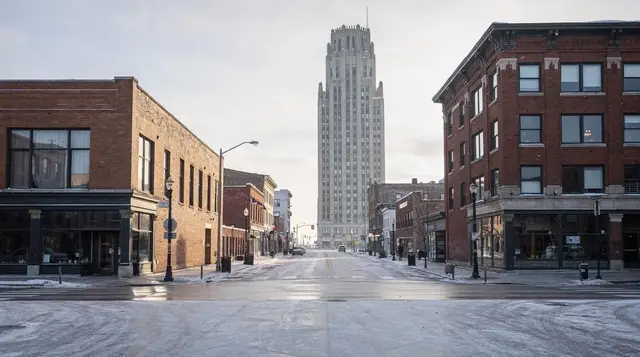
Youngstown is a genuinely small place — a village of a few thousand people built around a marina and a short main street. It once handled real freight traffic as a deep-water port on Lake Ontario; today the working waterfront is mostly gone, replaced by pleasure boats and a few blocks of restaurants and shops. There’s no headline attraction here beyond the fort itself, and that’s worth saying plainly rather than padding out the village into something it isn’t. Most visitors park, walk into the fort grounds, and leave a couple of hours later having barely seen the rest of the village — which is a reasonable way to do it.
If you do want a slower morning or afternoon around the water, the marina is pleasant for a short walk, and the village supports the fort with a small tourism trade rather than competing with it. Anglers sometimes base a Lake Ontario outing from this stretch of river rather than from Lewiston itself; a guided fishing charter working the Niagara River and lake mouth near Youngstown is one way to spend a morning here beyond the fort walls if the history alone isn’t enough to fill your day.
Not on this page: Lewiston, Fort Erie, and the wine route
To be clear about scope: Lewiston, a few minutes south, has its own village, its own history as a portage town, and its own dining and events — it’s covered separately, including a walking food tour through Lewiston’s historic main street if that village is your next stop after the fort.
The Niagara wine region and its wineries sit well to the west, on the Canadian side of the border, and don’t factor into a Youngstown or Old Fort Niagara visit at all. And as noted above, Fort Erie — a different fort, near Buffalo, on the Canadian side — is a separate site with a separate history; don’t plan a trip around Old Fort Niagara expecting to see it in the same afternoon.
Pairing it with the rest of western New York
Old Fort Niagara works best as one stop on a loop rather than a there-and-back trip on its own. Coming from the falls, a common pattern is fort in the morning, Lewiston for lunch, and Buffalo in the afternoon or evening — the drive from the fort down to Buffalo takes about 50 minutes, and a day trip to Buffalo or a Buffalo-to-falls guide can help fill out the rest of that day.
In Buffalo itself, a walking and cycling food tour through Buffalo’s neighbourhoods or an evening underground history tour of Buffalo rounds out a day that started at a fort built almost three centuries earlier. Travellers routing through Toronto before or after can also look at a Toronto-to-Buffalo stopover itinerary that threads the whole western New York shoreline together.
Practical details: hours, admission, and planning
| Season | Typical hours | Notes |
|---|---|---|
| Summer (June–August) | Daily, generally 9 am–5 pm or later | Living-history weekends, cannon and musket demonstrations |
| Spring and fall (April–May, September–October) | Daily, shorter hours than summer | Fewer demonstrations; quieter, cooler visit |
| Winter (November–March) | Reduced days and hours | Check ahead — some buildings may be closed or on limited access |
Admission runs in the range of USD 15–25 per adult, with lower rates for children, seniors, and military; a state-park vehicle-use fee is charged separately at the gate. Prices and hours shift year to year, so treat these as planning ranges rather than fixed numbers and confirm before you drive up, especially outside the summer season when hours contract. If you’re weighing whether to add this to a Niagara Falls itinerary at all, the honest answer depends on how much War of 1812 and colonial history interests you — it’s a genuine half-day commitment on top of the falls themselves, not a five-minute detour.
Old Fort Niagara FAQ
How far is Old Fort Niagara from Niagara Falls?
About 20 km (12 miles) north of Niagara Falls, New York, roughly a 30-minute drive. It’s farther than Lewiston, which sits roughly halfway between the falls and the fort — a common planning mistake is assuming the two stops are about the same distance.
How is Old Fort Niagara different from Fort George?
Old Fort Niagara sits on the American side at the mouth of the Niagara River and dates to 1726, nearly a century before the War of 1812. Fort George sits on the Canadian side near Niagara-on-the-Lake and was the American army’s target in the 1813 campaign that eventually led to Old Fort Niagara’s own capture by British forces that December. They’re related by the same war but are separate sites with separate stories.
Is Old Fort Niagara the same as Fort Erie?
No. Fort Erie is a different, British-built fort on the Canadian side of the river near Buffalo, where the Niagara River begins at Lake Erie. Old Fort Niagara sits at the opposite end of the river, where it meets Lake Ontario, and the two have no shared history beyond both dating from colonial-era conflicts in the region.
How long should I budget for a visit?
Two to three hours covers the French Castle, the ramparts, and the grounds at a comfortable pace. Living-history weekends in summer can easily stretch that longer if demonstrations are running.
What is the French Castle?
A stone building completed in 1726 by French colonial forces, built and initially presented as a trading post to satisfy Seneca objections to a fortification on their land, while functioning as a fortified strongpoint from the start. It’s usually cited as the oldest standing building in the Great Lakes region.
Is there much to see in Youngstown itself?
Not really — Youngstown is a small village with a marina and a short main street of shops and restaurants. It supports a visit to the fort rather than being a destination on its own; most people budget little to no separate time for the village.
Do I need a car to visit?
Effectively yes. There’s no practical transit connection, and the drive along the river past Lewiston is part of getting there. Confirm any rental car’s cross-border terms in advance if you’re coming from the Canadian side.
When are the busiest and best times to visit?
Summer weekends bring the most programming — cannon and musket demonstrations and living-history encampments — along with the biggest crowds. Spring and early fall offer a quieter, cooler visit with fewer special events but full access to the fort buildings and grounds.