Fort George and Old Fort Niagara: two forts, one river mouth
Are Fort George and Old Fort Niagara the same era, and can I visit both in one day?
No to both. Old Fort Niagara's French Castle dates to 1726, nearly a century before Fort George was built by the British in the 1790s and burned during the War of 1812. The two sites sit on opposite banks of the river mouth on Lake Ontario, so visiting both means a full international border crossing, not a quick hop — plan a single dedicated day if you want to see them together.
Two forts, opposite banks, different centuries
Stand at the mouth of the Niagara River, where it empties into Lake Ontario, and you can see both forts from roughly the same spot on a clear day. Fort George sits on the Canadian side near Niagara-on-the-Lake; Old Fort Niagara sits on the American side at Youngstown, New York. They look like a matched pair on a map, and plenty of day-trip itineraries treat them that way. They aren’t a matched pair. One predates the other by nearly a century, they were built for different reasons by different powers, and getting from one to the other means a passport-controlled international crossing, not a stroll across a parking lot.
This page exists to untangle the two: what each fort actually is, what’s genuinely worth seeing at each, and an honest answer to the question visitors keep asking — can I do both in one visit? The short version is yes, but only if you plan around the border crossing rather than trying to squeeze it into the gaps of a bigger day. For the battle history that made Fort George famous, see the separate guide to Queenston Heights and the War of 1812 — this page stays focused on the forts themselves.
Old Fort Niagara: the older fort by a century
Old Fort Niagara’s centrepiece is the French Castle, a stone structure completed in 1726 by the French, who controlled the fur trade routes along the river and needed a fortified post at this strategic river mouth. Disguising a military fort as a trading house — the “castle” has the bones of both — was a deliberate move to keep Indigenous nations in the region from objecting to an obvious military build-up on their land.
The fort changed hands more than once over the following two centuries. The British took it from the French in 1759, during the French and Indian War. It stayed British through the American Revolution, technically on the wrong side of the new border after 1783 but not formally handed to the United States until 1796. During the War of 1812, the British captured it back in December 1813, in the same string of frontier fighting that also touched Fort George. The Americans reclaimed it under the terms that ended the war, and the U.S. Army continued to use the site into the 20th century.
That timeline is the whole point of visiting Old Fort Niagara with clear expectations: this is not a War of 1812 site with a French detour, it’s a site whose full arc runs French, then British, then American, then British again, then American, over roughly two hundred years — with the War of 1812 occupying a comparatively small slice near the middle. The stone French Castle you walk through is largely original 1720s construction, which is rare for the region and worth knowing before you arrive, since it changes what you’re actually looking at.
Old Fort Niagara sits within its own state park at Youngstown, on the American side, about a 30-minute drive from the falls via Lewiston. Costumed interpretation, artillery demonstrations, and a small museum collection round out a visit that typically runs two to three hours for anyone reading the exhibits rather than walking straight through.
Fort George: British, purpose-built, and burned
Fort George is a different kind of site entirely. The British built it between 1796 and 1802, specifically because the terms that finally handed Fort Niagara over to the newly independent United States left the British without a fortified post on this stretch of the river. Fort George was the direct answer: a purpose-built garrison across the water from a fort the British no longer controlled, sited to watch the river mouth and protect the settlement that would become Niagara-on-the-Lake.
Its most consequential moment came during the War of 1812. American forces captured Fort George in May 1813 after a fight that also destroyed much of the town of Niagara (as Niagara-on-the-Lake was then called). The British retook the fort by the end of that year, but by then it had been so thoroughly damaged that almost none of the original wooden structures survived. What stands on the site today is a careful reconstruction on the original earthworks and footprint, built in the 20th century once the site became a national historic site, rather than a preserved original like the French Castle across the river.
That distinction matters for setting expectations. Fort George’s value is less about walking through 18th-century timber and more about the layout, the earthworks, the powder magazine (one of the few structures that is original), and the interpretation of what frontier garrison life and the 1813 fighting actually looked like. Costumed interpreters, cannon firings, and battle reenactments run on a seasonal schedule, generally more frequent in summer.
Fort George is a short drive from central Niagara-on-the-Lake, close enough to combine with a walk down Queen Street or an afternoon at the Shaw Festival — though this page treats Niagara-on-the-Lake itself as its own destination rather than covering it here. Budget roughly 25 minutes from the falls by the Niagara Parkway.
Not twins: a side-by-side comparison
| Fort George | Old Fort Niagara | |
|---|---|---|
| Side of the river | Canadian | American |
| Nearest town | Niagara-on-the-Lake | Youngstown, New York |
| Built | 1796–1802, by the British | 1726 (French Castle), by the French |
| Original structures standing | Mostly reconstructed after 1813 | French Castle is substantially original |
| Defining era | War of 1812 | French colonial period through the 1800s |
| Managed by | Parks Canada | New York State Parks |
| Typical visit length | 1.5–2.5 hours | 2–3 hours |
| Distance from the falls | About 25 minutes | About 30 minutes |
The mistake worth avoiding is treating these as two halves of the same story built at the same time. They aren’t. Old Fort Niagara’s stone castle was already standing for nearly seventy years before Fort George’s first log palisade went up, and by the time both forts were drawn into the War of 1812, one was a brand-new British garrison and the other was already on its third flag.
Can you actually visit both in one trip?
Geographically, yes — the two sites are roughly 20 to 25 minutes apart by road once you account for the crossing itself. Logistically, it depends entirely on the border.
The direct route runs through the Queenston-Lewiston Bridge, north of the busier crossings closer to the falls. On a quiet weekday morning, that crossing can take as little as 10 to 15 minutes. On a summer weekend afternoon, it can run well past an hour, and there’s no way to know in advance which you’ll get. A passport is required in both directions regardless of nationality; a NEXUS card helps at eligible lanes but isn’t a substitute for planning around wait times you can’t control.
For more detail on documents and lane choice, see the dedicated guide to crossing the border at Niagara, and if you’re driving a rental car, confirm your contract actually permits taking it across the border before you plan around it.
The realistic way to see both forts is to give the day to it rather than bolting the crossing onto another itinerary. A workable order: start at Fort George in the morning while Niagara-on-the-Lake is still quiet, cross via Queenston-Lewiston into New York around midday, and spend the afternoon at Old Fort Niagara before heading back.
Trying to also fit in wine tasting, Queenston Heights, or a stop in Lewiston on the same day usually means shortchanging one of the forts or the crossing itself. If a full binational day isn’t appealing, picking one fort and pairing it with what’s actually nearby — Niagara-on-the-Lake and the wine route for Fort George, or Lewiston and the Underground Railroad Heritage Center for Old Fort Niagara — makes for a less rushed day either way.
Visiting Fort George
Fort George opens seasonally with reduced hours in the shoulder months and typically closes for the coldest weeks of winter; check current hours before visiting, since Parks Canada schedules shift year to year. Admission is a fixed adult rate with family and group rates available, and combination tickets with other Niagara Parks or national historic sites sometimes apply — again, worth confirming for the year you’re travelling.
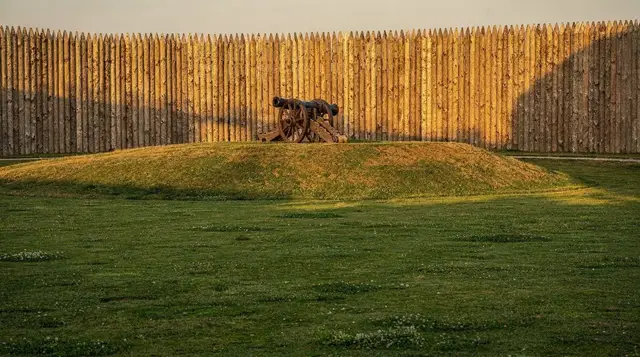
Inside the reconstructed palisade, the main points of interest are the officers’ quarters, the barracks, the powder magazine (the one structure that survived 1813 largely intact, and it shows), and the earthworks themselves, which give a genuine sense of how the fort was sited to command the river approach. Guided tours run on a schedule through the day; costumed interpretation and artillery demonstrations are more frequent in July and August and around commemorative War of 1812 dates.
Combine a visit with a short walk into central Niagara-on-the-Lake — Queen Street and the historic core are close enough to walk — or with a guided look at the town itself.
a guided walking tour through historic Niagara-on-the-Lake pairs naturally with a Fort George morning, covering the town’s colonial-era streets and buildings on foot with someone who can put the fort’s history in context.
Visiting Old Fort Niagara
Old Fort Niagara sits inside Fort Niagara State Park at Youngstown and is generally open year-round, with reduced winter hours; the fort itself is the main draw within the broader state park, which also has river and lake shoreline. Admission is separate from state park parking fees in some seasons, so check the current fee structure before arriving.
The French Castle is the highlight — walk through rooms that have served as living quarters, a chapel, and storage across three centuries of use, with exhibits explaining the fort’s shifting flags along the way. Beyond the castle, the grounds include additional fortifications, a small military museum, and seasonal cannon-firing demonstrations. Costumed interpreters cover French, British, and American periods depending on the day and season, so the specific era on display when you visit is partly a matter of timing.
Youngstown itself is a small, quiet village with a handful of places to eat near the river — a reasonable stop before or after the fort, though it’s not a destination in its own right the way Niagara-on-the-Lake is on the Canadian side.
What this page doesn’t cover
Two things are deliberately left out here. First, the detailed narrative of the fighting during the War of 1812 — troop movements, the death of Isaac Brock, the course of the battle itself — belongs to the dedicated guide on Queenston Heights and the War of 1812, a separate site a short drive south of Fort George along the escarpment. Second, Niagara-on-the-Lake as a destination — its wineries, Queen Street shops, and the Shaw Festival — gets its own coverage elsewhere; this page treats the town only as the immediate neighbour of Fort George, not as the subject.
Getting there from the falls
Both forts are reachable as a half-day add-on to a Niagara Falls stay, or as the anchor of a full day if you’re doing both. Fort George is about 25 minutes from the falls via the Niagara Parkway, staying entirely on the Canadian side. Old Fort Niagara is about 30 minutes via Lewiston, requiring the border crossing described above if you’re coming from the Canadian side of the falls rather than flying into Buffalo.
Travellers building a longer stay around Niagara-on-the-Lake and the wine region often fold Fort George into a day that also includes tastings — worth knowing if a fort-only day feels like too narrow a focus.
a Niagara-on-the-Lake wine and whiskey tour covers several wine country stops with a driver, which solves the drinking-and-driving problem the wine route otherwise creates, and can be arranged around a Fort George visit earlier in the day.
Visitors basing themselves in Toronto rather than at the falls have their own logistics to consider, since Fort George and Old Fort Niagara both sit closer to the falls than to the city.
a private custom tour from Toronto can be built around a Fort George stop for travellers who’d rather not drive themselves, though a same-day add-on of Old Fort Niagara from a Toronto base isn’t realistic once the drive and border crossing are both factored in.
The honest summary
Fort George and Old Fort Niagara sit close enough on a map to look interchangeable, and marketing copy sometimes treats them that way. They aren’t interchangeable. Old Fort Niagara is the older, largely original site with a French colonial core; Fort George is a purpose-built British reconstruction whose story is almost entirely about the War of 1812. Visiting both is worthwhile for anyone with a genuine interest in the region’s military history, but it takes a dedicated day built around an international border crossing, not a quick double-header. Picking one and pairing it with what’s actually next door — wine country for Fort George, Lewiston and the river for Old Fort Niagara — is the less rushed way to spend the day for most visitors.
History and heritage tours on GetYourGuide
Verified deep-linked GetYourGuide tours. Book through these links and we earn a small commission at no cost to you.
GetYourGuide does not provide a product photo for this activity — the image shows the meeting point, photographed by us.