The flow is a treaty, not nature
Doing the arithmetic at the railing
I was standing at Table Rock on a July afternoon, close enough to the crest of the Horseshoe Falls that the spray was landing on my notebook, when a guide nearby told her group a number: somewhere north of 168,000 cubic metres a minute goes over that edge at peak flow. I wrote it down, then went looking for where the number came from. That’s how I ended up reading the 1950 Niagara Treaty instead of just admiring the view.
The treaty is not a poetic document. It is a piece of infrastructure law between Canada and the United States, and it does something I hadn’t expected: it sets a floor, not a description, for how much water is allowed to fall in front of you. By day, in the touristy months from April through mid-October, at least 2,832 cubic metres per second has to pass over the crest. At night, and for the rest of the year, that guaranteed minimum drops to 1,416 cubic metres per second — half as much. Everything above those numbers is what’s left over after the hydroelectric stations on both riverbanks have taken their share.
Read that again and it reframes the whole site. What I’d been calling “the falls” was, more precisely, a scenic allotment. The river carries far more water than the treaty requires it to show me.
The engineering behind the postcard
None of this is hidden, exactly. It’s just not the story either country tells at the ticket counter. The Niagara Parks Power Station — the decommissioned Rankine station on the Canadian side, now open as a museum with a tunnel bored 55 metres down to the river — makes the diversion tangible in a way the treaty text doesn’t. You can stand where the water used to be forced into turbines instead of over the crest, and read the story of Tesla’s alternating current and Westinghouse’s system that made the diversion commercially worthwhile in the first place — a history I’ve written about separately, because it deserves its own telling rather than a paragraph here.
What struck me more, on the treaty itself, was the diplomacy of it. Two countries with a shared, valuable river had to agree not just on how much power each side could generate, but on how much spectacle they owed the public in exchange for taking the rest. That’s an unusual thing for a treaty to legislate — not safety, not trade, but the minimum acceptable appearance of a natural wonder. I found that more fascinating than deflating. Someone, in 1950, sat at a table and decided how much water was owed to the view.
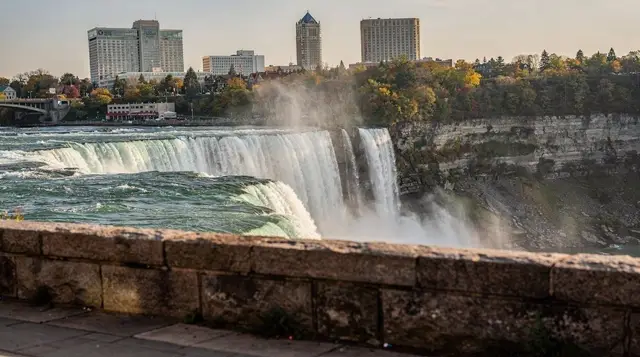
It also means the falls have a kind of daily rhythm that has nothing to do with weather. Fuller by day, thinner at night. Fuller in summer, thinner in winter. If you stood at Prospect Point at 3 a.m. on a Tuesday in November and again at 3 p.m. on a Saturday in July, you would be looking at two genuinely different volumes of water, governed by an international agreement rather than the Niagara River itself.
Why I don’t think this is a scandal
I want to be careful here, because it would be easy to write this as a “they’ve been lying to you” post, and that’s not what I found, or what I believe. Nobody at Niagara Parks is hiding the treaty. The diversion tunnels are marked on maps. The power stations are visible from the Niagara Parkway if you know what you’re looking at. This isn’t a secret; it’s a fact that most visitors simply never ask about, because the water is loud and immense and doesn’t invite scrutiny.
And even at the reduced night-time minimum — the smallest amount the treaty ever permits — you are still looking at something on the order of a million and a half litres a second going over a cliff. That’s not a diminished spectacle. It’s a still-enormous one, with an asterisk. I’d rather know the asterisk than not.
What the treaty did for me, in practice, was turn a passive “wow” into an active curiosity. I started noticing things I’d have skipped past otherwise: that the flow at American Falls looks different depending on where the Army Corps has scheduled maintenance upstream; that the gorge downstream of the falls carries the reunited water, diverted and undiverted alike, back toward Lake Ontario; that “natural wonder” is doing a lot of quiet work in most marketing copy, papering over just how administered the wonder actually is.
What this changes about how you should visit
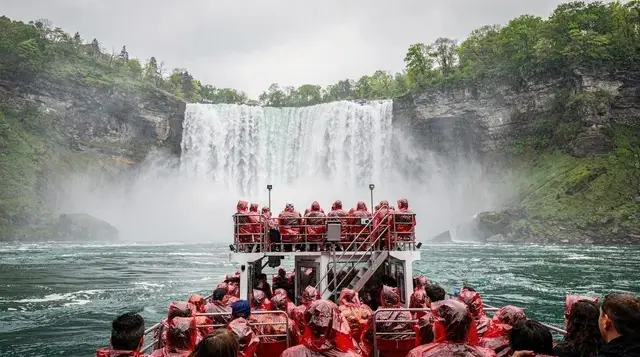
Practically, it changes very little about planning a trip — I’m not telling you to time your visit around turbine schedules. But it’s worth knowing before you book a boat. Whether you’re heading out on the Hornblower boat that runs right up to the base of the Horseshoe or combining a tower visit with a cruise on the Skylon Tower trail and boat tour, you’re looking at a treaty-managed river either way, and it’s still worth doing. The volume in front of you, even at its legal minimum, dwarfs almost anything else moving water you’ll see in your life.
If you want to see the falls at something close to their most generous, come in the warmer months during daylight hours, when the higher treaty minimum applies — not that anyone stages this for tourists, but the coincidence of the treaty’s own daytime, tourist-season minimum lining up with when people actually visit is not entirely an accident either.
If you’re curious about the opposite extreme, the falls have never frozen solid in recorded history, treaty or no treaty, though the reduced night flow does help ice bridges form some winters at the base — one more place where the managed flow and the visible spectacle quietly intersect. Check what’s open by season before you plan around any of it, since boats and walkways close independently of how much water is running.
I still think the falls are worth the trip, worth the crowds, worth the ponchos. I just don’t think of them as untouched anymore, and I don’t think that’s a loss. A negotiated, administered, still-astonishing amount of water is a more interesting thing to stand in front of than a myth. If you want the fuller comparison of where to stand for which version of the view, I’ve laid out my honest take on which side is better elsewhere — but wherever you end up, know that the number on the gauge that day was set by two governments, not by the river alone.
For a first pass at the whole site, including how the gorge below the falls carries all that water — diverted and undiverted — back toward the lake, and how the evening illumination plays across whatever flow the treaty has scheduled for that hour, my explainer is the place to start. Bring the number with you next time you’re at the railing. It doesn’t ruin the view. It just means you’re looking at something built as much as it is grown.
Wildlife and nature attractions on GetYourGuide
Verified deep-linked GetYourGuide tours. Book through these links and we earn a small commission at no cost to you.
GetYourGuide does not provide a product photo for this activity — the image shows the meeting point, photographed by us.