Niagara Falls illumination: the nightly light show explained
What is the Niagara Falls illumination and when does it happen?
It's a nightly LED light display, running every night of the year, projected onto the Horseshoe Falls and the American Falls after dark. The start time follows sunset, so it shifts through the seasons, and the colour programme can change without notice.
How the Niagara Falls light show actually works
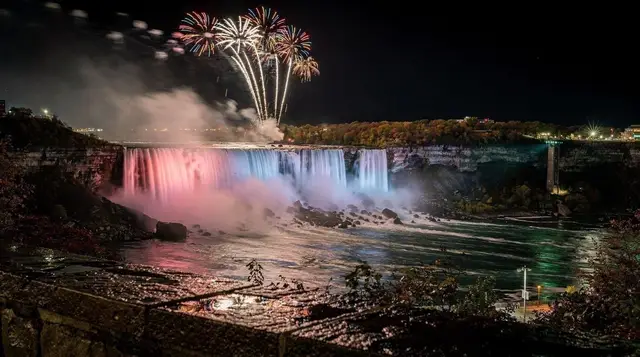
Every night of the year, once the sky is properly dark, banks of coloured LED floodlights mounted on the Canadian side sweep across the Horseshoe Falls and the American Falls. The lights don’t sit on the water — they’re aimed at it from fixed towers along the rim of the gorge, which is why the display looks different depending on where you’re standing and how much spray is in the air that night.
This is the one after-dark spectacle at Niagara Falls Ontario that runs 365 nights a year, rain, snow, or heat wave, which sets it apart from the fireworks and from the Winter Festival of Lights, both of which are seasonal add-ons covered on their own pages, not this one.
The current system dates to 2016, when the older sodium and xenon floodlights — some in place since the 1920s — were replaced with LED fixtures. The switch cut electricity use dramatically and let the operators programme far more colour combinations than the old coloured gels ever allowed. It also made the whole thing cheaper to run nightly instead of on a reduced schedule, which is part of why the illumination is now a year-round fixture rather than a summer-only extra.
Because it’s programmed lighting and not a natural event, nobody involved — not Niagara Parks, not the operators on the American side, not any tour selling a “night cruise” — can promise you a specific colour at a specific minute. Programmes get adjusted for holidays, sponsorships, and testing, and cloud cover or heavy mist changes how any colour actually reads from the ground. Any listing that guarantees “the falls will glow purple at 9:15” is guessing, and you should treat it that way.
Where to watch it for free
You don’t need a ticket, a boat, or a tower reservation to see the illumination. Two viewpoints do almost all the work.
On the Canadian side, Table Rock sits right at the crest of the Horseshoe Falls, and it’s the closest you can get on foot without paying for anything. Queen Victoria Park, the green space running along the top of the gorge behind Table Rock, gives you the same view with more room to stand and less crowding directly at the rail. Both put the Horseshoe Falls almost directly in front of you, lit from the towers just upstream, and both are open and unticketed after dark every night. For a longer rundown of exactly where to stand and what’s within walking distance, see the guide to free viewpoints on the Canadian side.
On the American side, the Niagara Falls Observation Tower at Prospect Point puts you over the gorge with a clear line on the American Falls, and the general overlooks around Goat Island — particularly the Terrapin Point end — give you a Horseshoe Falls view from the American side of the river instead. None of this costs anything beyond getting into Niagara Falls State Park, which is itself free. The companion guide to free viewpoints on the American side breaks these down by distance and crowd level.
If you only have one night and want a single answer to “Canadian side or American side,” the short version is that the Canadian viewpoints face the Horseshoe Falls head-on and feel more like watching a stage, while the American viewpoints put you closer to moving water and spray but at more of an angle. Neither is objectively better for the illumination specifically — see Canada vs. USA side at Niagara Falls if you’re deciding where to base yourself for the whole trip rather than just this one evening.
When it actually starts
The illumination begins after sunset, not at a fixed clock time, so the honest answer to “what time does it start” changes through the year. In the depths of a Canadian winter, that can mean lights on by 5 or 5:30 p.m.; at the height of summer, closer to 9:30 or 10 p.m. Niagara Parks and the New York State Parks system both post an estimated nightly start time that updates through the season, and that same-day estimate is worth checking before you plan an evening around it — a schedule printed months in advance, or repeated on a travel blog without a date, is not reliable.
A practical rule that holds up better than any specific hour: arrive at your chosen viewpoint 20 to 30 minutes before the posted sunset time. The transition from daylight blue to full illumination isn’t instant — the lights build gradually as the sky darkens — so getting there a little early means you see the whole change rather than walking in partway through. For a season-by-season sense of what else is running or closed around that same evening, the guide to what’s open and closed by season is worth a look before you build an itinerary around a night visit.
What you’ll actually see — and what not to expect
The lights cycle through a rotating set of colours across the evening, sometimes holding on one colour for a stretch, sometimes shifting more quickly. On any given night that might mean the Horseshoe Falls running blue while the American Falls sits in white, or both falls washed in the same amber or green for a period. This is programmed and it changes; nobody can tell you in advance which colour you’ll get when you show up, and that’s fine — the shifting is part of what makes it worth watching for more than a couple of minutes.
What the illumination will not give you is a rainbow. During the day, a genuine rainbow can form in the mist off the Horseshoe Falls when sunlight hits the spray at the right angle — that’s a real optical phenomenon tied to the sun. At night, there’s no sunlight, so anything that looks rainbow-like in the photos is the coloured light itself, not a rainbow. Don’t plan a proposal or a photo around “catching the rainbow at night” — it isn’t a thing the illumination does, however the marketing photos are cropped.
It’s also worth knowing what this display isn’t. The fireworks shows run on a separate, more limited schedule — summer nights and selected dates rather than every night — and they’re a distinct pyrotechnic event set off from a barge or the shoreline; see fireworks over Niagara Falls for when those actually happen.
The Winter Festival of Lights is different again: a ground-level trail of lit displays strung along the Niagara Parkway and through Dufferin Islands, running only from November into January, with its own free driving or walking route — covered separately at Winter Festival of Lights. None of the three substitute for each other, and a tour or article that blends them together is being imprecise about what you’re actually going to see.
Watching it from the water or from height
Standing at Table Rock or Prospect Point costs nothing and gives you a full, unobstructed view, but a boat or an elevated dinner spot puts you at a different angle and, on the American side, close enough to feel the spray while the lights are running. If you’d rather have that on the water than from the railing, an evening illumination tour on the American side that pairs a Maid of the Mist crossing with the light show covers that combination without you having to time two separate outings.
Several operators bundle a daytime falls visit with the after-dark version so you’re not making two trips: a combined day and night tour of the falls is built for exactly that, seeing the Horseshoe Falls in full daylight and then returning after dark once the lights are on. If dinner with a view matters more to you than a boat deck, a tour that pairs an evening meal with the light show gets you a seated view without competing for railing space at Table Rock.
None of these are necessary to see the illumination — the free viewpoints do that job perfectly well — but they solve a real problem if you’re short on time, don’t want to navigate parking after dark, or want the falls worked into a single planned evening rather than a return trip. If you’re weighing whether a boat trip is worth adding at all versus just walking down to the rail, the Maid of the Mist vs. Niagara City Cruises comparison and the note on boat tour season and winter alternatives cover the trade-offs, since neither boat runs in the coldest months.
Cold weather, mist, and what to bring
The illumination runs through winter, but two things change once temperatures drop. First, ice builds up on railings, stairs, and the rim of the gorge around Table Rock and the American side overlooks, so footing needs more care after dark than it does in summer — bring boots with real grip, not just warm ones. Second, the boats that would otherwise let you see the lights from the water are laid up for the season, so a winter illumination visit is a shore-based one by default; see do the falls freeze and Niagara Falls ice formations for what winter actually looks like at the rail, since “frozen falls” is a myth worth clearing up before you go.
Whatever the season, the mist off the Horseshoe Falls reaches the rail at Table Rock more nights than not, and it’s colder and wetter after dark than it feels from photos. A hooded rain jacket does more for you than an umbrella, which is awkward in the crowd and useless in the wind that comes off the gorge. If you’re bringing a camera, the mist is the main obstacle to a clean shot — see what the mist does to your camera before you head down, and pair it with photographing the falls’ illumination and fireworks for settings that actually work in low light with moving water in frame.
Planning the evening around it
If the illumination is the main reason you’re heading down after dinner, treat it as a 30- to 45-minute stop rather than an entire evening, unless you’re combining it with a meal or a boat tour. Parking on the Canadian side fills up around Table Rock on weekend evenings even outside summer, so budget extra time or use WEGO and the Incline Railway to get down from a Fallsview hotel instead of driving. If you’re staying over specifically to catch a night view without rushing back, the where to stay guide flags which hotel clusters put you within walking distance of Table Rock after dark.
Families with younger kids can manage the illumination easily since it doesn’t involve loud noise the way fireworks do — see Niagara Falls with kids if you’re weighing a night outing against an earlier bedtime. And if you’re stretching a single night at the falls into more than one day, the long weekend at Niagara Falls guide has a sense of where an evening at the rail fits against everything else worth doing in daylight.
The Niagara Falls illumination, questions people actually ask
Does the Niagara Falls illumination happen every night?
Yes. Unlike the fireworks or the Winter Festival of Lights, the illumination runs every night of the year, weather and equipment permitting. It’s the one after-dark show at the falls you can plan around without checking a calendar first.
What time does the illumination start?
It starts around dusk, so the clock time moves with the season — well after 9 p.m. in midsummer and closer to 5 or 6 p.m. in December. Check Niagara Parks or the New York State Parks page for the same-day estimate rather than trusting a fixed hour.
Where’s the best free spot to watch it?
Table Rock and Queen Victoria Park on the Canadian side put you directly across from the Horseshoe Falls with no ticket required. On the American side, Prospect Point Observation Tower and the Niagara Falls State Park overlooks face the American Falls, also free.
Will I see a rainbow at night?
No. What you’ll see is the projected light itself changing colour — it’s a lighting effect, not a natural rainbow, and it never appears the same way twice. Treat any promise of a specific colour at a specific hour as marketing, not a schedule.
Is the illumination the same as the fireworks or the Winter Festival of Lights?
No, all three are separate. The illumination is a year-round nightly wash of coloured light on the water itself. Fireworks are a seasonal add-on set off from a barge or the riverbank. The Winter Festival of Lights is a ground-level lighting display along the Niagara Parkway and Dufferin Islands, running only from November to January.
Do I need a ticket to see the illumination?
No. The illumination lights the falls themselves, and every standard viewpoint along Table Rock, Queen Victoria Park, and the American side overlooks is free and open after dark. You only pay if you choose to watch it from a boat, a tower restaurant, or a paid tour.
Does cold or winter weather cancel the illumination?
The light projection itself keeps running year-round, including in winter, though ice buildup on the gorge walls and railings can make some viewpoints slippery or partly closed. What does close for the season is the Maid of the Mist and Niagara City Cruises, so a boat-based view of the illumination isn’t available every month.
Can I photograph the illumination well without a tripod?
It’s difficult. The falls are lit but the surroundings are dark, and a handheld phone shot at night usually comes out blurred or grainy. A small tripod or a steady railing, plus your camera’s night mode, makes a real difference — see the dedicated guide on shooting the illumination and fireworks for settings.
Illumination and fireworks tours on GetYourGuide
Verified deep-linked GetYourGuide tours. Book through these links and we earn a small commission at no cost to you.
GetYourGuide does not provide a product photo for this activity — the image shows the meeting point, photographed by us.