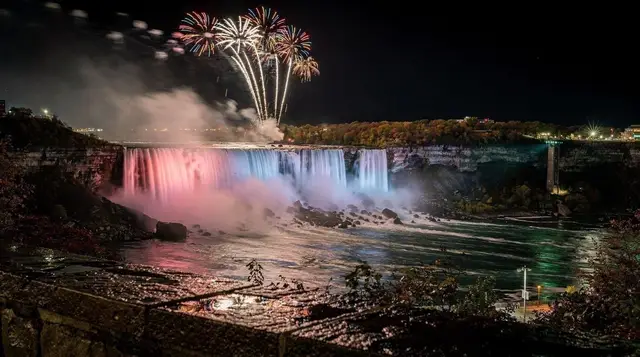
Photographing the illumination and fireworks at Niagara Falls
Where's the best spot to photograph Niagara Falls at night?
For the illumination itself, Table Rock and Queen Victoria Park on the Canadian side face the Horseshoe Falls head-on. For a wide shot with fireworks over the water, the Skylon Tower's outdoor observation deck gives you height and both falls in one frame. A tripod and a few seconds of shutter time matter more than any specific camera.
Once the sun goes down, Niagara Falls becomes a different photographic subject. The water doesn’t change, but the light does, and on certain nights fireworks are added on top of it. Two separate things are happening after dark, and it’s worth keeping them straight before you plan an evening around either one: the illumination is a lighting installation that runs every single night of the year, and fireworks are a scheduled event that does not. Conflating the two is the single most common way visitors end up disappointed at Table Rock on a random Tuesday in November, camera ready, waiting for a show that was never booked for that date.
This guide covers both, with the specific viewpoints that work for each and camera settings simple enough to dial in once and leave alone. It doesn’t cover daytime hours or the mist that soaks every camera at the base of the falls — those are handled in their own guides — this one is strictly about what happens after dark.
Two different shows, one riverbank
The illumination is infrastructure. Since 2016, Niagara Parks has lit the Horseshoe Falls, the American Falls, and the Bridal Veil Falls with an LED system that replaced the older floodlights, and it runs every night, year-round, in a rotating program of colour that shifts slowly over the course of an evening. There is no ticket, no schedule to check, and no season when it doesn’t happen — rain, snow, or a Tuesday in January, the lights come on.
Fireworks are a separate, scheduled event, and this is the part worth being precise about. Through summer, Niagara Parks runs fireworks on a regular basis, often multiple nights a week, timed to draw a crowd along the Niagara Parkway and Queen Victoria Park. Outside summer, fireworks move to select dates only — long weekends, holidays, festival nights — and the calendar thins out considerably.
There is no fixed pattern you can rely on for, say, a random evening in March. If a fireworks display is the centrepiece of your evening plan, check the current Niagara Parks events calendar for your actual travel dates before you build anything else around it, and treat any show as subject to cancellation for weather or operational reasons right up until it starts.
How the nightly illumination actually looks
The LED system throws colour across all three falls — Horseshoe, American, and Bridal Veil — from banks of lights positioned on the Canadian shoreline, aimed across the gorge. The colours shift gradually rather than flashing or strobing, which is good news for photographers: there’s no need to time a shot to catch a particular hue, because each colour typically holds for a stretch of minutes before blending into the next. White light appears in the rotation too, and on national or civic occasions the programming sometimes shifts to specific colour combinations tied to the event.
What this means practically is that you have time. Arrive, set up, and shoot through several colour changes rather than rushing for one specific look. The falls themselves are moving constantly — spray, current, the churn at the base — so even a static colour produces a slightly different frame every few seconds as the water catches the light differently.
Where to stand for the illumination itself
For a straight-on view of the lit Horseshoe Falls, the Canadian side has two viewpoints that do the job well and cost nothing to use.
Table Rock sits right at the brink of the Horseshoe, and it’s the closest you can get on foot to the falling water. At night this proximity works in your favour — the illuminated curtain fills the frame, spray catches the coloured light in the air, and you don’t need much of a lens to make the shot feel immersive. The railing along the plaza doubles as a passable substitute for a tripod if you didn’t bring one, though a genuine tripod still produces sharper results.
Queen Victoria Park, the parkland running along the top of the gorge north of Table Rock, gives more separation and a slightly wider angle — useful if you want the Horseshoe Falls and a portion of the American Falls in the same frame, or if Table Rock’s plaza is too crowded to get a clean line of sight. It’s a short walk between the two, and on a quiet night it’s worth working both.
Neither location requires a ticket or a booking. Both get busy on weekend evenings and any night with fireworks scheduled, so arriving thirty to forty-five minutes before you want to shoot buys you a decent spot at the railing rather than a view over someone’s shoulder.
The wide view: Skylon Tower and fireworks together
Ground-level viewpoints have one limitation for fireworks specifically: shells burst well above the falls, and from directly below or beside them you’re often craning upward and cropping out either the water or the display. The Skylon Tower solves this by putting you above the whole scene. Its outdoor observation deck, roughly 160 metres up, looks down over both the Horseshoe and American Falls with the gorge and river beyond, and on a fireworks night the shells burst at roughly eye level or below, laid out over the illuminated water in a single wide frame.
This is the composition most of the classic “falls plus fireworks” photographs come from, and it’s the one to aim for if that combined shot is what you’re after. The trade-off is distance — you’re farther from the water than at Table Rock, so the falls read as a smaller, more graphic element in the frame rather than an immersive one. Bring more focal length than you’d use at ground level, or plan for a composition where the fireworks, not the falls, are the primary subject.
| Viewpoint | Distance to falls | Best for | Cost |
|---|---|---|---|
| Table Rock | At the brink | Close, immersive illumination shots | Free |
| Queen Victoria Park | Along the gorge top | Wider angle, both falls in frame | Free |
| Skylon Tower | ~160 m above | Wide view with fireworks overhead | Paid admission |
| Evening cruise | On the water | Close-up illumination from below | Paid ticket |
Camera settings, kept simple
None of this requires specialized equipment. A tripod is the single most useful thing to bring, because both illumination shots and fireworks call for exposures longer than a hand can hold steady — anything from half a second to several seconds. If you don’t own one, bracing the camera on the Table Rock railing or a similarly solid surface gets you most of the way there.
For the illumination alone, without fireworks: set the camera to a low ISO (100 to 400 keeps noise down), a mid-range aperture (f/5.6 to f/8 is a reasonable starting point), and let the shutter run for one to three seconds. The water blurs into a soft, silky texture at these speeds, which generally looks better than a frozen splash. If your camera has a self-timer, use it — even pressing the shutter button by hand can introduce a small shake at these speeds.
For fireworks specifically, the settings shift: aperture around f/8 to f/11, ISO 100 to 400, and shutter speeds of two to six seconds, timed (or left open on “bulb” mode, if your camera has it) to capture a full burst rather than a fragment of one. A remote shutter release or the camera’s self-timer avoids the shake of pressing the button right as a shell explodes. Focus manually on the falls or the tower opposite before the fireworks start — autofocus struggles in the dark and even more so once shells are bursting.
A phone camera can produce a respectable result too, particularly with a “night mode” that extends the exposure automatically, though a phone still benefits enormously from being braced against something solid rather than held free in the air.
Watching from the water
The Niagara City Cruises evening sailings and their Maid of the Mist counterpart on the American side both run trips specifically timed to the illumination, and on scheduled nights, to fireworks as well. Being on the water puts you directly beneath the lit falls at a scale and proximity no shoreline viewpoint matches — the boats sail close enough that the coloured light on the spray surrounds you rather than sitting across the gorge.
Photography from the boat has real limits, though. Spray coats lenses within minutes, the deck moves, and a tripod is impractical in the crowd and motion. Treat an evening cruise as an experience to watch with your eyes and shoot handheld with whatever settings your camera manages automatically, rather than a session to bring serious gear to. If the priority is getting a technically clean, tripod-based photograph, do that from shore first and save the cruise for the view itself.
an evening that combines a boat ride under the illuminated falls with the Skylon Tower and dinner packages both vantage points from this guide into one outing, which is a practical way to cover the close-up and the wide shot in a single evening without doubling back across town. For a shorter option focused purely on the water, a shorter evening sailing timed to the illumination and, on scheduled nights, the fireworks gets you on the river without committing a full evening.
From the American side
Photographers based on the New York side aren’t left out. Prospect Point and the Niagara Falls State Park shoreline offer their own angle on the American Falls and Bridal Veil Falls at night, closer to that side’s illumination and, on the nights it runs, closer to fireworks launched from that shore. a guided evening on the American side built around the falls after dark and its fireworks schedule is a straightforward way to get a local’s read on where to stand that night, rather than guessing at a viewpoint you’ve never used before.
Planning the evening around what’s actually scheduled
The order that works best, in practice: pick your date first, then check whether fireworks are actually scheduled for that night rather than assuming they are, and only then decide which viewpoint suits the plan. If it’s a confirmed fireworks night and the wide combined shot matters most, head to the Skylon Tower with time to find a rail spot. If it’s any other night, or fireworks aren’t part of the plan, Table Rock and Queen Victoria Park deliver the illumination on its own terms and cost nothing.
Either way, arrive before full dark. The transition period — sky still holding some blue, illumination already on — often produces a more balanced photograph than full black night, when the dynamic range between the lit falls and the dark sky becomes harder for a camera to handle in one frame. Fifteen to twenty minutes before the posted sunset gives enough buffer to set up and test settings before the light gets difficult.
For travellers coming from Toronto for the evening, a day tour from Toronto that runs into the evening illumination solves the return-drive problem, since photographing fireworks and then facing an hour and a half back up the QEW is its own kind of unpleasant. Whichever way you’re arriving, check what’s open and closed by season before locking in an evening plan, since some of the boats and towers used for these shots run on a seasonal schedule of their own, separate from the illumination and fireworks calendar.
A realistic set of expectations
None of this is complicated photography, and none of it requires expensive gear. What it does require is separating two things that get conflated constantly: the illumination is guaranteed, nightly, free, and needs nothing more than showing up with a tripod or a steady rail. Fireworks are neither guaranteed nor free of a schedule to check, run reliably through summer, and thin to select dates the rest of the year — always confirmed against the current calendar, never assumed. Plan around that distinction and the evening tends to go the way you pictured it; ignore it and you’re the person standing at Clifton Hill in February, camera up, waiting for shells that were never going to appear that night.
Questions about photographing the falls at night
Is the Niagara Falls illumination every night, all year?
Yes. The LED lighting system installed in 2016 runs every night, year-round, regardless of season or weather, though the exact colour programming can change for holidays and special events.
Are there fireworks at Niagara Falls every night?
No. Fireworks run on a regular schedule through summer, but through the rest of the year they’re set for select dates only — long weekends, holidays, and festivals. Always check the Niagara Parks event calendar for the week you’re visiting rather than assuming a show that night.
Can fireworks be cancelled?
Yes, for weather, wind, or operational reasons, with little notice. If a fireworks show is the whole reason for your evening, build in a backup night or don’t count on it as the anchor of the trip.
Do I need a tripod to photograph the falls at night?
Not strictly, but it helps a lot. The illumination and fireworks both call for exposures longer than you can reliably hand-hold, and a tripod (or even the railing at Table Rock, in a pinch) is the difference between a sharp shot and a blurry one.
What camera settings work for fireworks over the falls?
A starting point that needs almost no fine-tuning: a low ISO (100–400), an aperture around f/8 to f/11, and a shutter speed of two to six seconds, ideally on a tripod with a self-timer or remote shutter to avoid shaking the camera at the moment of release.
Is Table Rock or the Skylon Tower better for photos?
They answer different questions. Table Rock and Queen Victoria Park put you at water level, close to the Horseshoe Falls, for a straight-on illuminated view. The Skylon Tower puts you high above both falls, which is what you want if fireworks are part of the shot and you want the whole river in frame.
Does the American side offer good night photography too?
Yes — Prospect Point and the Niagara Falls State Park side give a different angle on the American Falls and Bridal Veil Falls, and several tours run from that side specifically for the illumination and fireworks. It’s a legitimate alternative, just a different composition than the Canadian viewpoints.
Do boat tours let you photograph the illumination up close?
Yes. Evening sailings put you on the water directly beneath the lit falls, which is a different and much closer perspective than any shoreline viewpoint — though spray on the lens and a moving deck make a tripod impractical there.
Illumination and fireworks tours on GetYourGuide
Verified deep-linked GetYourGuide tours. Book through these links and we earn a small commission at no cost to you.
GetYourGuide does not provide a product photo for this activity — the image shows the meeting point, photographed by us.