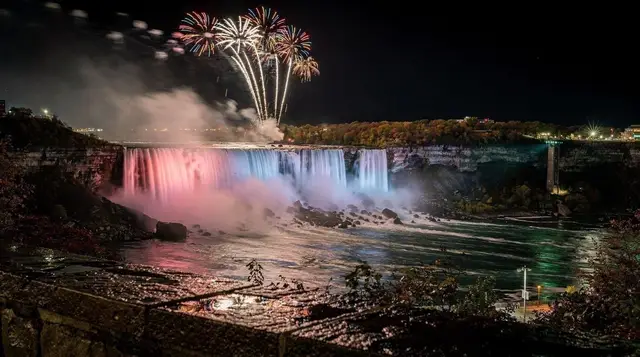
Fireworks over Niagara Falls
When are the fireworks over Niagara Falls?
Niagara Parks runs fireworks on a regular basis through the summer months, usually Friday and Sunday nights, plus a handful of extra dates tied to holidays and events the rest of the year. There is no fixed year-round schedule, and any show can be postponed or cancelled for weather, so always check the current calendar before you plan an evening around it.
When the fireworks actually happen
Fireworks over Niagara Falls are not a nightly fixture, and it is worth saying that plainly before anything else, because plenty of trip-planning is built around the wrong assumption. What runs every single night of the year, rain or shine, is the coloured floodlighting on the falls themselves — that is covered separately in our guide to the illumination of the falls. Fireworks are a different, occasional layer on top of that lighting, launched from the Canadian side and timed to specific nights rather than the calendar as a whole.
Summer is the reliable season. Niagara Parks typically runs fireworks on a set of weekly nights through June, July, and August — historically Friday and Sunday evenings have been the pattern, though the exact nights can shift from one season to the next. Outside summer, shows become occasional rather than routine: a Victoria Day weekend, Canada Day, Labour Day, New Year’s Eve, or an event tied to a festival can each bring a one-off display, but the gaps between them can run to weeks or months with nothing scheduled at all.
The honest way to plan is to treat any fireworks calendar you find online — including the current dates on the Niagara Parks site — as a plan, not a guarantee, and to check it again close to your travel dates rather than trusting a printout from months earlier. Programs get revised, sponsorship-tied shows get added or dropped, and weather can move or cancel a night with little warning. If watching fireworks is the actual point of your evening rather than a bonus, build in a second night if your schedule allows it.
Summer: the closest thing to a schedule
From roughly late May or June through Labour Day, this is when a first-time visitor has the best odds of catching a show without special planning. Multiple nights a week, the display launches from behind the Horseshoe Falls after the sky has gone properly dark, which in a Canadian summer means a start time closer to 10 p.m. than 9 p.m. — check the posted time for the date you are there rather than assuming.
This is also the busiest season at the falls generally, covered in more detail in our guide to summer in Niagara Falls, and fireworks nights concentrate that crowd into the same few hundred metres of riverfront at the same hour. Expect the sidewalks along the parkway to be genuinely full, restaurant patios booked out, and the Falls Incline Railway running a long queue right around show time. None of that makes the fireworks not worth seeing — it just means arriving with a plan rather than wandering up at 9:55 p.m. and hoping for a rail spot.
The rest of the year: fewer nights, but real ones
Outside summer, fireworks become tied to specific dates rather than a running weekly slot. Long weekends, Canada Day, and New Year’s Eve are the most consistent anchors, and some years add extra dates around festivals or one-off civic events.
Winter is the season most likely to be misunderstood: the Winter Festival of Lights runs its own program of illuminated displays along the Niagara Parkway and at Dufferin Islands from November into January, and that event is covered on its own page — see the Winter Festival of Lights guide for what that actually involves. Fireworks are not a nightly part of that festival; they are typically reserved for a small number of marquee dates within it, New Year’s Eve being the most reliable.
If your trip falls in shoulder season — spring or fall, outside any named holiday — do not assume there will be a show at all. Check current dates before building an evening around it, and treat our what’s open and closed by season guide as a useful companion for the rest of what does and doesn’t run at that time of year.
Where to watch from — and why “best” depends on the crowd
There is no single best vantage point for Niagara Falls fireworks, and any guide that tells you otherwise is skipping the part that actually matters: the right spot on a quiet Tuesday in September is the wrong spot on a packed Canada Day weekend, because the difference is entirely about how many other people had the same idea.
Table Rock and Queen Victoria Park
The closest, most direct sightline is along the railing at Queen Victoria Park and the outdoor terrace at Table Rock, both of which look straight across at the Horseshoe Falls with the fireworks launching from behind and above the water. This is the classic postcard angle — falls in the foreground, colour exploding above them — and it is free. It is also where the crowd concentrates most heavily on any popular date, so on a summer weekend or long weekend expect to be several rows back from the rail unless you arrive well ahead of the show.
Skylon Tower
For a different trade-off, the observation deck at the Skylon Tower puts you above the crowd rather than in it. From roughly 160 metres up, you get a wider frame that takes in both the Horseshoe and American Falls at once, city lights spreading out below, and no jostling for railing space — but it is a paid attraction, and on fireworks nights the deck and revolving restaurant both draw their own smaller crowd of people who had the same idea about avoiding the crowd at ground level. It suits visitors who would rather pay for comfort and a guaranteed sightline than gamble on arriving early enough for a rail spot below.
The American side
Watching from Niagara Falls, New York — Prospect Point or Goat Island — gives a legitimately good view, and it is where you avoid the thickest of the Canadian-side crowd entirely. The catch is angle: the shells launch from the Canadian side, so from the American side you are watching the display from beside or behind it rather than from directly underneath, and the falls themselves read less dramatically lit from that side at night. It is a reasonable choice if you are already based in New York State that evening, less so if you are choosing where to stand from scratch.
Getting a spot without wrecking your evening
A few practical points that make the difference between a good night and a frustrating one:
- Eat first, not after. Restaurants along the Fallsview strip and Clifton Hill fill up in the hour before a show and stay full afterward as the whole crowd tries to leave at once. Plan dinner well before the display, not around it.
- Arrive with margin on popular dates. An hour ahead is a reasonable minimum for a rail spot at Queen Victoria Park or Table Rock on a normal summer weekend; on Canada Day, Victoria Day weekend, or New Year’s Eve, closer to ninety minutes gives you a real shot at the front rather than a view over other people’s phones.
- Have a fallback that isn’t the railing. The grassy slopes back from the rail at Queen Victoria Park still see the fireworks perfectly well over the crowd in front, just with people’s heads in the lower part of the frame — a fine trade if you’d rather not queue that early.
- Plan your exit before the show starts. WEGO buses and the parking exits around Fallsview and Clifton Hill back up hard in the twenty minutes after a show ends. If you’re driving, walking a few minutes further from the falls before parking can save you a much longer wait leaving.
- Check parking on the Canadian side before you go, since lots close to the action fill early on any fireworks evening and cost more than the ones a short walk away.
Fireworks with children, grandparents, or limited mobility
A late show changes the maths for anyone who is not a night owl. Young children often fade well before the display starts, so it helps to keep the afternoon light, schedule a proper rest, and treat the fireworks as the finale of the day rather than one more stop in a packed itinerary. Our guide to Niagara Falls with kids has more on pacing a day around small attention spans, and the same logic applies to teenagers, who tend to prefer a spot with room to move over a front-row squeeze.
For visitors who find long standing or uneven ground difficult, the crowded railing is the hardest option. Read the notes in accessibility and mobility at Niagara Falls before choosing a viewpoint, and consider a seated vantage such as a window table or a boat, where you are not holding a place on your feet for an hour. Noise is worth a thought too: the bangs carry across the water, and some children and pets find them unsettling, so ear protection for little ones is a sensible thing to pack.
Making a whole evening of it
Fireworks last a short time, so the evening around them is what you actually plan. A workable shape is an early dinner, a stroll along the Niagara Parkway or through Queen Victoria Park while the light fades, a look at the coloured floodlighting once it comes on, and then the display itself. Our where to eat in Niagara Falls, Ontario guide helps with the dinner part, and the nightlife, shows and casino guide covers what is still open once the crowd disperses.
If you would rather see the falls from the water before dark and stay for the lights, dinner cruises fold the meal and the view into one booking. Wherever you are staying, our where to stay guide is worth a look: a hotel within walking distance of the falls means no driving, no parking queue, and an easy walk back after the last shell.
What can cancel or move the show
Fireworks depend on weather in a way the falls themselves don’t. High wind is the most common cause of a cancellation or postponement, since safety margins around a fireworks launch are stricter than for most outdoor events; lightning and heavy rain do the same. Unlike a boat tour or a zipline that might simply pause and resume once conditions clear, a cancelled fireworks show is usually just off for that night — Niagara Parks does not typically run a same-night backup slot, though a rained-out date on a multi-date program may sometimes be made up on another scheduled night later in the run.
None of this is published with much lead time. If you’re travelling any real distance specifically to see fireworks, checking the forecast a day or two out and having a plan B — the nightly illumination is still worth seeing on its own, and it never gets cancelled — takes the pressure off a single evening.
Photographing fireworks over the falls
A longer treatment of camera settings and composition lives in our guide to photographing the falls’ illumination and fireworks, but the short version: bring something to steady the camera, because a slow shutter both catches the firework trails and smooths the mist rising off the water, and a handheld shot at that speed usually comes out blurred. The best times to photograph the falls guide covers the blue-hour window just before full dark, which is also roughly when a summer fireworks show gets underway — useful if you want both the fading daylight and the fireworks in the same evening’s shooting.
Watching from the water
A different way to see the same show is from a boat on the river. Cruises timed to the fireworks put you on the water below the falls as the display goes off directly overhead, which is a genuinely different vantage point from anything on land — no crowd to navigate, and the sound and spray add something the shoreline view doesn’t. A few tours run specifically around this:
a night cruise on the river timed to coincide with the fireworks display puts the falls’ illumination and the fireworks together in one outing without needing to plan around parking or a viewing spot on land at all. For visitors basing themselves on the American side, a guided evening tour from the New York side that includes the fireworks covers the same evening from that angle, useful if you’d rather not manage the border crossing after dark.
And if you’re coming from Toronto for the day and want the fireworks folded into a longer itinerary rather than a separate evening trip, a full-day guided tour from Toronto that runs into the evening is worth checking against the current fireworks calendar before booking, since not every departure date lines up with a show.
Building the fireworks into a longer visit
None of this needs to be its own trip. If fireworks are one part of a broader stay rather than the whole reason for coming, our how to order your day at the falls guide walks through fitting an evening show around daytime attractions like Clifton Hill or a Niagara City Cruises outing, and the weekend for two itinerary sketches out a two-day stay that leaves an evening free for whichever nights the current schedule has on offer.
The honest summary: check the current dates before you travel, don’t build your only evening around a single show that weather could cancel, and pick your viewing spot based on how busy that specific night is likely to be rather than chasing a single “best” location that a blog post named without knowing your dates.
Illumination and fireworks tours on GetYourGuide
Verified deep-linked GetYourGuide tours. Book through these links and we earn a small commission at no cost to you.
GetYourGuide does not provide a product photo for this activity — the image shows the meeting point, photographed by us.