Inside the Niagara Parks Power Station Tunnel
What is the Niagara Parks Power Station Tunnel?
It's a 2022 attraction built inside the decommissioned Rankine hydroelectric station (in service 1905 to 2006), which reopened to the public in 2021. An elevator descends 55 metres, then a 671-metre tunnel leads to a platform at the edge of the Niagara River. It's a separate site and a separate ticket from Journey Behind the Falls.
The Niagara Parks Power Station Tunnel is the newest way to go underground at the falls, and it’s also the most misunderstood. People hear “tunnel” and “behind the falls” in the same sentence and assume it’s Journey Behind the Falls under a different name. It isn’t. This is a separate attraction, on a separate site, built inside a decommissioned hydroelectric station, and it opened to the public only in the 2020s even though the building itself is more than a century old. If you’re deciding which underground experience to book, or whether to book both, here’s what the Tunnel actually is, what you do inside it, and where people get it confused with something else entirely.
A Century-Old Power Plant, a Brand-New Way Underground
The building at the heart of this attraction is the old Rankine power station, which generated electricity from the Niagara River from 1905 until it was decommissioned in 2006. For fifteen years after that it sat closed, a hulking industrial shell a short walk from Table Rock and Queen Victoria Park. Niagara Parks reopened the building to visitors in 2021, and then, in July 2022, opened the feature that gives the attraction its name: the Tunnel.
That timeline matters, because it’s easy to assume a building this old comes with an attraction this old. It doesn’t. The Power Station Tunnel is one of the newest things to do at the falls, not one of the oldest, even though you’re walking through 1905 machinery to get there. If you’re the kind of visitor who likes industrial history alongside the natural spectacle, this is genuinely one of the more interesting stops in the area, precisely because so much of what you see is original to the building rather than built for tourists.
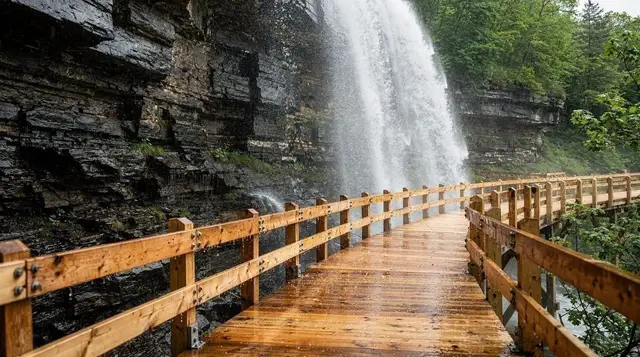
It’s worth being precise about what this attraction is not. It is not Journey Behind the Falls, the older, separate attraction that tunnels into the rock directly behind the sheet of the Horseshoe Falls. That one has its own portals, its own observation deck at the base of the falls, and its own ticket. The Power Station Tunnel doesn’t put you behind falling water at all. Keep that distinction in mind before you buy, because the two are sold and experienced separately, and visitors who assume they’re the same thing sometimes end up disappointed by one or the other.
From the Turbine Hall to the River’s Edge
A visit starts inside the old station building, where the scale of the original industrial architecture is the first thing that lands. Rather than climbing down a rock-cut passage like at Journey Behind the Falls, here you take an elevator that descends 55 metres from the power station floor. That’s a genuinely deep descent, deeper than most people expect from a building that, from the street, doesn’t look that tall.
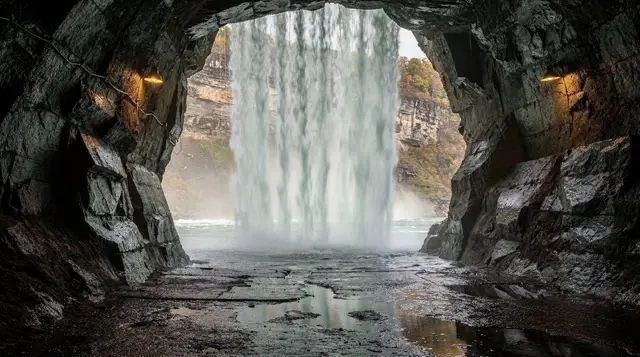
At the bottom, the elevator opens onto the Tunnel itself: a 671-metre passage that was excavated to carry water to the station’s turbines when it was still generating power. Today it’s lit, level, and walkable, running in a straight shot from the base of the elevator to a platform at the edge of the Niagara River. That’s a one-way walk of a little under 700 metres, so plan on covering more than a kilometre round trip once you add the way back.
The platform at the end is the payoff: an outdoor viewpoint at river level, downstream of the falls, with the Niagara River moving past at close range. It’s a different vantage point from anything else in the area, closer to the water’s working history than to the postcard view. You won’t get the classic tabletop shot of the Horseshoe Falls from here; for that, you want Table Rock or the elevated view from Skylon Tower. What you get instead is a sense of the river as the machine it was built to be, which is really the point of the whole attraction.
Currents: The Evening Show Inside the Tunnel
In the evening, the Tunnel becomes the setting for Currents, a projection show combining image and sound inside the passage itself. It’s sold as a separate evening ticket from the daytime tunnel visit, on its own schedule, so check show times before you plan an after-dark trip specifically for it.
an evening ticket that includes the Tunnel walk and the Currents projection show is the straightforward way to book this if an evening visit suits your schedule better than daytime. It pairs naturally with a night spent watching the illumination of the falls afterward, since both are after-dark activities within easy walking distance of each other along the Niagara Parkway corridor.
Tickets, Passes and What Costs What
This is the point where a lot of visitors trip up, so it’s worth being blunt about it: the Niagara Parks Adventure Pass Classic, the season pass most guides point you toward, does not include the Power Station Tunnel. That pass bundles Journey Behind the Falls, the White Water Walk, the Butterfly Conservatory, and two days each of WEGO and the Falls Incline Railway. The Power Station Tunnel is sold separately, either as its own ticket or bundled into combination packages with other attractions.
| Way to visit | What it covers | Roughly |
|---|---|---|
| Daytime Tunnel entry | Power station building, elevator, tunnel walk, river platform | See current ticket for exact CAD pricing |
| Evening Tunnel + Currents | Same tunnel walk, plus the after-dark projection show | Priced separately from the daytime ticket |
| Combined with Skylon | Power station entry paired with a Skylon Tower dining experience | A step up from a standalone ticket |
| Adventure Pass Classic | Journey Behind the Falls, White Water Walk, Butterfly Conservatory, WEGO, Incline Railway | Does not include the Power Station Tunnel |
a standard daytime ticket covering power station entry and the full tunnel walk to the river platform is the simplest way to book if you’re only doing this one attraction. If you’d rather turn it into an evening out, a combined ticket pairing a Skylon Tower dining visit with power station entry stacks the elevated view with the underground one on the same outing.
Always check the current Niagara Parks calendar and your ticket’s fine print before you go: hours shift by season, and the evening Currents showings in particular are not guaranteed to run every night.
Not Journey Behind the Falls: How to Tell Them Apart
Because the confusion between these two attractions is so common, it’s worth laying the differences out directly rather than assuming context will sort it out.
| Power Station Tunnel | Journey Behind the Falls | |
|---|---|---|
| Site | Former Rankine hydroelectric station | Separate location near Table Rock |
| Public since | 2021 building, tunnel from July 2022 | Long-established, decades-old attraction |
| What the tunnel does | Runs to a platform at the river’s edge | Runs to portals directly behind the Horseshoe Falls |
| You end up | Beside the river, downstream of the falls | Behind the falling water itself |
| Evening option | Currents projection show | Not the same evening feature |
If you only have time for one, the choice comes down to what you actually want to see: falling water at close range, or a piece of hydroelectric history you can walk through. Journey Behind the Falls delivers the first. The Power Station Tunnel delivers the second, with a genuinely striking river view as its payoff. Neither is a substitute for the other, and plenty of visitors do both on the same trip since they’re a short walk apart along the Niagara Parkway.
Don’t Mix It Up With the Adams Power Plant
There’s a second, easier mix-up worth flagging: the Adams Power Plant on the American side. That building, opened in 1895 in Niagara Falls, New York, was the first major hydroelectric station to generate alternating current at scale, built on Nikola Tesla’s patents and George Westinghouse’s engineering. It’s a genuinely historic site in its own right, tied directly to the birth of AC power, and it sits across the border, not beside the Rankine building.
The Niagara Parks Power Station covered in this guide is the Canadian counterpart: the Rankine station, in service from 1905 to 2006, on the Ontario side of the river. Both buildings matter to the same broader story of Niagara’s hydroelectric history, and both eras trace back to the same rivalry between Tesla and Westinghouse’s AC system and Thomas Edison’s DC alternative, but they’re different buildings, different countries, and different visitor experiences. If your interest is the Tesla and Westinghouse history specifically, that story is covered in more depth on its own page rather than repeated here.
Planning Your Visit
Give this attraction 60 to 90 minutes if you’re doing the standard daytime visit: time in the power station building itself, the elevator descent, the walk out to the river platform and back, and a few minutes at the platform before you head back up. Add extra if you’re combining it with an evening Currents showing, since that runs on its own schedule and isn’t something you can simply drop into after a daytime visit without a second ticket.
The tunnel floor is level and the descent is by elevator rather than stairs, which makes this more manageable for visitors who find the stair-heavy attractions in the gorge, like the White Water Walk, harder going. That said, confirm current accessibility details before you book if mobility is a concern, since conditions at the outdoor river platform can vary with weather and season.
Hours and seasonal availability shift year to year rather than running on a fixed year-round schedule, so check what’s open and closed by season before you build a winter itinerary around it, and don’t assume the evening Currents show is running on a given night without checking first. Photographers should note that the standout shot here isn’t the falls themselves, since you don’t see them from the platform, but the river at close range and, in the building above, the industrial architecture of the station itself.
For where this fits into a broader day, it pairs naturally with Table Rock and Queen Victoria Park since all three sit within an easy walk of each other, and with an evening spent watching the falls lit up after dark if you’re staying for Currents. If you’re weighing this attraction against the full roster of things to do on the Canadian side, the Niagara Parks pass guide is the place to work out which combination actually saves money for your itinerary, since, as covered above, the standard pass won’t cover this one.
Frequently Asked Questions About the Power Station Tunnel
What is the Niagara Parks Power Station Tunnel?
It’s a 2022 attraction built inside the decommissioned Rankine hydroelectric station, which reopened to the public in 2021 after ceasing to generate power in 2006. An elevator descends 55 metres, then a 671-metre tunnel leads to a platform at the edge of the Niagara River. It’s a separate site and a separate ticket from Journey Behind the Falls.
Is the Tunnel the same thing as Journey Behind the Falls?
No. They’re on different sites with different histories. Journey Behind the Falls takes you into tunnels behind the sheet of the Horseshoe Falls itself. The Power Station Tunnel runs from the old Rankine building to a platform beside the river, downstream of the falls, and doesn’t put you behind the water at all.
How deep is the elevator and how long is the tunnel walk?
The elevator descends 55 metres. From there, the tunnel runs 671 metres to a viewing platform at the river’s edge, so the one-way walk is a little under 700 metres, all on a level, lit tunnel floor.
What is Currents and when does it run?
Currents is a projection show, image and sound, shown inside the tunnel in the evening. It runs on a separate schedule from daytime tunnel visits, and evening tickets are sold specifically for it.
How long should I set aside for a visit?
Budget roughly 60 to 90 minutes for the building, the elevator descent, the tunnel walk to the platform and back, and time at the river. Add extra if you’re visiting in the evening for Currents.
Is the Power Station Tunnel open in winter?
The building and the Tunnel operate on a seasonal schedule that can shift year to year, unlike some of the Niagara Parks’ fully year-round sites. Check the current calendar before planning a winter visit, especially for evening Currents showings.
Is the Tunnel accessible by wheelchair or with a stroller?
The descent is by elevator rather than stairs, and the tunnel floor is level and paved, which makes it more manageable than some gorge attractions. Confirm current accessibility details for the platform area before you go, since conditions at the river’s edge can vary.
Is this the same as the Adams Power Plant in New York?
No, and it’s a common mix-up. The Adams Power Plant is on the American side, opened in 1895, and is tied to Nikola Tesla and George Westinghouse’s alternating-current system. The Niagara Parks Power Station is the Canadian counterpart, the Rankine station, which ran from 1905 to 2006 and only opened to visitors, with the Tunnel, in the 2020s.
Tunnels and decks behind the falls on GetYourGuide
Verified deep-linked GetYourGuide tours. Book through these links and we earn a small commission at no cost to you.
GetYourGuide does not provide a product photo for this activity — the image shows the meeting point, photographed by us.