An appellation, not a town
Ask for directions to “the Niagara wine region” and you’ll get a shrug, because it isn’t one place. It’s the VQA Niagara Peninsula appellation, close to 90 licensed wineries scattered across a band of land between the Niagara Escarpment and Lake Ontario, and it takes up a meaningfully large chunk of the peninsula between the falls and the lake. There’s no gate, no single main street, and no one winery that stands in for all of it.
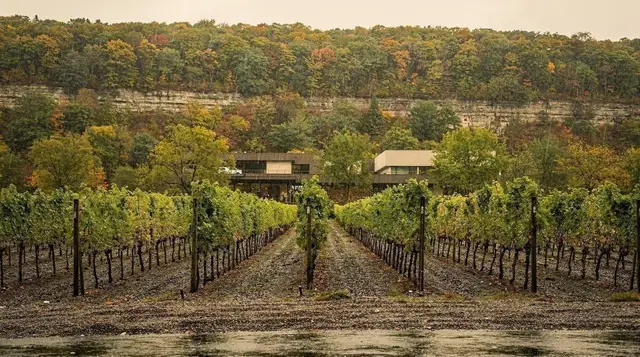
What holds it together is the Niagara Escarpment itself, a limestone ridge that moderates temperatures and drains water off the vineyards, and the lake, which does the same thing from the other direction. Together they create one of the few spots in Canada warm enough, and cold enough at the right moment, to grow wine grapes reliably. For the full mechanics of how the appellation and its sub-zones are organized, see our wine route guide; this page is the overview that sits above it.
It’s easy to lump this in with a trip to St. Catharines or the Welland Canal, since all three sit in roughly the same stretch of the peninsula. They’re not the same thing. St. Catharines is a city with its own downtown and its own attractions, and the canal is a shipping route with ship-watching and lock tours of its own — both are covered on their own pages. The wine country described here is the growing region around and between them, not either place itself.
Two zones, one peninsula
The appellation splits into two growing zones, and which one you visit changes the day.
The first is centred on Niagara-on-the-Lake, the flattest and closest part of the wine country to the falls, roughly 25 to 30 minutes by car. Within it, the industry recognizes several sub-appellations — Four Mile Creek, St. Davids Bench, Niagara Lakeshore, and Creek Shores — each named for a slightly different combination of soil and distance from the lake.
You don’t need to memorize which winery sits in which sub-appellation to enjoy a day here; what matters practically is that this zone is compact, easy to reach from Niagara-on-the-Lake itself, and the one most visitors default to on a first trip. Our Niagara-on-the-Lake wineries guide and the separate page on St. Davids go into the individual estates.
The second zone runs along the Niagara Escarpment, sometimes called Twenty Valley, further west toward Beamsville and Jordan. It splits into its own sub-appellations — Beamsville Bench, Twenty Mile Bench, Short Hills Bench, Lincoln Lakeshore, and Vinemount Ridge — and it sits higher, on the slope of the escarpment rather than the flat lakeshore plain.
That elevation change is more than scenery: it affects drainage and frost risk enough that wineries here are often associated with more structured, mineral-driven wines, particularly riesling. Getting into which estate does what along this stretch is the job of our Beamsville Bench and Twenty Valley guide and the Jordan Village page — deliberately not covered here, since this page stays at the region level.
Both zones fall under the same VQA Niagara Peninsula designation, and nothing stops you from visiting both in one longer day, but doing so means more driving, or more time in a hired vehicle, and less time at any one estate.
What grows here
Six grape varieties define the appellation, and most visitors will taste at least two or three of them without asking.
Riesling is the grape most closely tied to the escarpment zone, prized for the acidity that ridge sites help preserve — it ranges from bone dry to noticeably sweet, and producers are usually upfront about where a given bottle sits on that scale. Chardonnay grows well across both zones and shows up in everything from crisp, unoaked styles to richer, barrel-aged versions. Pinot noir, a notoriously fussy grape elsewhere, does better here than the latitude might suggest, again thanks to the escarpment’s moderating effect.
Cabernet franc is the region’s most distinctive red, more herbal and lighter-bodied than a Bordeaux-style cabernet sauvignon, and often the grape locals point to when asked what Niagara does that nowhere else in Canada quite matches. Gamay, the grape behind French Beaujolais, turns up as an easy-drinking, food-friendly red that rarely gets the attention it deserves. And vidal, a hardy hybrid grape that tolerates hard freezes without the vine itself dying, is the backbone of the region’s specialty, covered next.
None of this requires expertise to enjoy. Most tasting rooms pour flights of four to six wines with short explanations, and staff expect first-time visitors. The grapes and appellations guide goes deeper into how soil and sub-appellation affect what ends up in the glass, for anyone who wants the longer version.
Ice wine: the specialty
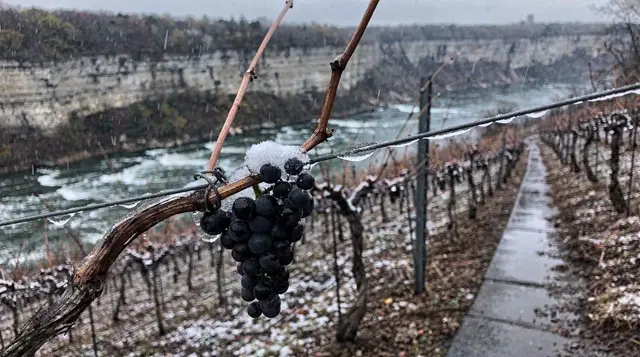
Ice wine is the one product from this region with genuine international standing, and it’s worth understanding before you buy a bottle at three times the price of everything else on the shelf. It’s made from grapes, usually vidal or riesling, left on the vine well past normal harvest and picked only once they’ve frozen solid on the vine at minus 8 degrees Celsius or colder — a threshold the VQA enforces, not a marketing claim. Freezing concentrates the sugar and acid inside each grape before it’s pressed, which is why a little goes a long way: ice wine is typically sold in 200 millilitre bottles rather than the standard 750, and served in small pours.
Canada is the world’s largest producer of ice wine, and this region is a major reason why — the same hard winters that make outdoor activities close down from December through March are exactly what the grapes need. Inniskillin, one of the appellation’s founding wineries, put Canadian ice wine on the international map in 1991 by winning the Grand Prix d’Honneur at Vinexpo in Bordeaux, a result that still gets mentioned in almost every tasting room introduction across the peninsula.
The harvest itself happens at night, sometimes in the middle of a January cold snap, with pickers working fast before the grapes have a chance to thaw. For a longer explanation of the process and how to judge quality when buying, see our ice wine guide.
The rule that shapes every visit: you don’t drive after tasting
Everything about how people move through this region comes back to one plain fact: you cannot taste at four wineries and then get behind the wheel. It sounds obvious written down, but it’s the single most common mistake first-time visitors make, arriving with a rental car and a loose plan to “just drive between a few places.”
The practical solutions are the same ones locals use. Hiring a driver for the day — a car service, a small group tour, or a designated-driver arrangement through your accommodation — lets you visit three or four estates without anyone in the group sitting out the tastings. Our wine tasting day with a driver guide walks through how that typically works and what it costs.
The other option, better suited to a slower pace, is the Niagara River Recreation Trail, a 56-kilometre cycling route along the river that connects into the flatter Niagara-on-the-Lake wine zone — riding between two or three nearby wineries, tasting lightly, and stopping for lunch is a genuinely pleasant way to spend a day, covered in our cycling the wine route guide. What doesn’t work, whatever a itinerary online suggests, is treating this like a self-driven pub crawl.
If beer and spirits interest you as much as wine, several breweries and distilleries have opened across the same stretch of the peninsula in the past decade, and the same driving rule applies to them; see the Niagara breweries and distilleries guide for that side of things.
Fitting this into a Niagara Falls trip
Most visitors are based at the falls and treat wine country as a day trip, not a base. That works well logistically: the closer zone around Niagara-on-the-Lake is a straightforward drive along the Niagara Parkway, and several tour operators run the falls-plus-wine combination as a single outing.
| Approach | Time from the falls | Best for |
|---|---|---|
| Self-drive with a hired driver for tastings | 25–40 min each way | Couples and small groups wanting flexibility |
| Guided wine tour with pickup | Included in the tour | First-timers who don’t want to plan stops |
| Cycling the river trail into Niagara-on-the-Lake | 30–45 min by bike | Cyclists, warmer months only |
| Combined with Niagara-on-the-Lake town | 25 min | Anyone also seeing Queen Street and Fort George |
Budget runs roughly CAD 150 to 280 for two people across tastings, a wine-country lunch, and transportation, though a driver or guided tour adds noticeably more than a self-guided cycling day. Every price here is in Canadian dollars — unlike most of this site’s coverage, which splits between CAD and USD depending on which side of the border a page is about, the wine region sits entirely on the Canadian side, so there’s no US equivalent to compare against.
For travellers combining this with the falls themselves rather than staying overnight in wine country, an evening on the water afterward is a common way to close out the day. A bar cruise out of Port Dalhousie near St. Catharines works well for that:
an evening cruise on Lake Ontario out of Port Dalhousie, with a bar on board, or the dinner version for a full evening, a sit-down dinner cruise on Lake Ontario departing the same harbour.
Travellers coming from Toronto sometimes try to squeeze wine country into the same day as the falls themselves, which is possible but tight — see our Niagara-on-the-Lake and wine country day trip guide for an honest read on whether that’s worth attempting versus splitting it into two days. If a full falls itinerary from Toronto is the priority and wine country is secondary, a day tour from Toronto covering the falls, the Skylon Tower, and a boat ride leaves the wine detour for another day rather than rushing both.
For a slower version based in the town itself rather than the falls, our Niagara-on-the-Lake day trip guide and the broader wine and food itinerary both build a day, or a weekend, around the wine country rather than treating it as an afternoon add-on.
Where this guide stops
This page covers the appellation as a whole: the two zones, the grapes, the ice wine specialty, and the driving rule that shapes every visit. It deliberately doesn’t get into which individual wineries to book, or which sub-appellation produces the driest riesling — that level of detail belongs to more specific pages. For the Niagara-on-the-Lake side, that’s St. Davids and the Niagara-on-the-Lake wineries guide.
For the escarpment side, it’s Beamsville Bench, Jordan Village, and the Twenty Valley wineries guide. And if you’re weighing wine country against nearby but unrelated stops, St. Catharines and the Welland Canal are worth a look on their own terms, not as part of the wine appellation.
Frequently asked questions about the Niagara wine region
Is the Niagara wine region the same as St. Catharines?
No. St. Catharines is a city and the Welland Canal is a shipping route between Lake Ontario and Lake Erie — both worth a separate visit, but neither is the wine appellation. The VQA Niagara Peninsula wineries sit inland from both, mostly around Niagara-on-the-Lake and along the escarpment.
How far is the wine region from Niagara Falls?
About 25 to 40 minutes by car, depending on which zone you’re headed to. The Niagara-on-the-Lake zone is closer and flatter; the escarpment zone around Beamsville and Jordan runs a bit further west.
Do I need a car to visit the wineries?
You need transportation, but not necessarily a car you drive yourself. Because tasting and driving don’t mix, most visitors either hire a driver for the day, book a guided tour, or base themselves in Niagara-on-the-Lake and taxi between a handful of nearby estates.
What is ice wine and when can I buy it?
Ice wine is made from grapes left on the vine and harvested only once they’ve frozen solid at minus 8 degrees Celsius or colder, which concentrates the sugars. It’s sold year-round in tasting rooms and shops, though the grapes themselves are only picked in the depths of winter, sometimes in the middle of the night.
Which zone should I visit if I only have half a day?
Niagara-on-the-Lake, simply because it’s closer to the falls and easy to combine with the town itself. The escarpment zone rewards a full day, since the wineries there are more spread out and the views back over the peninsula are part of the appeal.
Can I cycle between wineries?
Yes — the Niagara River Recreation Trail runs 56 kilometres along the river and connects into quieter roads through the Niagara-on-the-Lake wine zone, which is flat enough for a relaxed ride. The escarpment zone is hillier and better suited to a car or van.
Is wine country open in winter?
Most tasting rooms stay open year-round, and winter is actually when ice wine is harvested, though not always open to the public to watch. Patios and outdoor seating close, and some smaller estates shorten their hours, so it’s worth checking ahead between December and March.