A working city, not a heritage village
St. Catharines gets mixed up with Niagara-on-the-Lake more often than it should. They’re both in the same wine appellation, both a short drive from the falls, and both come up in the same breath when someone says “let’s do the wine route.” That’s where the similarity ends. Niagara-on-the-Lake is a preserved 19th-century town built around one main street, a fort and a theatre festival.
St. Catharines is the region’s largest city — a working port and manufacturing centre that grew up around a canal, with a university, a downtown core, strip malls, and neighbourhoods that have nothing to do with tourism. If you come expecting boutique storefronts and a village green, you’ll be disappointed. If you come for a cheaper hotel room, a real grocery store, and a canal you can watch actual ships pass through, it’s a genuinely useful base.
The other correction worth making early: St. Catharines is not walking distance from Niagara Falls, Ontario. It’s about 20 km away, roughly 20 minutes by car via the QEW outside of peak traffic. People sometimes assume that because it’s “in Niagara” it must be close to the falls themselves the way Clifton Hill is close to Table Rock. It isn’t. Treat it as a day trip or a driving base, not a walkable extension of the falls district.
Getting here and getting around
The QEW runs directly through St. Catharines, which is exactly why it works as a base: it sits on the corridor between Toronto and the falls, rather than off to one side of it the way Niagara-on-the-Lake is. Coming from Toronto, you’ll pass St. Catharines before you reach the falls, and the drive time is close to what it takes to get from Toronto to the falls themselves, since St. Catharines is only marginally closer.
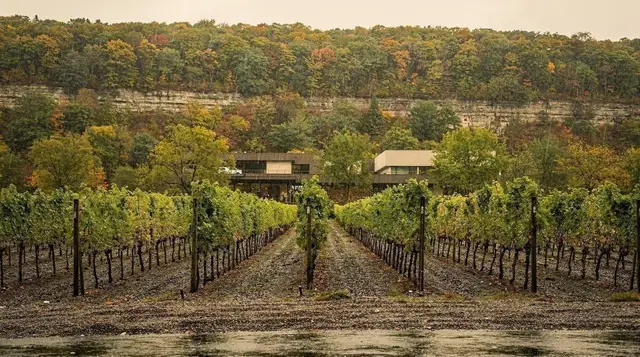
From St. Catharines, the wineries split roughly two ways: the Niagara-on-the-Lake cluster (Four Mile Creek, St. Davids Bench, Niagara Lakeshore) sits to the east, and the escarpment cluster around Beamsville Bench and Twenty Valley sits to the west, closer to Jordan Village. St. Catharines is genuinely in the middle of both, which is the practical case for staying here rather than picking a side.
A car is close to essential. There’s no equivalent of the falls-district WEGO shuttle here, and while downtown St. Catharines and Port Dalhousie are each walkable on their own, getting between wineries, the canal, and the falls means driving — or hiring a driver, which is worth doing anyway if you’re tasting wine.
The Welland Canal runs straight through downtown
The Welland Canal cuts across St. Catharines at surface level, and it’s one of the more overlooked things to see in the whole region. Ocean-going lakers and salties pass within a few blocks of downtown office buildings, low bridges lift for ship traffic, and the whole thing is visible for free from several points in the city.
The lock-by-lock detail — how many locks, how much elevation the canal climbs, how the ships are lifted between Lake Ontario and Lake Erie — belongs to the dedicated write-up on Lock 3, so it isn’t repeated here. What matters for a visit to St. Catharines specifically is that the canal isn’t a side attraction you drive out to see; it’s part of the city’s daily texture, crossed by bridges you’ll use just getting around.
The Lock 3 belvedere: an urban viewpoint, not a wine-country one
The viewing platform at Lock 3 is the best single stop in the city for actually watching the canal work. It’s an elevated belvedere built specifically so visitors can watch ships being raised or lowered at close range, paired with a small museum on the canal’s history. It’s a genuinely different kind of Niagara sight compared to everything clustered around the falls or the vineyards — industrial rather than scenic, and worth building into a St. Catharines stop precisely because it’s the one thing here you can’t get anywhere else in the region. Check ship schedules before making a special trip, since the platform is far more interesting with a vessel in the lock than without one.
Port Dalhousie: the part of the city that looks like a postcard
If St. Catharines has a neighbourhood that photographs the way people expect “Niagara” to look, it’s Port Dalhousie, at the north end of the city where the old canal route meets Lake Ontario. It has a small beach, a harbour lined with restaurant patios, and a wooden carousel dating to 1905 that’s still running rides. It’s a pleasant place to spend an evening — walk the pier, eat on a patio, watch the sun go down over the lake — and it’s different enough in character from downtown St. Catharines that visitors sometimes don’t realize they’re in the same city.
Port Dalhousie’s harbour is also where lake cruises depart, which makes it one of the more relaxed ways to see this stretch of Lake Ontario without dealing with border logistics or falls-area crowds. An evening on the water, drink in hand, is a genuinely different pace from a day spent chasing viewpoints:
an evening cruise out of Port Dalhousie’s harbour, with a bar on board, or the equivalent dinner cruise if you’d rather make it a full meal on the water.
Brock University and why the city doesn’t shut down off-season
The wine villages around St. Catharines get quiet once the harvest crowds thin out in November — tasting rooms cut their hours, some close midweek, and restaurants that thrive on summer patio traffic scale back. St. Catharines doesn’t follow the same pattern, and the reason is Brock University, whose campus sits on the escarpment above the city. A resident student population keeps bars, cafés, cheap restaurants and a live-music circuit running through the winter in a way the wine villages simply can’t sustain on tourist traffic alone. If you’re visiting outside the June-to-October window and want somewhere with actual evening options, St. Catharines — not Niagara-on-the-Lake, not Jordan Village — is where you’ll find them.
Brock also runs the Cool Climate Oenology and Viticulture Institute, which is part of why the university and the wine industry are more entangled here than the “college town” label suggests; several producers in the region have ties to Brock’s viticulture program.
Wine country on the doorstep, without the wine-village prices
Hotel rates in St. Catharines run noticeably below what comparable rooms cost in Niagara-on-the-Lake, particularly in summer and during the Shaw Festival season, which makes it a sensible place to sleep if the plan is really about the wineries rather than the town itself. From here, the Niagara wine route is a short drive in either direction — toward St. Davids and the Niagara-on-the-Lake appellations, or toward Beamsville Bench and Twenty Valley on the escarpment side.
Anyone building a tasting day around St. Catharines should plan on a designated driver or a hired driver for the day — nobody should be tasting and then getting back on the QEW. Cyclists have an easier option: the Niagara River Recreation Trail and the region’s other cycling routes connect several wineries without a car at all, though St. Catharines itself sits a bit outside the densest cluster of cycle-friendly tasting rooms. If ice wine is the specific target, it’s worth reading up on how ice wine is actually made before booking tastings, since not every winery makes it and the ones that do treat it differently.
| Base | Character | Typical lodging cost | Best for |
|---|---|---|---|
| St. Catharines | Working city, canal, university | Lower | Budget stays, canal-watching, off-season nightlife |
| Niagara-on-the-Lake | Preserved heritage town | Higher | Walkable sightseeing, Shaw Festival, boutique stays |
| Niagara Falls, Ontario | Tourist district at the falls | Mid to high | First-timers who want to walk to the falls |
If you’re still deciding where to sleep for a wine-country trip, the fuller comparison is in where to base yourself: the falls or Niagara-on-the-Lake, and the general where to stay near Niagara Falls guide covers the falls-district options this page deliberately doesn’t repeat.
Building St. Catharines into a falls trip
Most visitors won’t make St. Catharines the single reason for their trip — it earns its place as a stop or a base, not a headline destination. A workable pattern: sleep in St. Catharines, spend a morning at the Lock 3 belvedere and downtown, an afternoon working through two or three wineries toward Beamsville Bench or St. Davids, and an evening back at Port Dalhousie for dinner on the water. The falls themselves are close enough to do as a separate half-day, either before or after the wine-country portion of the trip, rather than trying to cram both into one day.
For anyone road-tripping the corridor between Toronto and the falls, St. Catharines also works as a practical stopover rather than a dedicated day: see the route between Toronto and the falls for how it fits into that drive, and the combined wine-and-falls itinerary or the both-sides-in-48-hours plan for how much time to realistically set aside.
If your goal is specifically a day trip to the wine region rather than a multi-night base, the day trip to Niagara-on-the-Lake and wine country covers that shorter version, with St. Catharines as an optional canal stop along the way rather than the centrepiece.
For a broader falls-area package that starts from Toronto and folds in the boat tour and the tower views most first-time visitors actually want, a guided day option covers the ground efficiently:
a day tour from Toronto that combines the boat cruise, Journey Behind the Falls and the Skylon Tower, or the shorter express version of the same three stops for a tighter schedule.
Anyone planning to split time between St. Catharines and the falls district should also check the things-to-do listing for Port Dalhousie and the region’s map tool before committing to a route, since the distances between the canal, the wineries and the falls are easy to underestimate on a first pass.
Questions about basing yourself in St. Catharines
How far is St. Catharines from Niagara Falls?
About 20 km, roughly 20 minutes by car via the QEW outside of peak traffic. It is not within walking distance, and there is no direct shuttle equivalent to the WEGO network that serves the falls district itself.
Is St. Catharines the same as Niagara-on-the-Lake?
No. St. Catharines is a working industrial and port city and the largest population centre in the Niagara wine region. Niagara-on-the-Lake is a smaller, preserved 19th-century town built around tourism, theatre and heritage sites. They share the same wine appellation but have almost nothing else in common.
What is there to see at the Welland Canal in St. Catharines?
The canal runs through the city at surface level, crossed by lift bridges, with an elevated viewing platform and small museum at Lock 3 where visitors can watch ships raised or lowered at close range. The full lock-by-lock detail of the canal is covered separately on the dedicated Welland Canal pages.
Is St. Catharines a good base for visiting Niagara wine country?
Yes, particularly for budget-minded travellers. It sits roughly between the Niagara-on-the-Lake wineries to the east and the Beamsville Bench/Twenty Valley wineries to the west, and hotel rates are typically lower than in Niagara-on-the-Lake itself.
What is Port Dalhousie?
Port Dalhousie is a lakefront neighbourhood at the north end of St. Catharines, with a small beach, a harbour lined with restaurants, and a 1905 carousel still in operation. Lake cruises depart from its harbour.
Does Brock University affect what’s open in St. Catharines?
Yes. The resident student population keeps bars, cafés and casual restaurants running through the off-season in a way the smaller wine villages, which depend heavily on tourist traffic, generally don’t manage.
Can I do St. Catharines as a day trip from the falls, or do I need to stay overnight?
Either works. A half-day covers downtown, the Lock 3 belvedere and Port Dalhousie; staying 2–3 nights makes more sense if you’re using the city as a base for working through several wineries without driving back to the falls each evening.
Do I need a car in St. Catharines?
Effectively yes. Downtown and Port Dalhousie are each walkable on their own, but reaching the wineries, the falls, or moving between the two ends of the city requires a car or a hired driver.