A terroir, not a town
Say “Niagara wine country” and most people picture Niagara-on-the-Lake — the walkable strip of tasting rooms along the lake plain south of the river. The Beamsville Bench is a different kind of place entirely, and it rewards a different kind of day. It’s a stretch of the Niagara Escarpment southwest of St. Catharines, where the land rises sharply off the lake plain and a shelf of ancient seabed — the “bench” — sits partway up the slope. That bench, not a village or a strip of storefronts, is what gives this sub-appellation its name.
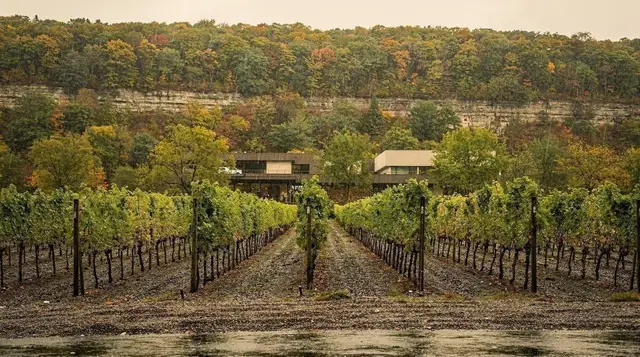
There is no downtown here to park in and wander. The wineries are spread along rural concession roads, some tucked into folds of the escarpment, a few climbing high enough that their patios look out over the vineyards below and, on a clear day, Lake Ontario beyond them. If you’re picturing an afternoon of walking between tasting rooms the way you might on Queen Street in Niagara-on-the-Lake, reset that expectation now — this is a driving (or being-driven) day, and the driving matters more here than almost anywhere else in Niagara wine country.
The soil that makes the wine
The Niagara Escarpment is a limestone ridge that runs from New York State up through Ontario to the Bruce Peninsula, and the Beamsville Bench sits on one of its most distinctive shoulders. Underneath the vines is a mix of limestone bedrock, clay, and glacial till left behind when the last ice sheets retreated — well-draining soils on a slope that catches more sun and drains better than the flatter lake-plain vineyards below. The escarpment also does something practical for the vines: cold air slides downhill off the bench at night, which helps protect the grapes from frost and gives the fruit a longer, steadier ripening season than you’d expect this far north.
That combination — limestone, slope, and the lake’s moderating presence a few kilometres away — is why growers and critics alike single out the Beamsville Bench for two grapes in particular.
Riesling and pinot noir: the Bench’s calling cards
Riesling from the Beamsville Bench tends toward the taut, mineral end of the spectrum — high acid, real backbone, the kind of wine that ages rather than one built to be finished the week you buy it. Pinot noir here leans savoury and structured rather than fruit-forward, shaped by the cooler nights the escarpment provides. Both are widely considered among the most serious examples produced anywhere in the Niagara Peninsula appellation, and it’s the reason wine writers and sommeliers treat “Beamsville Bench” as a meaningful term on a label, not just a place name.
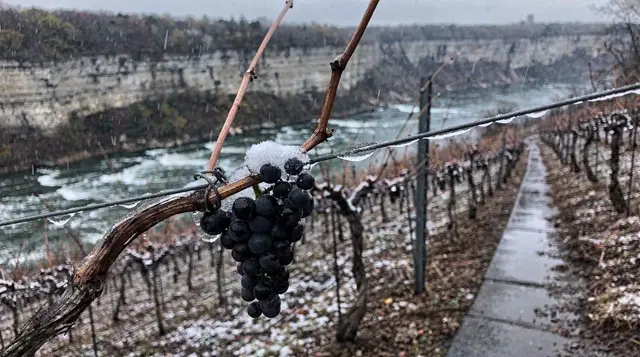
Chardonnay and cabernet franc are planted as well, and in years when a hard freeze arrives at the right moment, some producers pick vidal grapes for ice wine — Ontario’s best-known export and, worldwide, the category the province more or less put on the map after Inniskillin’s wine took top honours at Vinexpo in 1991. If you want the fuller story of how ice wine is made and why it’s priced the way it is, that’s covered on its own page rather than here — this one stays on the Bench itself.
| Grape | What to expect on the Bench |
|---|---|
| Riesling | Dry to off-dry, high acid, mineral — built to age |
| Pinot noir | Savoury, structured, cooler-climate style |
| Chardonnay | Both oaked and unoaked bottlings, escarpment acidity |
| Cabernet franc | Herbal, peppery, a Niagara specialty more broadly |
| Vidal (ice wine) | Made in select years when conditions allow |
Wineries to build a day around
Producers most associated with the Beamsville Bench include Thirty Bench, whose name is practically synonymous with the appellation’s riesling reputation, and Tawse, a biodynamic estate built into the slope with tasting rooms that look straight down over its own vineyard rows. Malivoire, Angels Gate, and Fielding Estate are other names regularly poured on wine lists across the region, each with its own take on the same soils. Exact hours, tasting-room reservations, and pricing change by season and by house, so confirm directly with whichever winery you’re planning to visit rather than relying on a fixed list — what stays constant is the style of wine the Bench produces, not the specifics of any one tasting menu.
Some of these properties are set well up the slope, with driveways that climb hard enough to notice, and patios with genuine views over the escarpment toward the lake. That elevation is part of the appeal and part of the planning problem: this is not flat ground, and a day spent moving between three or four hillside wineries covers real vertical distance as well as horizontal.
The piece that trips people up: this is not flat wine country
Niagara-on-the-Lake’s wine route runs mostly along the lake plain — gentle, easy to cycle, easy to drive between stops without thinking much about the road. The Beamsville Bench is the opposite. Roads climb the escarpment face, switch back, and drop again between properties; driveways to hillside wineries can be steep enough that you notice it in a rental car. None of that is a problem on the way there. It becomes a real problem on the way back, after tasting flights at two or three stops.
The rule here is the same one that applies across Niagara’s wine region generally, just with sharper consequences given the terrain: nobody who has been tasting drives afterward. Build the day around a hired driver, a licensed wine-tour operator, or one strictly sober member of your group behind the wheel. If you’re coming from Niagara Falls or Toronto without your own transport, a guided tour solves the elevation problem and the driving problem in one move — someone else deals with the switchbacks while you deal with the glass in front of you.
a private evening wine tour with dinner through Niagara-on-the-Lake wine country covers a version of this with a fixed itinerary and a driver included, which removes the guesswork if you’d rather not plan the routing yourself.
For a fuller day that folds in more of the region rather than the Bench alone, a full-day wine and falls tour pairing Niagara-on-the-Lake with the falls gives you a driven loop that covers more ground. And for visitors starting from Toronto rather than the falls, a private wine tour running from Toronto out to Niagara-on-the-Lake handles the QEW drive as well as the tasting-room hopping.
Beamsville Bench vs. Jordan Village vs. St. Catharines
These three names get used almost interchangeably by visitors, and they shouldn’t be. Each is a genuinely different kind of place, and mixing them up is the fastest way to plan a disappointing afternoon.
| Place | What it actually is |
|---|---|
| Beamsville Bench | An escarpment terroir — vineyards and wineries on a limestone slope, no central street |
| Jordan Village | A small commercial hamlet nearby, with shops, cafes and a few wineries of its own, walkable in a way the Bench isn’t |
| St. Catharines | A city of about 135,000 on Lake Ontario, home to Welland Canal’s Lock 3 and Port Dalhousie, north of both the Bench and Jordan |
If what you actually want is a stroll past shopfronts with a glass of wine at the end of it, that’s Jordan Village, and it’s worth treating as a separate stop on the same trip rather than assuming it’s part of the Bench itself. If you want a city day with the canal and a lakefront beach, that’s St. Catharines, further north again. The Beamsville Bench is neither — it’s the vineyards and the hillside tasting rooms themselves, and the reason to come is the wine and the view, not a main street.
Planning a day from Niagara Falls
Figure on roughly 40 minutes by car from the falls via the QEW, similar to the drive out to Niagara-on-the-Lake but heading toward the escarpment rather than along the river. Most visitors treat the Bench as a half-day of tasting — two to three wineries is a realistic ceiling if you actually want to taste rather than rush — paired with lunch at one of the estates or a stop in Jordan Village on the way back. A fuller day adds Niagara-on-the-Lake itself, or continues north to St. Catharines for the canal.
Budget for the day, per person and in Canadian dollars, generally runs somewhere in the 150 to 260 CAD range once you count a hired driver or tour, tasting fees at two or three wineries, and lunch — treat that as a working range rather than a fixed number, since tasting fees and tour pricing both shift by season.
Late September into mid-October is the strongest window: harvest is underway, the escarpment turns colour, and most estates are fully open, though it’s also the busiest stretch, so weekend reservations for tastings and any restaurant seating are worth locking in ahead. May and June bring blossom season and noticeably thinner crowds, with the trade-off that some patio seating and later tasting flights may not yet be running at full capacity.
However you build the day, the two decisions that matter most are the same ones: settle transport before you settle the winery list, and don’t mistake the Bench for a place you can park once and walk. Get those right and the rest — which two or three houses, riesling or pinot first — is the easy part.
Beamsville Bench: quick answers
Is the Beamsville Bench a town you can walk around?
No. It’s a stretch of escarpment slope covered in vineyards and wineries, not a village. There’s no main street of shops here — that’s Jordan Village, a short drive west. Plan to drive (or be driven) between wineries rather than park once and walk.
How is the Beamsville Bench different from Jordan Village?
The Beamsville Bench is a wine appellation defined by soil and slope, within the Niagara Escarpment sub-region. Jordan Village is a commercial hamlet nearby with shops, cafes and a handful of wineries of its own. Some itineraries pair both in one day, but they are not the same place.
How is it different from St. Catharines?
St. Catharines is a city of roughly 135,000 people about 20 kilometres north, on Lake Ontario, home to the Welland Canal’s Lock 3 and Port Dalhousie. The Beamsville Bench sits up on the escarpment to its southwest and is agricultural, not urban.
Do I need a car to visit the Beamsville Bench?
You need a way to get between wineries that are several kilometres apart on rural roads with no sidewalks and, in places, real elevation. A car works for the drive there, but not for the tasting itself — book a driver, a licensed tour, or a designated non-taster in your group.
Can I bike the Beamsville Bench instead of driving?
Some visitors do, and the scenery rewards it, but the escarpment roads climb and drop more than the flatter Niagara River Recreation Trail near Niagara-on-the-Lake. Treat it as a moderate ride, not a flat wine-country cruise, and still arrange transport after any serious tasting.
What grapes is the Beamsville Bench known for?
Riesling and pinot noir are its calling cards, on soils that mix limestone, clay and glacial till. Chardonnay and cabernet franc are also planted, and several producers make vidal ice wine in years the crop and weather cooperate.
How far is the Beamsville Bench from Niagara Falls?
Roughly 40 minutes by car via the QEW, similar to the drive to Niagara-on-the-Lake, though the Bench sits further west along the escarpment rather than on the river.
Is there a fee to taste at Beamsville Bench wineries?
Most charge a tasting fee, sometimes waived with a bottle purchase; a few require reservations for flights or tours, especially on weekends in September and October. Confirm directly with each winery, since policies and prices change by season and by house.