Ice wine explained: how Niagara freezes grapes into dessert wine
What exactly is ice wine, and is it really made from frozen grapes?
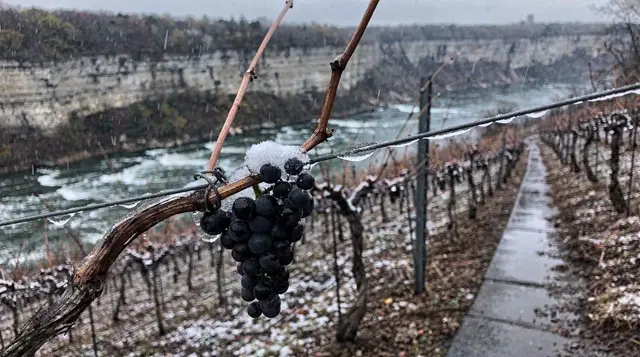
Ice wine is pressed from grapes left hanging on the vine into winter and picked while frozen solid at -8°C or colder, not from grapes harvested normally and frozen afterward in a freezer. Niagara's VQA rules require this natural freeze on the vine, which is why the harvest date moves every year and a mild winter can shrink or delay it.
Frozen on the vine, not frozen in a freezer
The single most misunderstood thing about ice wine is where the cold happens. It is not a technique where grapes are picked at a normal harvest and then frozen artificially in a walk-in freezer to concentrate the juice. That would produce something else entirely, and it would not be legal to sell as ice wine under Ontario’s rules. Real ice wine comes from grapes that stay on the vine long after every other block in the Niagara wine region has already been picked, pressed, and fermenting. They hang through October, through November, often into December, exposed to birds, wasps, rot, and the risk of an early thaw, until the temperature finally drops low enough to freeze the water inside each berry solid.
That distinction matters because it is the whole reason ice wine tastes the way it does and costs what it costs. When water freezes inside a grape, it turns to ice crystals that stay behind in the press while the sugar, acid, and flavour compounds concentrate in a tiny amount of liquid that never quite freezes. Picking normal grapes and freezing them mechanically afterward does not replicate this cleanly, and the flavour difference is noticeable to anyone who has tasted both side by side. If a bottle on a shelf outside Canada is labelled “ice wine style” or similar, that qualifier usually exists precisely because it skipped the on-the-vine freeze.
The VQA rules behind the label
Ontario’s Vintners Quality Alliance sets the legal bar for anything called ice wine within the province, and the Niagara Peninsula appellation is where the overwhelming majority of it is made. The rule that matters most: grapes must be harvested and pressed at a natural temperature of -8°C or colder. That threshold is not arbitrary. Below -8°C, the water inside a wine grape is reliably frozen enough to separate from the concentrated sugars and acids during pressing. Above it, growers risk pressing juice that is only partly concentrated, which would not meet the sugar levels the designation requires.
In practice, most producers wait for colder than the legal minimum. A press at -10°C to -13°C yields a smaller volume of more concentrated juice and is considered the sweet spot by many Niagara winemakers, even though it means gambling on the weather holding at exactly the wrong time of night. VQA rules also cover where the grapes can be grown, how the fruit is netted and protected through the fall, and how the wine is tested before the label goes on the bottle. None of that changes the basic physics: no natural freeze on the vine, no ice wine, no matter how sweet the finished juice might taste.
a guided tasting day through Niagara-on-the-Lake with lunch included is one of the more direct ways to hear this explained by a working wine educator rather than read it off a label, and it usually includes at least one ice wine pour alongside the table wines.
Why vidal carries Niagara’s ice wine
Riesling makes excellent ice wine and shows up on plenty of Niagara shelves, but the grape that carries the category in volume, in price accessibility, and in most visitors’ first taste of ice wine is vidal. Vidal is a hybrid grape with notably thick skin, which turns out to be the deciding advantage through a Niagara autumn. A thin-skinned grape left hanging for two extra months is far more likely to split, rot, or simply drop off the vine before the cold arrives. Vidal’s skin holds up through the wait, and the grape keeps its acidity as sugar concentrates inside it through the freeze, which is what keeps a finished vidal ice wine tasting balanced — apricot, tropical fruit, honey — rather than flat and cloying.
This guide is not the place to compare vidal against riesling, chardonnay, or the reds Niagara grows for table wine; that ground is covered on the peninsula’s grape varieties and sub-appellations guide. What matters here is narrower: vidal is the grape most Niagara producers reach for specifically because it survives the wait that ice wine demands, and it is very likely the grape in the half-bottle a tasting room hands you first.
The night Inniskillin put Canadian ice wine on the map
Ice wine had been made in small quantities in Niagara for years before it had any international reputation, and the moment most often credited with changing that took place in Bordeaux, not Ontario. In 1991, Inniskillin entered its 1989 Vidal Icewine at Vinexpo, the wine industry’s largest trade fair, and it won the Grand Prix d’Honneur — the top award of the competition. It was the first time a Canadian wine had won at that level on a genuinely global stage, and it landed at a moment when very few wine professionals outside Canada had tasted, or even heard of, ice wine from the Niagara Peninsula.
The effect was immediate and lasting. Export demand followed the award, other Niagara producers scaled up their own ice wine programs through the 1990s, and Canada’s ice wine output grew into a category that now leads the world in volume produced, not just reputation. Inniskillin itself remains one of the most visible names tied to the style, and its story is a useful shortcut for understanding why a fairly small, labour-intensive wine from one Canadian wine region became internationally recognized rather than staying a regional curiosity.
This guide does not list which wineries to visit — that’s covered on the Niagara-on-the-Lake wineries guide and the Twenty Valley and Beamsville Bench wineries guide — but knowing the Vinexpo story gives context to why so many tasting rooms across Niagara-on-the-Lake and the Beamsville Bench treat their ice wine pour as the centrepiece of a visit rather than an afterthought.
Inside a night harvest
Ice wine harvests happen at night, almost without exception, because that is when the temperature drops furthest below -8°C. Growers watch forecasts obsessively through November and December, waiting for a stretch of cold air that will hold long enough for a full night of picking. When it arrives, often with only a day or two of notice, crews go out into the vineyard in the dark, sometimes in temperatures of -12°C or colder, and hand-pick the frozen clusters as fast as possible before sunrise starts to warm the fruit back up.
The clusters go straight to the press while still frozen. Because the water inside each grape is locked as ice, the press yields only a small trickle of intensely concentrated juice — commonly a fifth or less of what the same grapes would have produced at a normal autumn harvest. That low yield is the direct reason ice wine is sold in half-bottles rather than standard 750 ml bottles, and it is a large part of why a bottle costs more per millilitre than most table wine on the same shelf. None of it is theatre for visitors; it is simply the only way to hit the sugar and acid concentration the VQA designation requires.
| Step | Timing | What happens |
|---|---|---|
| Normal harvest | September–October | Most Niagara grapes are picked and pressed as table wine |
| Netting and waiting | October–November | Ice wine blocks stay on the vine, netted against birds |
| Cold watch | November–December | Growers track forecasts for a hard enough freeze |
| Night harvest | Usually December–January | Hand-picked in the dark at -8°C or colder |
| Pressing | Same night | Frozen clusters pressed immediately, low juice yield |
| Fermentation | Months, very slow | High sugar content slows yeast activity considerably |
| Release | Often a year or more later | Bottled in half-bottles (375 ml is common) |
A vintage that isn’t promised
It is worth saying plainly: a hard enough freeze is not guaranteed every winter, and a Niagara ice wine vintage is never a sure thing. Growers who commit fruit to ice wine are gambling months of vineyard care — netting, monitoring, protecting the crop from birds and rot — against weather that has not happened yet. A warm December, an early thaw, or a run of storms that knocks fruit off the vine before the cold arrives can all reduce or wipe out a given winery’s ice wine batch for that year. Some producers have skipped a vintage entirely rather than press underripe or insufficiently frozen fruit.
This is also why volumes and prices vary from year to year in a way table wine mostly does not. A small, cold-favoured vintage can sell out quickly at the winery, while a larger year brings prices down slightly and keeps more on shelves through the following summer. Anyone told that a particular ice wine is “always available” or that the harvest happens “like clockwork” every December is getting an oversimplified version of how the category actually works. The honest version is that ice wine is a genuinely weather-dependent wine, produced only when a Niagara winter delivers what the vines need.
Tasting ice wine: what actually lands in the glass
Ice wine is sweet, but it should not taste one-dimensionally sugary if it is well made. The acidity that vidal and riesling carry through the freeze is what keeps the wine tasting bright rather than syrupy — apricot, dried mango, honey, and citrus peel are common notes, with a finish that lingers far longer than a table wine’s. Because it is intensely flavoured and higher in alcohol than its sweetness alone would suggest (typically in the 9% to 12% range), ice wine is served in small pours, usually 60 ml or so, in a narrow glass that concentrates the aroma.
Serving temperature matters more than with most wines: chilled to around 8°C to 10°C, not ice cold, which would mute the fruit. It pairs well with strong cheeses, foie gras, and fruit-based desserts, though plenty of visitors are happy drinking it on its own as the dessert. An opened half-bottle keeps in the fridge for one to two weeks thanks to its sugar and acid content, longer than an opened bottle of dry white would last, which makes it a reasonable souvenir to bring home rather than something that has to be finished the night it’s opened.
Fitting ice wine into a Niagara visit
Most visitors meet ice wine at the end of a regular tasting flight, as the small, sweet pour a winery saves for last, rather than as the whole point of the visit. That’s a sensible way to approach it: treat ice wine as one stop within a broader Niagara wine route day rather than the sole reason to book a tour, since most tasting rooms pour it alongside their table wines rather than running dedicated ice wine sessions except during harvest season itself.
A guided day removes the one real complication, which is that nobody should be driving between wineries after a proper tasting — a small-group wine tour with lunch included on the Canadian side covers that with a driver and a paced schedule, and it’s a reasonable first stop for anyone who wants the ice wine explanation delivered in person before deciding which bottle to bring home.
For an evening version, an evening tasting tour that pairs a proper dinner with the reds and dessert wines tends to close with the ice wine pour rather than opening with it, which suits the way the wine is meant to be tasted — after a meal, not before one.
Visitors who’d rather cover ground under their own power can try an e-bike route through the Beamsville Bench with tasting stops built in, which crosses several of the sub-appellations covered on the grape varieties guide without requiring anyone to drive. And for a shorter outing closer to the falls themselves, a half-day pickup tour that covers two wineries with a Table Rock stop works for travellers building a wine and food day around a limited window of time.
Whichever route gets used, the wineries themselves — which ones to book, what each sub-region specializes in, how to plan a tasting day around St. Davids, Jordan Village, and the Beamsville Bench — are covered on the dedicated wineries guides rather than repeated here.
Anyone timing a visit around the harvest itself should also check the month-by-month weather guide and the notes on winter in Niagara Falls, since a December or January trip built around seeing an ice wine harvest firsthand is a genuinely different visit — colder, quieter, and dependent on weather that no tour operator can promise in advance.
Niagara ice wine, the questions worth answering
The basics of how ice wine is made, why it costs what it does, and where it fits into a Niagara visit come up constantly at tasting counters. A few of the most common questions, answered plainly, follow below.
What is ice wine actually made from?
Ice wine is made from ordinary wine grapes, mostly vidal in Niagara, that are left on the vine after the regular autumn harvest and picked once they freeze naturally in the winter cold, typically in December or January.
How cold does it have to be to pick ice wine grapes?
Ontario’s VQA rules require the grapes to be harvested and pressed at -8°C or colder. Growers often wait for -10°C to -13°C for a cleaner, more concentrated press, and picking almost always happens overnight when the temperature is at its lowest.
Why is vidal the main grape for Niagara ice wine?
Vidal has thick skin that resists rot and splitting through a long autumn on the vine, and it holds its acidity as sugar concentrates through the winter freeze, which keeps the finished wine balanced rather than simply sweet.
Is ice wine made every single year?
No. The harvest depends on a hard enough freeze arriving before birds, rot, or a warm spell strip the crop, so some vintages are smaller than others and a handful of wineries have skipped a year entirely when the cold never came.
What did Inniskillin do at Vinexpo in 1991?
Inniskillin’s 1989 Vidal Icewine won the Grand Prix d’Honneur at Vinexpo in Bordeaux in 1991, the first major win for a Canadian wine on a global stage, and it is the moment most often credited with putting Niagara ice wine on the world wine map.
Is Canada really the world’s largest ice wine producer?
Yes. Canada, and the Niagara Peninsula specifically, produces more ice wine than any other country, helped by a climate that reliably delivers a hard winter freeze most years without losing the whole crop to rot first.
How is ice wine different from a regular dessert wine?
Most dessert wines get their concentration from noble rot, late harvest, or fortification with spirits. Ice wine gets its concentration purely from the grapes freezing on the vine, which pulls out water as ice crystals and leaves the sugar, acid, and flavour behind in a small amount of juice.
How should ice wine be served and stored once opened?
Serve it chilled, around 8°C to 10°C, in a small glass since a little goes a long way. An opened bottle keeps well in the fridge for one to two weeks thanks to its high sugar and acid content, longer than most table wines.
Niagara wine country and icewine tours on GetYourGuide
Verified deep-linked GetYourGuide tours. Book through these links and we earn a small commission at no cost to you.
GetYourGuide does not provide a product photo for this activity — the image shows the meeting point, photographed by us.