Niagara-on-the-Lake wineries: the appellation guide
Which wineries are worth visiting around Niagara-on-the-Lake?
The Niagara-on-the-Lake side of the VQA Niagara Peninsula appellation covers four sub-appellations — Four Mile Creek, St. Davids Bench, Niagara Lakeshore and Creek Shores — and includes long-established houses such as Inniskillin, Peller Estates, Trius, Jackson-Triggs, Chateau des Charmes, Konzelmann and Reif. Most sit within a 15-minute drive of each other, which is why a driver or a guided tour makes more sense than self-driving between tastings.
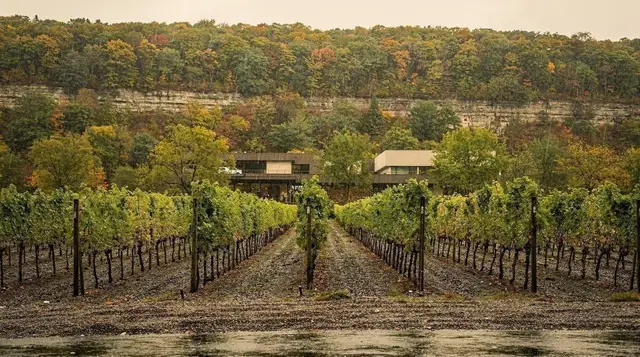
Say “Niagara wine country” and most people picture a single strip of vineyards. It isn’t one. The VQA Niagara Peninsula appellation splits into two very different halves: the Niagara Escarpment side around the Beamsville Bench, and the flat lakeshore side around Niagara-on-the-Lake, where the land runs gently down to Lake Ontario instead of climbing a ridge. This page is about the second half — the wineries, not the town. Queen Street, the Prince of Wales and the Shaw Festival have their own guide; here the subject is where the grapes actually grow and which tasting rooms are worth the stop.
Where the vines line up: four sub-appellations on one plain
The Niagara-on-the-Lake side of the appellation is itself divided into four sub-appellations, and the differences between them come down to distance from the lake and soil. Lake Ontario moderates temperature enough to matter for a delicate grape like riesling, so the closer a vineyard sits to the shoreline, the less it swings between a hot afternoon and a cold night.
Niagara Lakeshore hugs the water most directly and includes some of the flattest, most maritime-influenced vineyard land in the province. Creek Shores, just inland along the small creeks that drain toward the lake, sits on similar soil with slightly less direct lake exposure. Four Mile Creek, further back from the shoreline, has heavier clay soils that tend to favour reds like cabernet franc and gamay alongside chardonnay. St. Davids Bench is the outlier — a small bench of higher, better-drained land near the village of St. Davids, between Four Mile Creek and the base of the escarpment, with a microclimate that several producers rate as the most distinctive on the lakeshore side.
None of this is trivia for its own sake: a tasting room’s address tells you roughly what’s in the glass before you’ve had a sip, and it’s the reason two wineries ten minutes apart can pour noticeably different rieslings.
The names you’ll recognize
A handful of Niagara-on-the-Lake houses built the appellation’s reputation, and they’re still the easiest places to start.
Inniskillin, founded in 1975 on the Niagara Parkway, was the first winery licensed in Ontario since Prohibition. It’s also the reason Niagara ice wine has an international reputation at all — the 1989 vintage won the Grand Prix d’Honneur at Vinexpo in 1991, and the winery has traded on that result ever since without needing to. Its estate sits close enough to the Niagara Parkway that a stop here folds easily into a drive toward Queenston.
Chateau des Charmes, dating to 1978, is the other founding-era estate on this side of the appellation — a French-style chateau building surrounded by St. Davids Bench vineyard, known for chardonnay and cabernet franc rather than for chasing trends.
Peller Estates and Trius share ownership and sit almost across the road from each other on the Niagara Parkway, both built around full restaurants as much as tasting rooms — the pair is a common lunch-plus-tasting stop for anyone doing a single afternoon on the lakeshore side.
Jackson-Triggs runs one of the larger and more visitor-oriented operations in the appellation, with a purpose-built amphitheatre that hosts a summer concert series alongside its regular tastings — worth checking if a trip lands in July or August.
Smaller pours worth the detour
Not every worthwhile stop is a household name. Konzelmann, on the Niagara Lakeshore bench with vines running almost to the water, is one of the few Niagara wineries where the tasting room genuinely looks out over Lake Ontario rather than over a parking lot. Reif, a family-run estate on the Niagara Parkway with German winemaking roots going back generations, pours a broader range of styles than its size would suggest and is a reliable stop for riesling drinkers specifically.
Further into St. Davids Bench, smaller producers such as Ravine and Two Sisters built their reputations on cabernet franc and small-lot bottlings rather than volume — worth knowing about if the plan is two or three unhurried stops rather than a checklist of famous names.
Building a route that doesn’t retrace itself
Four Mile Creek, Niagara Lakeshore and St. Davids Bench wineries cluster loosely along and near the Niagara Parkway between Niagara-on-the-Lake and Queenston, which makes a there-and-back drive along the parkway a reasonable spine for a self-guided day — Inniskillin, Peller Estates and Trius sit almost on the road itself, with Konzelmann and Reif a short detour off it. Creek Shores producers sit a little further south, closer to St. Catharines, and are easier to fold into a route that continues toward the Welland Canal than into a lakeshore-only loop.
None of that solves the actual problem, which is that nobody should be driving between more than one or two tastings. Three realistic options cover most visitors:
| Option | Best for | Trade-off |
|---|---|---|
| Designated driver in your own group | Small groups who want total control of pace | Someone doesn’t get to taste properly |
| Guided small-group or private tour | Couples and small groups, no logistics | Fixed stops, fixed schedule |
| Cycling the Niagara River Recreation Trail | Fit visitors, good weather, Niagara Lakeshore stops | Slow between stops, weather-dependent |
For the guided option, a Niagara-on-the-Lake wine and whiskey tour covers several lakeshore producers in one outing with a driver built in, which removes the spit-or-swallow calculation entirely. Groups who’d rather mix wine with beer can look at a Niagara-on-the-Lake beer and wine tour that pairs a winery stop or two with a local brewery — useful if not everyone in the group actually likes wine.
For an evening plan built around a single unhurried stop rather than several rushed ones, a private sunset wine tour with dinner trades breadth for a proper meal paired to what’s in the glass.
Whichever option you pick, book the tasting fees and any dinner seating ahead in July and August weekends — the restaurants at Peller Estates and Trius in particular fill up, and a walk-in tasting slot isn’t guaranteed at the busier estates in peak season. Outside summer, most tasting rooms take walk-ins without difficulty.
Reading a tasting room before you walk in
Tasting rooms on the lakeshore side tend to work the same way: a short flight of a few pours for a fee, poured at a bar or a table, with the option to buy by the bottle afterwards. Tasting fees, flight sizes and hours change from year to year and between estates, so check the winery’s own site before you set out rather than trusting a number on a page like this one. What you can plan around is the shape of the visit. Allow enough time at each stop to sit with the glass instead of rushing the flight, and two stops in an afternoon is a more honest pace than four.
Ask the person pouring what the vintage did. Lakeshore vineyards feel the weather of a given year strongly, and a good tasting-room host will tell you whether a riesling came from a cool season or a warm one, and what that does in the glass. That conversation is worth more than the tasting notes printed on the menu.
If you’re travelling with someone who doesn’t drink, say so at booking. Several of the larger estates run restaurants and grounds that are worth the visit on their own, and a lunch at Peller Estates or Trius works as a stop without anyone tasting a thing.
Where the river and the history fit in
The wineries sit in one of the most layered corners of the peninsula, and a vineyard day doesn’t have to be only about wine. The Niagara River runs along the eastern edge of this plain, and the parkway that follows it is the reason the route is so easy to drive. The same road leads to Fort George, a short stretch from the tasting rooms, and on toward the heights above Queenston, where the story of the War of 1812 at Queenston Heights gives a historical counterweight to an afternoon of tastings. Putting one of these between two wineries breaks up the day and gives the driver, or the cyclist, a reason to stop that isn’t a glass.
When to go, and what changes by season
Summer is the busiest stretch, with full patios, concerts and booked-out restaurants. Early autumn is the season many wine people prefer: the harvest is under way, the light is softer and the crowds thin slightly. The fall in Niagara Falls guide covers what else is open then, and the best time to visit Niagara Falls page compares the seasons across the whole region.
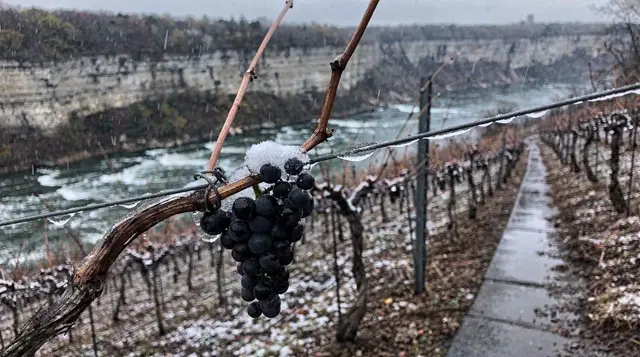
Winter is the quiet season, and it is also when ice wine is at the centre of the conversation, since the frozen-grape harvest happens in the cold months. If you’re coming for that, the winter in Niagara Falls guide covers what to expect from the weather, and the off-season in Niagara-on-the-Lake piece describes how quiet the town gets. Some tasting rooms keep shorter hours outside summer, so confirm before you drive out.
Staying here or visiting from the falls
You don’t have to stay near the vineyards to visit them, but a night in the area changes the day: no early drive, no rush at closing time, and an evening meal without a long road home afterwards. If you’re deciding where to sleep, Niagara-on-the-Lake or the Falls: where to base weighs the two options honestly. For a wine day that falls on a summer weekend, read book ahead or buy on site before you commit, because tasting slots and restaurant tables are the first things to go.
What this page deliberately leaves out
Two things on purpose. First, the Twenty Valley and Beamsville Bench side of the appellation — Tawse, Cave Spring, Thirty Bench, Vineland Estates and the escarpment producers generally — has its own dedicated guide, because it’s a different landscape with a different route logic and mixing the two into one page does a disservice to both.
Second, how ice wine is actually made — the frozen-grape harvest, the VQA rules, why Canada leads the world in it — is covered fully in a separate explainer rather than repeated here; most of the wineries named on this page pour it, Inniskillin and Peller Estates especially, but the process itself belongs to that page, not this one.
If the goal is the town rather than the vineyards — Queen Street, the Prince of Wales, the Shaw Festival — that’s a separate day-trip guide built around walking rather than tasting.
And if wine is only one piece of a longer visit, the wine-and-food itinerary and the broader Niagara wine route guide both zoom out to cover both sides of the appellation together, plus where to eat afterward on either the Ontario or the New York side of the border, and where local breweries and distilleries fit into the same day.
Getting here first
Most visitors arrive from the falls themselves — it’s about a 25-minute drive up the Niagara Parkway — or from Toronto, which is roughly 100 kilometres and just over an hour away depending on QEW traffic; the route from Toronto is covered in more detail in a dedicated guide. A private day-trip pairing the vineyards with a look at the town itself is available as a private Niagara-on-the-Lake tour from the Niagara Falls side, useful for visitors who’d rather not rent a car at all.
Wine, by the numbers
| Sub-appellation | Character | Notable houses on this page |
|---|---|---|
| Niagara Lakeshore | Closest to Lake Ontario, most maritime-moderated | Konzelmann |
| Creek Shores | Similar soils, slightly less direct lake exposure | — |
| Four Mile Creek | Heavier clay, favours reds and chardonnay | Inniskillin, Peller Estates, Trius, Jackson-Triggs, Reif |
| St. Davids Bench | Higher, better-drained bench land | Chateau des Charmes, Ravine, Two Sisters |
None of this replaces an actual tasting — soil descriptions are a starting point for choosing a route, not a substitute for what’s poured on a given afternoon.
Niagara-on-the-Lake wineries, frequently asked
What’s the difference between Niagara-on-the-Lake wineries and the Twenty Valley wineries?
They’re two sub-zones of the same VQA Niagara Peninsula appellation, on opposite sides of St. Catharines. Niagara-on-the-Lake sits on the flat lakeshore plain near the mouth of the Niagara River; the Twenty Valley wineries, including the Beamsville Bench, climb the Niagara Escarpment further west and have their own guide.
Do I need a car to visit Niagara-on-the-Lake wineries?
You can drive between them, but not after tasting at more than one or two. Most visitors book a driver, a small-group tour, or cycle the flat Niagara River Recreation Trail between stops, since none of the tasting rooms are more than about a 15-minute drive from Niagara-on-the-Lake.
Which Niagara-on-the-Lake winery is the most historic?
Inniskillin, founded in 1975, was the first winery licensed in Ontario since Prohibition and put Niagara ice wine on the world map after winning the Grand Prix d’Honneur at Vinexpo in 1991. Chateau des Charmes, dating to 1978, is also among the appellation’s founding estates.
What grapes do Niagara-on-the-Lake wineries grow?
Riesling and chardonnay do well on the lakeshore plain, alongside pinot noir, cabernet franc and gamay; vidal is the grape most often used for ice wine. Exact strengths vary by sub-appellation and by how close a vineyard sits to Lake Ontario’s moderating effect.
Is Niagara-on-the-Lake the same as the wine region?
No. Niagara-on-the-Lake the town, with Queen Street and the Shaw Festival, sits at the edge of a much larger wine-growing area that stretches south along Four Mile Creek and St. Davids Bench. This guide covers the vineyards, not the town — that’s covered separately.
Can I taste ice wine at these wineries?
Yes, most of the wineries named here produce it, Inniskillin and Peller Estates in particular. For how ice wine is actually made and regulated, see the dedicated ice wine explainer rather than expecting the details repeated at every winery listing.
Niagara wine country and icewine tours on GetYourGuide
Verified deep-linked GetYourGuide tours. Book through these links and we earn a small commission at no cost to you.
GetYourGuide does not provide a product photo for this activity — the image shows the meeting point, photographed by us.