Walking across Rainbow Bridge
How much does it cost and how long does it take to walk across Rainbow Bridge?
Walking across Rainbow Bridge costs a few coins in each direction and takes roughly ten minutes outside of a queue. Pedestrians usually clear the border faster than drivers, especially in summer and on holiday weekends when the vehicle line can run past an hour.
Skip the car line: crossing on foot
Of the four bridges over the Niagara River, Rainbow Bridge is the one nearly every visitor actually uses, and it’s the only one built for pedestrians in the first place. Opened in 1941 and named for the arcs of colour that show up in the mist below it on a sunny day, it sits closer to the falls than any of the other crossings — close enough that you can walk from the Fallsview hotel strip or Clifton Hill to Niagara Falls State Park on the American side without ever getting in a car.
That position is the whole appeal. Niagara Falls Ontario and Niagara Falls New York sit directly across the gorge from each other here, and Rainbow Bridge is the short, direct link between them. The other crossings — Whirlpool Rapids, Queenston-Lewiston, and Peace Bridge — all sit well north or south, built for different traffic and, in one case, off-limits to casual visitors entirely. This page is about the practical business of walking across Rainbow Bridge: what it costs, how long it takes, and when it beats sitting in a car. For the paperwork you’ll need and a rundown of all four bridges, see the border-crossing guide.
What it actually costs
Walking into the United States from Canada across Rainbow Bridge costs a small pedestrian toll, paid in cash or coins at a turnstile just before the U.S. border booth. It’s genuinely a few coins, not a few dollars, and American and Canadian change are both generally accepted, though it’s worth carrying a small amount of each so you’re not fishing through pockets while a line forms behind you. Walking from the United States into Canada, by contrast, is free — there’s no turnstile on that side, just the border booth itself.
Vehicles pay a toll in both directions and it’s considerably more than the pedestrian fee. That gap is one more reason the walk makes financial as well as practical sense for a same-day visit: no toll booth line, no parking to find on the far side, and a lower fee to cross at all.
How long it takes
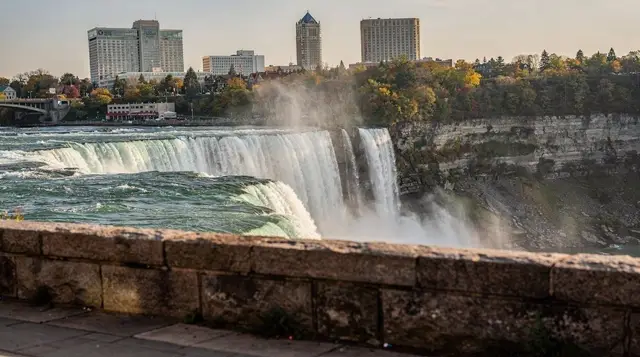
Outside a queue, walking across Rainbow Bridge takes about ten minutes from sidewalk to sidewalk — a short, unremarkable stretch over the gorge with a decent middle-distance view of both the Horseshoe and American Falls off to your right. Add a few minutes at each end for the passport check, and a round trip on foot, park to park, is realistically 25 to 35 minutes including the walk to and from the bridge itself on both sides.
That’s the number that matters for planning: if you’re staying on the Canadian side and want to see Goat Island or the American viewpoints for an afternoon, walking there and back is a genuinely small time cost, not a half-day expedition.
When the sidewalk beats the car line
This is where the pedestrian crossing earns its reputation. In July and August, and on long weekends and U.S. and Canadian holidays throughout the season, the vehicle lane backing up to cross Rainbow Bridge can run past an hour, sometimes considerably more, as cars queue for the toll booth and then the border booth beyond it. The pedestrian line, by contrast, tends to keep moving — it’s a narrower bottleneck with fewer cars’ worth of people ahead of you at any given moment, and border officers can usually clear walkers faster than they can clear vehicles full of passports and questions.
The practical rule: if you’re staying near Fallsview or Clifton Hill and want to spend an afternoon on the American side in peak summer, walk. Driving across in August traffic can genuinely cost you more time sitting in a car than the entire pedestrian round trip would take. Outside peak season — spring, fall, and winter, and on an ordinary weekday even in summer — the gap narrows and driving across becomes a reasonable option again, particularly if you’re headed onward to somewhere the sidewalk doesn’t reach, like Lewiston or Buffalo.
| Scenario | Typical wait, on foot | Typical wait, by car |
|---|---|---|
| Weekday, spring or fall | Minimal | Minimal to 15 minutes |
| Weekday, midsummer | 5–15 minutes | 15–45 minutes |
| Weekend or holiday, midsummer | 10–20 minutes | 45 minutes to over an hour |
| Winter | Minimal | Minimal |
These are rough patterns, not guarantees — border wait times shift with staffing and with whatever else is happening that day, and there’s no way to promise a number in advance.
Getting to the bridge from each side
From the Canadian side, the bridge’s pedestrian approach sits below the Fallsview hotel strip, an easy downhill walk from Clifton Hill or from Table Rock along the river. If you’re staying up at Fallsview, it’s mostly downhill on the way over and a noticeably steeper walk back up — worth knowing before you commit to the round trip on a hot day. WEGO buses run along this stretch too, though most visitors find the walk down manageable on its own.
From the American side, the walkway lets out near Prospect Point, right at the edge of Niagara Falls State Park and a short walk from the park’s shuttle stops, Goat Island, and the observation tower. It’s a genuinely convenient drop point — you’re inside the park boundary within a few minutes of clearing the border booth, no taxi or shuttle needed.
Either direction, the walkway itself is a fenced sidewalk running alongside vehicle traffic — not a scenic promenade, and not somewhere to linger with a tripod. Treat it as a border crossing that happens to have a decent view, not a destination in its own right.
What’s on the other side
Crossing into the United States on foot puts you within walking distance of Niagara Falls State Park’s free entrance, Goat Island and its loop trail, Prospect Point, and the boat and cave attractions that only run from the American shore.
If a boat ride is part of the plan for the day, the Maid of the Mist boat and walking tour from the American side departs a short walk from where the bridge lets out, and a combined outing like the Niagara Falls USA van tour with a Maid of the Mist ride can turn a walked border crossing into a full afternoon without ever needing a car on the American side.
Crossing the other way, back into Canada, puts you close to Table Rock, the Skylon Tower, and Clifton Hill — see the honest rundown on Clifton Hill before you spend an evening there, since not everything on that strip is run by Niagara Parks or priced accordingly.
For a same-day loop that uses the bridge in both directions — morning on one side, afternoon on the other, back before dinner — the both-sides itinerary lays out a full 48-hour version if you’d rather spread it over two days instead of one long one.
Planning a day around the walk
The bridge works best as a hinge in a day rather than a stop in itself. A sensible pattern from the Canadian side: see the Horseshoe Falls and Table Rock early, before the crowds thicken, walk over in the late morning, and spend the middle of the day in Niagara Falls State Park. Park-side highlights such as the American Falls, the Bridal Veil Falls and the Cave of the Winds are all clustered close together, so there is little backtracking once you are across. The Goat Island loop guide lays out a walking order that keeps the effort low.
Coming the other way, the logic reverses. Spend the morning on the American side, where the free viewpoints cost nothing, then walk back into Canada in the afternoon so you finish near the illuminations. Our guide to the illumination of the falls explains the evening light show, and the fireworks guide covers the nights when it is paired with a display. Both are best watched from the Canadian side, which is a good reason to end the day there. If you would rather see the falls from the water first, Niagara City Cruises runs from the Canadian shore and the Maid of the Mist from the American one; the comparison of the two boats helps you pick.
If you only want a taste of the other country, you can cross, look around for an hour or two, and walk straight back. Most people who do this plan it as a single loop rather than two separate trips, which also means only one set of border formalities to think about in each direction.
Border formalities on foot
Walking does not change what the border officers expect. You carry a passport, you answer the questions you are asked, and you declare what you are carrying. Entry to the United States under visa exemption requires an ESTA, and the Canadian electronic travel authorisation (AVE) applies to air arrivals only, so a visitor who flew into Toronto Pearson and is walking across does not need it for the land crossing. The longer explanation, including what to do if you are travelling with children or a rental vehicle, sits in the border-crossing guide, and a first-person account of the walk is in crossing the border on foot.
Two practical points are worth repeating. First, you can be asked to prove you are heading home, so keep your return plans easy to explain. Second, a day-trip crossing is still a crossing: if a hotel, a pass or a booked tour depends on getting back on time, build in a margin rather than planning the return to the minute. The Niagara Falls tourist scams guide and the page on avoiding street ticket resellers are also worth a glance, because people approaching walkers near the bridge approaches are rarely selling anything official.
Weather, accessibility and families
The walkway is open to the sky, and the bridge is high above the gorge, so wind and cold are felt more than you expect from the street. In winter, dress for the exposure; our notes on winter in Niagara Falls and the month-by-month weather guide help you judge what to wear. In summer the walk is shadeless, so carry water and sun protection, and remember that the climb back up towards Fallsview is the harder direction.
For travellers using a wheelchair or pushing a stroller, check the accessibility guide before you commit, since the approaches on each side are not identical. Families will find the Niagara Falls with kids guide useful for pacing a day that includes a border walk, and the family itinerary shows one way to fit the crossing in without tiring young walkers.
When walking is the wrong choice
Walking is not always the best answer. If you are carrying luggage, travelling with limited mobility, or heading on to Buffalo or Lewiston, a vehicle may make more sense, and the rental car guide covers the rules. If you plan to leave the car on one side, compare the parking on the Canadian side with parking on the American side before choosing where to leave it, since the best option is often to park once and walk across. For a trip that avoids a car altogether, see the Niagara without a car itinerary, and for a comparison of the two shores, the guide to which side is better sets out the trade-offs.
The bridge that isn’t an option
It’s worth being direct about this because it trips people up: the Whirlpool Rapids Bridge, the crossing north of Rainbow Bridge near the gorge’s narrowest point, is not a pedestrian option and is not open to general traffic either. It’s restricted to NEXUS cardholders in pre-cleared vehicles using the NEXUS lane — there’s no walkway, and showing up on foot or without NEXUS gets you turned around, not processed slowly. If you don’t have NEXUS, or you’re travelling on foot, Rainbow Bridge is the crossing for a same-day visit between the two downtown cores; the other two vehicle bridges, Queenston-Lewiston and Peace Bridge, sit well north and south and aren’t set up for a quick walk between the falls themselves.
Getting the crossing right
A few habits make the walk smoother in either direction. Carry your passport in hand rather than buried in a bag — both booths move faster when people aren’t digging for it. Bring coins for the pedestrian toll into the United States rather than counting on a machine to make change from a bill. Check the wait before you commit to the sidewalk during a heat wave or a holiday weekend; posted border wait times are usually visible near the approach on the Canadian side, and if the pedestrian line looks unusually long too, it’s rarely because the crossing itself has closed — officers do occasionally slow processing on both sides for reasons that have nothing to do with weather or crowd size.
None of this requires much planning. Rainbow Bridge is short, cheap, and — for most of the year, for most hours of the day — faster on foot than in a car. That combination is why it carries the bulk of the pedestrian traffic between the two Niagara Falls, and why a walked border crossing is worth building into a day here rather than treating the border as a reason to stay on one side.
Walking across Rainbow Bridge: the essentials
Toll: a few coins into the United States, free into Canada. Time: about ten minutes end to end outside a queue, 25 to 35 minutes round trip with the walk to and from each side. Peak risk: July and August, plus holiday weekends, when the car line can run past an hour and the sidewalk generally doesn’t. Not an option: the Whirlpool Rapids Bridge, which is NEXUS-only with no pedestrian access. Documents: a passport is required in both directions — see the border-crossing guide for the full list of what’s accepted.
Whether you’re headed over for an afternoon on Goat Island, a boat ride from the American side, or just to compare the view from Prospect Point against the one from Table Rock, the bridge itself is a short, unglamorous, and genuinely useful piece of the trip — cheaper and often quicker than driving, and the reason so many Niagara visitors end up seeing both sides in a single day. If you’re deciding which side deserves more of your time before you even get to the bridge, the Canada-versus-USA comparison and the free-viewpoints guide for the American side are both worth reading first, and driving-a-rental-car-across-the-border covers the alternative if you’d rather not walk at all.
Transfers and transport passes on GetYourGuide
Verified deep-linked GetYourGuide tours. Book through these links and we earn a small commission at no cost to you.
GetYourGuide does not provide a product photo for this activity — the image shows the meeting point, photographed by us.