Ten minutes, one river, two countries
There’s a particular kind of disorientation in leaving one country and arriving in another without getting on anything. No security line, no boarding pass, no engine noise. You just walk, and somewhere in the middle of a bridge over a gorge full of whitewater, you stop being in Canada and start being in the United States, or the other way around, and nothing marks the exact point where it happens.
I’ve crossed the Rainbow Bridge on foot more times than I can count, between Niagara Falls, Ontario and Niagara Falls, New York, and it still does something to me every time. Not because it’s dramatic. It isn’t. It’s a plain steel arch bridge with a pedestrian walkway along one side, cars beside you, a chain-link fence between you and a two-hundred-foot drop to water moving faster than it looks like it should. What gets me is the ordinariness of it. A border that took wars and treaties and a century of negotiation to draw is, for the person walking across it, just a sidewalk with a booth at each end.
What the walk is actually like
You start on whichever side you’re leaving. If it’s the Canadian side, you’re coming from around Queen Victoria Park or the Clifton Hill strip, and the approach to the bridge is unremarkable — a crosswalk, a sign, a small building where you pay a toll in coins or by card. Then you’re on the walkway itself, and this is the part that’s worth doing for its own sake, not just as a means of getting from one attraction to another.
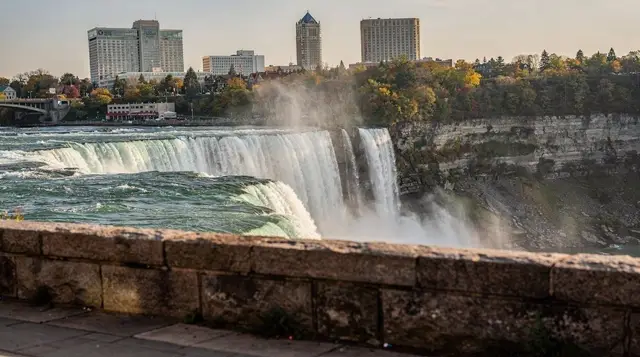
Below you, the Niagara River is already moving hard, funnelled through the gorge after the drop over the falls. To your left, depending on which way you’re facing, the mist column from the Horseshoe Falls hangs over the river even from this distance, and the American Falls are close enough that on a clear day you can pick out people standing at Terrapin Point on the far side.
It takes about ten minutes to walk the whole span when there’s no line, and for most of that ten minutes you’re neither quite in Canada nor quite in the United States. You’re over a river that belongs to both countries and to neither, watching water that was, a few minutes earlier, falling past millions of people’s cameras, and is now just running fast and green and indifferent under your feet.
Then there’s a booth. An officer, a question or two, a look at your passport, and you’re somewhere else. Not somewhere dramatically different — Niagara Falls, New York and Niagara Falls, Ontario share a name, a river, and a tourist economy built around the same three waterfalls — but the currency changes, the road signs change, the accent behind the counter at the coffee shop changes. It’s the fastest, cheapest, least ceremonious way I know to feel a national border as a physical fact rather than an abstraction on a map.
The queue is the variable
The bridge itself doesn’t change. What changes, a lot, is how long you wait to get on and off it. Early on a weekday morning in October, I’ve walked the whole round trip — Canada to the US and back — in under twenty-five minutes including both passport checks. On a Saturday in July, the same walk has cost me the better part of an hour, most of it standing in a line of pedestrians that snakes back from the booth while the sun does its work and everyone slowly unzips a layer.
There’s no real trick to avoiding this beyond timing. Midweek beats weekends, mornings beat afternoons, and the shoulder seasons — spring and fall — beat the peak of summer by a wide margin. If you’re trying to cross both ways in a single day, which plenty of visitors do just to say they’ve stood on both sides, building in slack for the queue matters more than building in slack for the walk itself. The bridge is a fixed ten minutes. The line in front of it is not.
A shared river, administered
What struck me the first time I really thought about it, standing over the rapids with a lineup forming behind me, is that this water doesn’t belong to the line at all. The Niagara River runs from Lake Erie to Lake Ontario, and for its whole length it’s shared — literally, by treaty, with the flow over the falls themselves managed under an agreement that dates back to 1950.
The border I was walking across follows the middle of a river that two countries have spent more than a century agreeing, and periodically re-agreeing, how to divide and use. That’s a strange thing to be standing over on a sidewalk. It’s easy to think of a border as a line on solid ground, a fence, a wall. Here it’s a moving current, invisible from above, that both governments have quietly decided is exactly half theirs.
I don’t think this needs to be a heavy thought to be a real one. You can cross the Rainbow Bridge on foot without dwelling on any of it — plenty of people do, headed to dinner on the other side, or back to a hotel, or across for the afternoon just because the American Falls and Goat Island side offers a different angle on the same water than the Canadian side does. But if you slow down for those ten minutes, rather than treating the walk as a chore between two “real” destinations, it turns into one of the more quietly memorable things you can do at Niagara without paying for a ticket.
Practical notes, briefly
A passport is required in both directions — there’s no shortcut for a short walk, though American citizens can use a passport card or enhanced driver’s licence instead of a full passport at this land crossing, and NEXUS holders move through faster. ArriveCAN, which used to require a submission before entering Canada, has not been mandatory since October 2022, so there’s nothing to fill out ahead of time for this crossing specifically. For the fuller rundown on documents, timing, and what to expect at the booth, the dedicated guide to crossing the border at Niagara covers it properly; this piece is really about the walk itself, not the paperwork.
If you’d rather see both sides without managing the crossing yourself, tours built around it exist — the Niagara Falls USA and Canada Tour with Boat Cruise handles the border logistics as part of the day, and the Ultimate Niagara Falls Tour with Boat Cruise pairs a boat ride with viewpoints on the Canadian side if you’re short on time.
For visitors coming from Toronto specifically, the Toronto: Niagara Falls Tour Boat Tower Behind the Falls folds a same-day round trip into one booking. None of that replaces the walk, though. A guided day gets you to both sides efficiently. Walking gets you the ten minutes over the water where you’re not quite anywhere, watching a river that isn’t fully anyone’s, before you’re somewhere else entirely.
Whichever way you’re headed — into Niagara Falls, Ontario for the wide view of the Horseshoe Falls, or into Niagara Falls, New York for the closer, wetter angle on the American Falls — the comparison between the two sides doesn’t really have a single right answer, and the walk across is as good a place as any to sit with that instead of rushing to settle it.
It’s also worth remembering, standing there, that the volume you’re watching thunder over the crest is itself the product of a negotiated agreement, not a purely natural event — a fact the piece on the treaty behind the flow goes into properly. For a longer stay that gives you time on both sides without rushing the crossing, the 48 hours on both sides itinerary builds the bridge walk in as its own stop rather than a formality between two better-known ones.
Transfers and transport passes on GetYourGuide
Verified deep-linked GetYourGuide tours. Book through these links and we earn a small commission at no cost to you.
GetYourGuide does not provide a product photo for this activity — the image shows the meeting point, photographed by us.