Why Brampton rarely fits a Niagara Falls trip
Brampton is a real place with a real downtown, not a suburb invented for a map. It is Canada’s ninth-largest city, home to well over 650,000 people, and it sits in the Greater Toronto Area northwest of Mississauga. None of that makes it a natural stop for someone visiting Niagara Falls. The honest answer, covered in full below, is that Brampton is off the direct route between the falls and both Toronto Pearson Airport and downtown Toronto.
Getting there and back adds real driving time rather than sitting conveniently along the way. This page exists so that visitors who search for Brampton in connection with Niagara Falls get a straight answer rather than an inflated case for a detour that mostly benefits people who already live or work there.
Where Brampton actually sits on the map
Picture the Niagara Falls to Toronto corridor as a line running along the western end of Lake Ontario: from the falls, the QEW curves past St. Catharines, Hamilton, and Oakville, then continues through Mississauga before reaching downtown Toronto. That lakeshore line is the direct route, and it is the one nearly every Niagara Falls day trip or shuttle actually drives.
Brampton is not on that line. It sits north of Mississauga and northwest of Toronto proper, inland from the lake, closer in character to the 400-series highway corridor than to the waterfront. Toronto Pearson Airport sits roughly on Brampton’s southern doorstep, straddling the Mississauga-Brampton boundary, and central Brampton itself is a further stretch north from there. In practical terms, if the falls-to-Toronto drive is a straight line along the shore, reaching Brampton means turning off that line and heading inland for an additional stretch.
The route trap: Brampton is not on the way to Pearson or downtown Toronto
This is worth stating plainly because it is the single most common misconception behind this search: Brampton is not a convenient stop between Niagara Falls and Toronto Pearson Airport, and it is not on the way to downtown Toronto either.
From the falls, Pearson sits about 128 km away, roughly a 1 h 20min to 1 h 40min drive on the QEW and Highway 427 in normal traffic. Downtown Toronto is about 130 km and roughly 1 h 30min, following the QEW the rest of the way along the lake. Brampton adds another leg on top of either of those trips: from Pearson, it is a further 15 to 20 minutes north on Highway 427 or 410, more once you account for the fact that GTA highways rarely move at posted speeds during the day. All told, a drive from Niagara Falls into central Brampton runs closer to 1 h 45min to 2 h 15min, and that estimate assumes you are not travelling during the morning or evening rush, when the 401, 407, and 410 corridors around Brampton back up badly.
The practical consequence: someone flying out of Pearson at the end of a Niagara Falls trip does not pass through Brampton on the way to the airport. Someone driving from the falls into downtown Toronto does not pass anywhere near Brampton either. Working Brampton into either itinerary means a deliberate detour north, not a stop that happens to sit along the road.
| From Niagara Falls | Distance | Typical drive time |
|---|---|---|
| Toronto Pearson Airport | 128 km | 1 h 20min to 1 h 40min |
| Toronto (downtown) | 130 km | About 1 h 30min |
| Mississauga | About 115 km | 1 h 15min to 1 h 30min |
| Brampton | About 145 to 150 km | 1 h 45min to 2 h 15min |
Traffic matters more here than the raw kilometres suggest. On a clear midday drive the gap between Pearson and Brampton might be 15 minutes. On a Friday afternoon, it can easily double. Anyone planning to add Brampton onto a same-day Niagara Falls itinerary should build in that variability rather than assuming it will run to the shortest-case number.
What is actually in Brampton
None of this is a case against Brampton as a city. It is a case against treating it as a Niagara Falls attraction, because it isn’t one, and inflating it into one would do visitors a disservice.
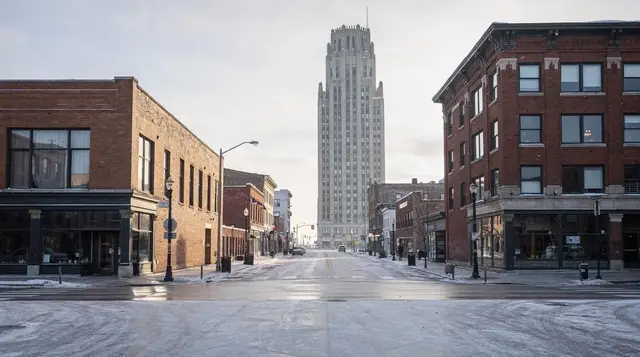
The historic downtown core, centred on Gage Park, is Brampton’s most walkable and photogenic area: a Victorian-era park with a bandshell, fountains, and mature trees, bordered by the restored Rose Theatre and a scattering of heritage buildings along Main Street. The Peel Art Gallery, Museum and Archives, known locally as PAMA, occupies the former county courthouse and jail and runs rotating exhibitions on regional history and contemporary art. Neither is a full-day draw, and neither competes with what Toronto itself offers a few kilometres south.
Brampton’s most distinctive feature for a visitor is demographic rather than architectural: it has one of the largest South Asian and Sikh populations of any city in Canada, and that shows up in the built landscape. Several large gurdwaras, including some of the biggest in the GTA, anchor community life, and mandirs serve the city’s Hindu population as well. The restaurant scene reflects the same community strongly, with a concentration of Punjabi, Gujarati, and broader South Asian dining that is genuinely a cut above what a casual visitor finds scattered through central Toronto. Farmers’ markets and community festivals run through the warmer months, timed loosely with the Gage Park events calendar from May through September.
None of this amounts to a tourist district in the way Niagara-on-the-Lake or the Distillery District in Toronto function as tourist districts. Brampton was not built around visitors, and it does not present itself as a destination the way those places do. That is not a criticism of the city; it simply means the honest comparison is: would a visitor with limited time near Niagara Falls get more from a few hours in Brampton, or from that same time in Toronto, Mississauga, or back at the falls themselves? For nearly everyone without a personal connection to the city, the answer favours the more central options.
When a stop in Brampton actually makes sense
There is a real, narrow set of cases where visiting Brampton on the same trip as Niagara Falls is a reasonable choice, and they mostly come down to a reason to be there that has nothing to do with sightseeing:
- Family or friends live there. If your Niagara Falls trip is really a visit to relatives or friends based in Brampton, the falls become the side trip, not the other way around, and the drive time is simply the cost of seeing people you came to see.
- Business or a specific event. Brampton hosts a significant logistics, manufacturing, and film production sector, along with community and cultural events tied to its South Asian population. A conference, a wedding, or a work meeting is a legitimate reason to build a day around the city.
- You are already staying in the northwest GTA. Travellers who booked accommodation near Pearson for flight timing, rather than for proximity to the falls or downtown, may find Brampton is genuinely closer to their hotel than either of those options, in which case a short local outing makes more sense than a long drive elsewhere.
- A deliberate South Asian food or culture outing. Visitors specifically seeking out Punjabi or broader South Asian cuisine, or wanting to see one of the GTA’s major gurdwaras, will find Brampton delivers on that in a way few other GTA cities do.
Outside of those situations, most visitors are better served treating Brampton as a place they might pass near, not a place worth routing a Niagara Falls trip through.
Getting from Niagara Falls to Brampton
If one of the situations above applies, the drive itself is straightforward, if long. From Niagara Falls, take the QEW toward Toronto, then transition onto Highway 407 (a tolled highway, with tolls billed to the vehicle’s licence plate on most rental agreements) or continue to Highway 427 and pick up Highway 410 north into Brampton. Both routings run 1 h 45min to 2 h 15min depending on time of day, with the 407 generally faster and more predictable since it is tolled and less congested than the free alternatives.
Public transit is a much weaker option for this specific trip. There is no direct GO Transit or VIA Rail service connecting Niagara Falls to Brampton; a transit-based trip would mean travelling first to Toronto and transferring to GO Transit’s Brampton or Mount Pleasant GO stations on the Kitchener line, adding well over an hour beyond the driving time. For visitors without a car, this route only makes sense as part of a longer, multi-day trip that already includes a stay in Toronto, using the guidance in getting around without a car alongside a separate GO Transit leg into Brampton, rather than as a same-day round trip from the falls.
For visitors weighing whether to base themselves in Brampton at all versus a more central location, the short version is: don’t, unless the reason above applies. Where to stay near the falls and Toronto versus Niagara-on-the-Lake as a base both cover far more practical options for anyone building an itinerary around the falls rather than around Brampton itself.
Brampton against Mississauga and Toronto
It is worth being direct about how Brampton compares to its two neighbours, since visitors researching the northwest GTA often confuse the three.
Mississauga sits between Brampton and the lake, closer to both Pearson and the QEW, and functions more as an extension of Toronto’s western edge, with its own downtown cluster of towers around Square One. It is the more practical stopover of the two for anyone genuinely travelling between Niagara Falls and the airport or downtown Toronto, simply because it sits on that direct corridor rather than north of it.
Toronto itself remains the main gateway city for this entire region, and nearly everything a visitor might hope to find in Brampton, aside from its specific South Asian cultural landmarks, exists in a denser and more accessible form somewhere in Toronto: museums, historic architecture, waterfront parks, a far larger and more varied restaurant scene, and direct transit connections back toward the falls.
Neither comparison is meant to dismiss Brampton. It simply means that for a visitor whose trip is organized around Niagara Falls, and who has no independent reason to go north into Brampton specifically, the time is almost always better spent in Mississauga or Toronto, both of which sit closer to the direct route and offer more for a similar amount of driving.
A realistic half-day in Brampton, if you do go
For visitors who have decided a stop in Brampton makes sense, a workable plan avoids trying to stretch the visit into a full day it does not support. Start at Gage Park and the historic downtown core, allowing an hour or so to walk Main Street, see the Rose Theatre, and take in PAMA if a rotating exhibition is on. From there, a South Asian lunch is the strongest single reason to linger; Brampton’s Punjabi and Gujarati restaurants are genuinely a highlight, not a consolation prize. Visitors with a specific interest in Sikh or Hindu heritage sites can build in a visit to one of the city’s larger gurdwaras or mandirs, checking visiting hours and dress expectations in advance, since these are active places of worship rather than museums.
Budget CAD $40 to $80 per person for the half-day, covering a meal, parking, and a museum ticket if PAMA has a paid exhibition running; Gage Park itself and most gurdwara visits are free. Treat the visit as bounded rather than open-ended: a few focused hours cover what Brampton offers a visitor well, and there is little upside to stretching it further at the expense of time that could go toward the falls themselves, Niagara-on-the-Lake, or a full day in Toronto.
Booking the return to Niagara Falls
Visitors approaching this from the other direction, already in Brampton or the northwest GTA and looking to add Niagara Falls as the day trip, have several tour options that pick up locally rather than requiring a drive into downtown Toronto first. The private Niagara Falls tour with hotel pickup from Brampton is the most convenient for anyone without a car, collecting travellers directly rather than routing them through a central Toronto meeting point.
For groups travelling together, the custom group bus tour from Brampton covers up to 56 people, which suits a family gathering, a wedding party, or a community outing better than booking seats individually.
Budget-conscious travellers who do not need door-to-door pickup can look at the best-value Niagara Falls tour departing from Brampton, which covers the core sights at the falls without the premium of a fully private vehicle. Whichever option fits, expect the same 1 h 45min to 2 h 15min transfer in reverse, so factor that into how early the tour needs to depart to make the most of time at the falls, using how many days to spend at Niagara Falls as a starting point for pairing the day trip with a longer stay if one makes sense.
Bottom line
Brampton is a genuine, sizeable Canadian city with its own history and, in its South Asian cultural landmarks and food scene, a few things a visitor would not easily find elsewhere in the GTA. What it is not is a stop on the way between Niagara Falls and Toronto Pearson Airport or downtown Toronto. It sits north of that corridor, and reaching it adds close to two hours of driving each way from the falls, more at rush hour, without shortening any part of a standard Toronto to Niagara Falls itinerary.
Visit it if you already have a reason to: family, friends, business, or a specific interest in its Sikh and South Asian community landmarks. Skip it, without guilt, if your trip is organized around the falls, Niagara-on-the-Lake, and Toronto, where Mississauga and Toronto sit closer to the road you are already driving.