Zip line to the falls: what the WildPlay ride is really like
What is the zip line to the falls at Niagara?
It's a roughly 670 m zip line run by the private operator WildPlay, launching from a tower near Table Rock on the Canadian side and running you face-on toward Horseshoe Falls. It's not a Niagara Parks attraction, it runs on a limited season, and there are weight limits for riders.
A private ride, not a Niagara Parks attraction
The zip line to the falls is the one experience in Niagara Falls, Ontario, where you’re moving faster than the water. It’s run by WildPlay, a private adventure-tourism operator, from a launch tower near the Table Rock area on the Canadian side.
That distinction matters more than it sounds: Niagara Parks runs Table Rock itself, Journey Behind the Falls, and the Niagara Parks Power Station, but the zip line is a separate business on separate land, with its own tickets, its own hours, and its own cancellation rules. A Niagara Parks pass, including the Adventure Pass Classic, does not cover it, and staff at Table Rock can’t sell or explain WildPlay tickets for you.
That’s not a knock on the ride — it’s one of the better adrenaline options on this side of the border, and the view on the way down is genuinely unlike anything else at the falls. It’s just worth knowing who you’re booking with and why it isn’t bundled with the public attractions.
The line: about 670 m toward Horseshoe Falls
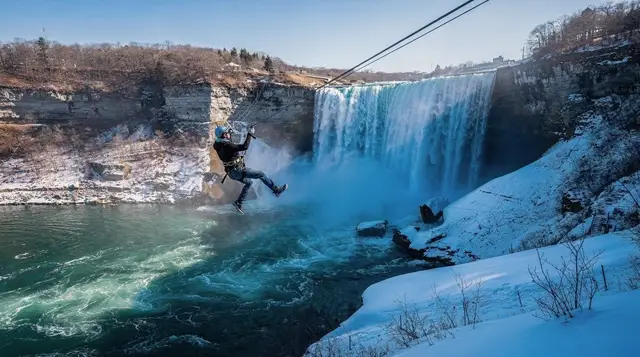
The cable runs roughly 670 m from the launch tower down to a landing zone closer to the river, angled so that for most of the ride you’re facing the Horseshoe Falls head-on rather than looking off to one side. That’s the whole appeal of this particular zip line over a generic forest canopy tour: the last third of Niagara’s most famous view fills your entire field of vision while you’re still moving, with the mist rising off roughly 90 percent of the river’s total flow crashing over the crest in front of you.
Riders are clipped into a harness and helmet at the top, given a short safety briefing, and sent down one or two at a time depending on how the operator is running the queue that day. The tower itself gives you a preview: you’re already elevated before you launch, so the first look at the falls comes from up high, then the ride closes the distance fast.
Speed, view, and what the descent actually feels like
The ride itself is short — well under a minute of actual line time — which surprises people who’ve built it up as a long thrill ride. It isn’t. It’s a fast, loud, wind-in-your-face sprint toward one of the largest volumes of moving water on the continent, and the speed is real: you cover the 670 m quickly enough that conversation with anyone on the line beside you isn’t really an option.
What people remember afterward isn’t the speed number, it’s the framing. Most zip lines run over trees or a gorge and the ground is the point of interest. Here the falls themselves are the target, growing from a wide backdrop into something that fills your vision as you close in, with spray visible and audible before you’re anywhere near it. It’s a genuinely different way to see Horseshoe Falls than any of the boats, towers, or walkways — you’re not standing still admiring it, you’re being delivered toward it at speed, which is either the appeal or the reason to skip it, depending on your tolerance for both heights and rushing water.
The landing zone is at ground level near the base of the falls area, and riders are guided back up to the main pathway rather than left to find their own way out.
Weight limits, harness checks, and who can’t ride
Zip lines are gravity rides, and gravity rides have weight rules on both ends. WildPlay sets a minimum rider weight, which rules out most young children, and a maximum rider weight, which rules out some larger adults — both figures exist for the mechanical safety of the braking system, not as an arbitrary cutoff. The operator publishes the current numbers on its own booking page, and they’re worth checking before you plan around the ride, especially if you’re travelling with kids or with anyone near either end of the range. Numbers like this do get revised, so treat whatever you read elsewhere as a starting point and confirm the current figures directly with WildPlay when you book.
Beyond weight, expect a standard adventure-park screening: closed-toe shoes are mandatory (no sandals, no flip-flops), loose items like hats, sunglasses on a loose strap, or anything in an open pocket need to be secured or left with a non-riding companion, and staff will check that the harness is fitted correctly before you’re cleared to launch. Riders typically need to be able to follow safety instructions independently, which is the practical reason very young children are excluded even before the weight minimum comes into play. If you have a specific mobility concern or medical condition, contact WildPlay directly rather than assuming either way.
Booking ahead, season, and weather cancellations
This is a seasonal ride, not a year-round one, and the exact opening and closing dates move from year to year based on conditions and demand. Don’t plan a winter trip around riding the zip line — check WildPlay’s current operating calendar before you build a day around it, because a date that worked last year may not hold this year.
Within the season, time slots fill up fast on summer weekends and around sunset, when the light on the falls is best and demand for the illumination window is highest. Booking a slot in advance, especially for July and August visits, removes the risk of arriving at Table Rock and finding the day sold out. Outside peak months you may be able to walk up and ride within an hour, but that’s a bet, not a guarantee.
Weather is the other variable nobody can promise around. The line runs in the open, over water, in a spot that regularly gets its own microclimate of wind and mist off the falls. High wind, lightning, or heavy rain can pause or cancel rides with little notice, and unlike a boat tour that might simply run a shorter route, a zip line generally just doesn’t operate until conditions clear. If the ride is a must-do rather than a nice-to-have, build a spare window into your schedule — a rebooked slot the next morning, or an early-season weekday when queues are shorter — rather than treating one afternoon as the only shot.
book the standard zip line to the falls in advance and lock in a daytime slot before the season’s weekend queues build up.
Early morning, night illumination, and other time slots
WildPlay sells more than one version of the same line. An early-bird slot gets you down the cable before the crowds build and before the day’s heat and haze set in, which also tends to mean a shorter wait between check-in and launch.
an early-bird zip line slot is worth it if you’d rather ride once and spend the rest of the morning at Table Rock or on the Niagara Parkway without a mid-afternoon queue eating into the day.
There’s also a version timed around the falls’ nightly illumination, when the coloured lighting is on and the crowd at ground level thins out even as the view changes completely.
the night illumination zip line trades the daytime clarity of the falls for the lit-up spray and a noticeably different atmosphere — check the season and hours before booking, since lit evening rides don’t run every night the daytime line does.
Price, what’s included, what to bring
Expect to pay somewhere in the range of a mid-tier paid attraction rather than a budget one — pricing sits above the free viewpoints and below a helicopter tour, and it moves with season and time slot, so treat any number you see as a starting range in CAD rather than a fixed rate. Tickets typically include the harness, helmet, and safety briefing; some packages bundle a souvenir photo or video, which is worth checking at booking since it’s often the single most-upsold add-on at the counter.
Wear closed-toe shoes and clothes you don’t mind getting a little damp — you’ll pass close enough to the falls that spray reaches you on the approach, well before you’d get properly wet on something like Cave of the Winds or Journey Behind the Falls. Cameras and phones need to be secured with a strap or left with a non-riding companion; there’s no safe way to hold a loose device at zip-line speed. If photos matter to you, check whether the operator’s own photo package is offered before assuming you’ll get a usable shot yourself.
Zip line vs Whirlpool Adventure Course
It’s easy to conflate the two big-name adventure options on the Canadian side, but they’re genuinely different products in different places. The zip line to the falls launches near Table Rock and sends you toward Horseshoe Falls in a single fast run. The Whirlpool Adventure Course is a separate ropes-and-zipline circuit built above the Niagara Gorge near the Whirlpool, several kilometres downriver, closer to the Whirlpool Aero Car than to the falls themselves — it’s a longer, multi-element course rather than one straight-line descent, and the view is over the gorge’s rapids and whirlpool basin, not the falls.
the Whirlpool Adventure Classic Course is the one to book if what you actually want is time in the gorge and a longer course rather than a single 670 m run at the falls — they’re not interchangeable, and neither ticket transfers to the other site.
If your time is tight, pick one rather than both: the falls zip line for the view, the Whirlpool course for the length of the outing. Combining them into one day is possible but means factoring in transit between two separate sites, both weather-dependent, both running on their own schedules.
Fitting it into a day at the falls
Because the ride itself takes under a minute once you’re clipped in, the real time cost is arrival, check-in, gear-up, and the wait if you haven’t pre-booked — plan for an hour to ninety minutes around the actual descent in peak season. That makes it easy to slot into a one-day Niagara Falls itinerary alongside Table Rock, a walk down Clifton Hill, or a boat ride on Niagara City Cruises — just don’t schedule it back-to-back with something else time-sensitive, in case weather pushes your slot.
If you’re travelling with anyone who falls outside the weight range, or with young kids who can’t ride, the wait area is at ground level rather than up on the tower, so a non-riding companion isn’t stuck watching from a distance — though there’s genuinely nothing for a non-rider to do there beyond wait, so plan their time separately, maybe at Queen Victoria Park nearby.
Compared with the helicopter tours that also promise a fast, different angle on the falls, the zip line is far cheaper and far shorter, and it gets you closer to the water rather than higher above it. Neither replaces the other; they’re answering different questions about how much you want to spend and how you want to see the falls move.
Zip line to the falls: frequently asked questions
Is the zip line to the falls operated by Niagara Parks?
No. It’s run by WildPlay, a private adventure-tourism operator, on land near Table Rock. Niagara Parks passes such as the Adventure Pass Classic don’t include it, and you book and pay for it separately.
How far is the zip line and how long does it take?
The line runs about 670 m from a launch tower down toward the base of Horseshoe Falls. The ride itself is over in under a minute; checking in, gearing up, and the safety briefing take much longer than the descent.
Is there a weight limit for the Niagara Falls zip line?
Yes, WildPlay sets both a minimum and a maximum rider weight for safety reasons, which rules out young children on one end and some larger adults on the other. The exact figures are published on WildPlay’s own booking page and are worth confirming before you plan a family trip around it, since operators do adjust them.
Do I need to book the zip line in advance?
In summer and on weekends, yes — time slots sell out, especially around midday and at sunset. Outside peak season you can sometimes walk up, but booking ahead removes the risk of arriving to a sold-out afternoon.
Does the zip line run all year?
No. It operates on a seasonal schedule that WildPlay sets and adjusts year to year, generally not running through the coldest winter months. Check current operating dates directly with WildPlay before building a trip around it, rather than assuming last year’s calendar still applies.
What happens if it’s windy or raining?
The ride can be paused or cancelled for high wind, lightning, or heavy weather, since riders are on an exposed cable over open ground. Nothing about availability is guaranteed on a given day — if the ride matters to your itinerary, build in a spare afternoon or an alternative.
Is the zip line the same thing as the Whirlpool Adventure Course?
No, they’re different activities on different sites. The zip line to the falls launches near Table Rock and runs toward Horseshoe Falls; the Whirlpool Adventure Course is a separate ropes-and-zipline course above the Whirlpool, several kilometres downriver in the gorge.
What do I wear and bring?
Closed-toe shoes are required, and you’ll be given a harness and helmet on site. Expect to get a little wet from spray on approach to the falls, so a layer you don’t mind splashing is worth it, and loose items like hats or phones need to be secured or left behind.
Zip lines, jet boats and thrills on GetYourGuide
Verified deep-linked GetYourGuide tours. Book through these links and we earn a small commission at no cost to you.
GetYourGuide does not provide a product photo for this activity — the image shows the meeting point, photographed by us.