The Whirlpool Adventure Course, explained
What is the Whirlpool Adventure Course at Niagara Falls?
It's a ropes-course style aerial park of suspended bridges, zip lines and platforms strung through the trees above the Niagara Gorge near the Whirlpool, done in a harness with staff supervision throughout. Plan on two to three hours, not a quick stop, and don't confuse it with the separate zip line to the falls or with the free Niagara Glen trail at the bottom of the same gorge.
What the Whirlpool Adventure Course actually is
Strip away the marketing and this is a treetop ropes course: a series of wooden platforms built into and between trees along the rim of the Niagara Gorge, near the Whirlpool, connected by suspended bridges, cargo nets, wobbly log crossings and a handful of shorter zip lines. You’re clipped to an overhead safety cable the entire time through a harness and a set of lanyards, so a stumble means a swing and a laugh, not a fall. It is guided in the sense that staff run the briefing, check your gear and supervise the ground station, but once you’re on the course you move through the elements yourself, at your own pace, inside your booked time slot.
The setting is the reason to bother: the course runs through mature forest directly above the same gorge that carries the Niagara River from the falls toward Lewiston and Queenston, with the Whirlpool itself visible through the trees at points along the route. It’s a genuinely different way to experience that stretch of Niagara Gorge than any of the viewing platforms closer to the falls, and a much quieter one — most first-time visitors never make it this far along the Niagara Parkway, so you’re sharing the forest with a fraction of the crowd at Table Rock or Clifton Hill.
Book the standard circuit through the Whirlpool Adventure Classic Course if this is your first time on a ropes course and you want the full route rather than a shortened version.
Two things this is not — and people mix both up
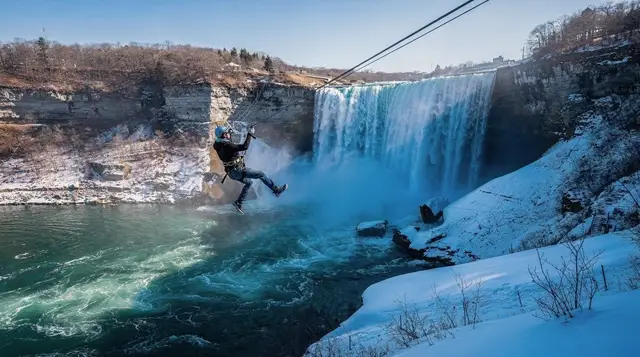
The single most common mistake is assuming this is the same thing as the zip line that sends you flying toward the Horseshoe Falls. It isn’t. That ride is a straight, one-way line from a fixed tower, over in under a minute, sold as a single adrenaline hit close to Table Rock and the falls themselves — you can compare the two properly in our guide to the zip line to the falls.
The Whirlpool Adventure Course is a longer, looping circuit a few kilometres upriver, built for repeated movement through the trees rather than one big drop. Different operator, different site, different sensation, and — worth saying plainly — a different kind of nervous energy. The zip line is over before you’ve processed it; the adventure course asks you to keep making small decisions (grip here, step there) for an hour or more.
The second mix-up is with the Niagara Glen Nature Reserve, which sits along the same general stretch of gorge and is genuinely free. The Glen is a ground-level hike: a steep metal staircase drops about 60 metres into the gorge to a shoreline trail through Carolinian forest and among glacial boulders, with a stiff climb back up. There’s no harness, no clipping in, and no fee — but there’s also no height, no bridges and no zip lines.
If what you actually want is to walk at river level and look up at the gorge walls, that’s the Glen, and the trail detail belongs in our guide to hiking the Niagara Glen and gorge trails, not here. If what you want is to move through the forest canopy on ropes and platforms, that’s this page. They are neighbours, not alternatives for the same afternoon unless you have real time to spare.
How physical it is, honestly
You don’t need to be an athlete, but you do need functioning arms as well as legs. Most elements ask you to grip a rope, cable or handhold while your feet find something unstable underneath — a swinging log, a net, a narrow plank — so upper-body strength and grip endurance matter more than raw fitness. A reasonable comparison: if you can climb a playground structure and aren’t bothered by looking down from a few storeys up, you’ll manage the course without much difficulty. If a rope bridge over water makes your stomach drop just reading about it, that discomfort won’t go away once you’re clipped in — it usually eases a little by the second or third element, but it starts on element one.
Staff run everyone through a ground briefing and a practice element before releasing the group onto the main course, and the safety system is designed so you’re always attached to something even mid-transition between elements. That’s the meaningful difference from an unsupervised outdoor scramble: the equipment and the checking-in are what make this an “adventure” activity rather than a hiking risk. Expect closed-toe shoes to be mandatory — sandals and flip-flops won’t be allowed past the gate — and expect gloves to be provided and worth wearing, since the ropes and cables will otherwise leave your hands raw after an hour of gripping them.
Duration and what to expect on the day
Set aside two to three hours total once you count arrival, waivers, the safety briefing, gearing up and the course itself. The course is self-paced inside your booked window rather than a fixed group march, so a family that takes its time on every bridge will use noticeably more of that window than two confident teenagers who move quickly. Arrive with time to spare — a rushed arrival right before a scheduled slot is the easiest way to lose actual course time to paperwork.
Because the elements are strung through live trees rather than a purpose-built steel frame, the route has more texture and unevenness than a typical amusement-park attraction: uneven footing between stations, natural shade that shifts through the afternoon, and the occasional bit of forest debris underfoot. That’s part of the appeal if you want something that feels like the gorge rather than a theme park, but it’s worth knowing going in if you were picturing something closer to a polished indoor climbing gym.
Season and weather
This runs outdoors on natural terrain and is a seasonal operation, generally open from spring through fall. Like the zip line and the other outdoor thrill activities along the gorge, it closes in rain, high wind, lightning or icy conditions, both for the ropes-course elements themselves and for the trees they’re built into. It is not a winter activity — check our season-by-season guide to what’s open and closed before building a shoulder-season or winter trip around it, since a course that’s closed on the day doesn’t usually refund a same-day walk-up, only a pre-booked reservation under the operator’s own policy.
Getting there and what’s nearby
The course is positioned along the gorge corridor near the Whirlpool, outside the tight loop that the WEGO shuttle covers between Table Rock, Fallsview and Clifton Hill. Practically, that means a car, taxi, rideshare, or a tour package that includes transport is the realistic way to reach it if you’re not driving yourself — walking from the falls themselves is not a reasonable option. If you are driving, note that parking near the gorge attractions fills differently than the main Table Rock lots; see our guide to parking on the Canadian side for the general pattern before you go.
Once you’re in the area, the Whirlpool Aero Car crossing and the viewpoints over the Whirlpool itself are close enough to combine into the same outing, and the Niagara Glen trailhead is a short drive or walk away if you want to add the free ground-level walk afterward — just budget separate time for it rather than assuming you can fit both into one course booking’s window.
What it costs, and what else is on the same gorge
Pricing for gorge-side adventure activities in Niagara Falls tends to sit in a mid-to-upper range compared with the free viewpoints and the standard boat tours — you’re paying for equipment, staffing and insurance on a supervised activity, not just admission. Expect the adventure course to run somewhat higher than the standalone zip line given the extra time and number of elements involved, and always confirm the current price and any online-booking discount before you go rather than relying on a number printed anywhere, including here.
| Activity | What it is | Typical duration | Setting |
|---|---|---|---|
| Whirlpool Adventure Course | Treetop ropes course: bridges, nets, short zip lines | 2–3 hours on site | Forest canopy above the gorge, near the Whirlpool |
| Zip line to the falls | Single one-way zip line ride toward the Horseshoe Falls | Under a minute per ride | Fixed towers near the falls themselves |
| Niagara Glen Nature Reserve | Free hiking trail at the bottom of the gorge | 1–2 hours | Riverside forest floor, steep staircase access |
| Jet boat on the river | Powered boat run through the rapids toward the Whirlpool | About 1 hour | On the water, downstream of the Whirlpool |
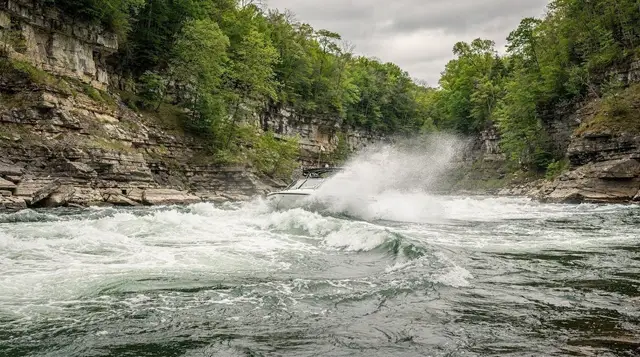
Two related thrill activities worth knowing about, even though this page doesn’t cover them in depth: the jet boat tours that run the rapids toward the Whirlpool and the calmer kayaking on the Niagara River both put you on the water in roughly the same stretch of gorge, which is a completely different sensation from being above it on ropes. If you’re weighing the full lineup of gorge and thrill activities against each other, our adventure and thrills category lays out what’s available side by side.
Comparing the zip line options near the falls
If the adventure course’s longer time commitment doesn’t suit your day but you still want an adrenaline stop, the standalone zip line comes in a few timing variants worth knowing about. An early-morning slot via the early bird zip line to the falls gets you a ride before the crowds build, while an evening option runs after dark with the falls lit up beneath you.
Either is a fundamentally shorter, simpler outing than the adventure course — a few minutes of ride time bookended by gearing up, rather than a couple of hours moving through a forest circuit — so treat them as separate decisions rather than a substitute for one another. If you’d rather ride the straight line toward the Horseshoe Falls than spend an afternoon in the trees, book the zip line to the falls directly and save the adventure course for a day with more time to spend.
Who it suits, and who should skip it
This is a strong match for teenagers and adults who find the standard sightseeing circuit — boat, tower, gorge walk — too passive, and for anyone who wants an active outdoor hour or two that isn’t a straight hike. It’s a weaker match for anyone short on time in Niagara Falls, since the travel out to the site plus the two-to-three-hour window eats a meaningful chunk of a single day that could otherwise cover two or three of the core falls attractions.
Our guide to visiting with teenagers covers where this fits against the rest of an itinerary for that age group, and if mobility or a fear of heights rules it out for part of your group, our accessibility and mobility guide and the ground-level Niagara Glen trail are the better fallback for the same stretch of gorge. On a wet or uncertain-weather day, don’t count on it as your backup plan — check our rainy day guide instead, since this closes in the same weather that ruins most other outdoor plans.
Booking sense
Reserve a specific time slot rather than showing up and hoping, particularly in summer when good-weather days fill fastest; our general advice on booking ahead versus buying on site applies here as much as anywhere on the gorge. Build in a buffer before your slot for parking and the waiver process, and don’t schedule anything time-sensitive immediately afterward — a course that runs long, or a group that moves slowly through the elements, is common enough that treating this as the anchor of your afternoon, not a quick add-on, is the more realistic plan.
Zip lines, jet boats and thrills on GetYourGuide
Verified deep-linked GetYourGuide tours. Book through these links and we earn a small commission at no cost to you.
GetYourGuide does not provide a product photo for this activity — the image shows the meeting point, photographed by us.