Kayaking the Niagara River
Can you kayak on the Niagara River?
Yes, but only on the calm stretch near the mouth of the river close to Niagara-on-the-Lake and Queenston, on Lake Ontario's edge. The rapids, the gorge, and the Whirlpool further upstream are unnavigable by recreational kayak and are used only by guided jet boats.
Two very different rivers, one name
The Niagara River runs 58 kilometres from Lake Erie to Lake Ontario, and it behaves like two entirely different waterways along that distance. For most of its length, especially anywhere near the falls, the gorge, or the rapids leading into the Whirlpool, it’s a fast, cold, unforgiving body of water that has nothing to do with recreational paddling. Then, in its final few kilometres before it widens into Lake Ontario near Niagara-on-the-Lake and Queenston, it slows down, flattens out, and becomes genuinely pleasant to paddle.
That split matters more here than at most rivers, because the two sections sit only about 15 kilometres apart, and a visitor glancing at a map could reasonably assume the whole river is fair game for a kayak. It isn’t. This guide is about the calm stretch you actually can paddle, the fast stretch you can’t, and why every legitimate operator in the area draws that line in the same place.
The calm water: Niagara-on-the-Lake to Queenston
The paddleable section of the Niagara River sits at its mouth, where the river empties into Lake Ontario. By the time the water reaches Niagara-on-the-Lake, it has already dropped through the gorge and the rapids well upstream, and what’s left is wide, slow-moving, and lake-like. This is the water guided kayak tours use, launching from or near the town and paddling along a shoreline that mixes historic waterfront, orchard country, and views across to the New York shore.
Just upstream of the town, near Queenston and the base of the Queenston Heights escarpment, the current picks up slightly as the river narrows before it opens out again toward the lake. Operators who run trips in this zone know exactly where that transition happens and stay well clear of it. A first-time paddler on a guided trip won’t notice the difference; a solo paddler without local knowledge could easily drift further upstream than they mean to, which is exactly why guided trips and supervised rentals are the norm here rather than an option.
Conditions on this stretch are still shaped by the lake, not just the river. Wind off Lake Ontario can build chop with little warning, particularly in the afternoon, and a morning launch is generally calmer than a late-day one. Boat traffic around the Niagara-on-the-Lake harbour adds another variable that a guide accounts for and a first-time visitor might not.
a guided kayak tour on the calm water near Niagara-on-the-Lake covers this stretch with equipment and a guide included, which is the standard way visitors paddle here.
What’s off-limits: rapids, the gorge, and the Whirlpool
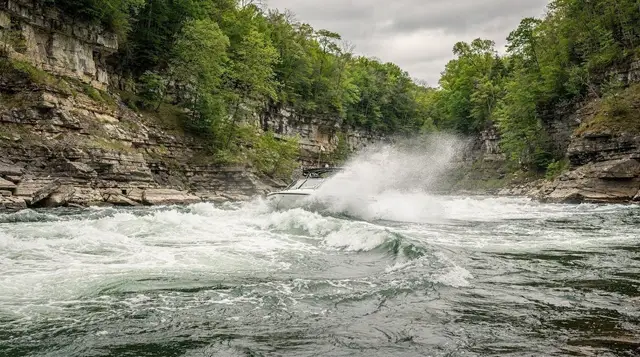
Moving upstream from Queenston, the river changes completely. This is the section that runs through the Niagara Gorge, past the class VI rapids of the White Water Walk on the Canadian side and the trails of Whirlpool State Park on the American side, and into the Whirlpool itself, a natural basin roughly 518 by 365 metres wide and 38 metres deep, fed by rapids that run at up to 9 metres per second. None of this is kayaking water, recreational or otherwise. It’s not a matter of skill level; it’s simply outside what any paddle craft, guided or not, is built to handle safely, and no tour operator in the region offers or would offer a kayak trip through it.
This is also the stretch covered by guided jet boat tours, which use purpose-built, powered boats and trained crews specifically because the water demands that kind of equipment. It’s a different activity from kayaking in every respect other than sharing the same river, and worth booking on its own terms rather than as a paddling substitute. A 45-minute jet boat tour on the Niagara River rapids, launching from the American side, is the way most visitors experience this section of the river up close, from inside a boat crewed for exactly that water.
Closer still to the falls themselves, the river isn’t navigable by any recreational craft at all. The stretch through and immediately below the Horseshoe Falls and American Falls drops dozens of metres over a short distance and churns constantly; it’s viewed from platforms, boats built for exactly that purpose, and observation points, never paddled. If a listing or a stranger on the street suggests kayaking near the falls, that’s a hard no, not a matter of finding the right operator.
Guided tours vs. rental kayaks
Two ways to get on the calm-water section exist, and both funnel through some form of supervision rather than a self-serve rental you paddle off with unaccompanied.
Guided tours are the more common option and the one most first-time visitors choose. A guide sets the route, points out landmarks along the Niagara-on-the-Lake shoreline, and manages timing around wind and boat traffic. Groups tend to be small, gear is provided, and no prior kayaking experience is expected. This is also the safer default if you’re not familiar with the specific stretch of river being used, since local knowledge of where the current picks up matters more here than raw paddling skill.
Rental kayaks exist too, but in this area they’re typically supervised or paired with a briefing rather than handed over with no oversight, precisely because of how close the calm section sits to water that isn’t calm at all. An operator renting kayaks near Niagara-on-the-Lake will generally keep renters within a marked or briefed area and won’t send anyone upstream toward Queenston without guidance.
| Option | What’s included | Best for |
|---|---|---|
| Guided kayak tour | Kayak, paddle, PFD, guide, set route | First-time paddlers, anyone unfamiliar with the river |
| Supervised rental | Kayak, paddle, PFD, briefed boundaries | Confident paddlers wanting more independence within limits |
| Jet boat tour (rapids) | Powered boat, crew, safety gear | Experiencing the rapids and Whirlpool up close, no paddling involved |
Prices for guided kayak trips in the region generally run in the CAD 60 to 100 range per person for a couple of hours, though it’s worth checking exactly what’s included, since some trips bundle in a second activity like a short walking segment through the town.
The Niagara River Recreation Trail as your map, not your route
The Niagara River Recreation Trail runs about 56 kilometres along the riverbank, from Fort Erie in the south to Niagara-on-the-Lake in the north, tracing the river’s entire route past Lake Erie, the rapids, the gorge, the Whirlpool, and finally the calm water at the mouth. It’s a cycling and walking path, not a paddling route, but it’s genuinely useful for understanding the river’s geography before you plan a kayak trip.
Ride or walk a section of the trail near the Niagara Parkway between Queenston and Niagara-on-the-Lake, and you can see the exact point where the water shifts from moving with purpose to sitting nearly flat, which is a clearer way to understand the boundary than any description. Further south, the trail runs above the gorge itself, giving cyclists and walkers a view down into the rapids that no kayaker will ever be paddling through. Treat the trail as a way to see the whole river’s character in one afternoon, separate from any time spent actually on the water.
A guided walking tour of Niagara-on-the-Lake covers the town end of that trail and the harbour area where kayak trips typically launch, which is a reasonable way to scout the area on foot before or after paddling it.
Combining a kayak trip with the rest of Niagara-on-the-Lake
Because the paddling zone sits right at the edge of Niagara-on-the-Lake, a kayak trip pairs naturally with time in the town itself: Queen Street, the historic waterfront, and the walk or ride out toward Queenston Heights and Fort George. Most guided kayak trips run two to three hours including setup and instruction, which leaves a good chunk of a day free for the rest of the area. Morning is generally the better slot for paddling, both because the water tends to be calmer before the wind builds and because it leaves the afternoon open for the town.
If a full day near the water and the river’s history sounds appealing, a two-day itinerary covering both sides of the falls can slot a kayak morning in alongside a jet boat afternoon upstream, which between them cover the entire calm-to-rapids range of the river without ever mixing the two up.
Other adventure options on and around the river
For visitors who want more speed or height than a calm paddle offers, the falls area has a cluster of separate adventure activities, all distinct from kayaking and each covering a different piece of the landscape. A zip line runs from the edge of the gorge on the Canadian side directly toward the Horseshoe Falls, which is about as close as anyone gets to the falls themselves without being in a boat below them. A zip line ride toward the Horseshoe Falls is a fixed-line, harnessed activity, nothing to do with paddling, but it’s often booked on the same trip by visitors weighing their adventure options.
Deeper in the gorge system, Niagara Glen on the Canadian side and the trail network around Whirlpool State Park on the American side offer real hiking down into the gorge itself, close enough to see the rapids and the Whirlpool from solid ground rather than from any boat. These trails are steep, involve a real climb back out, and are worth planning as their own outing rather than an add-on.
Practical tips for kayaking the Niagara River
A few things are worth knowing before booking a kayak trip in this area. First, season matters: most operators run from late spring through early autumn, roughly May to October, since the calm-water stretch is exposed to Lake Ontario’s wind and cold shuts most trips down outside that window. Second, weather can cancel a trip on short notice, particularly if wind off the lake picks up; ask about an operator’s rescheduling or refund policy before booking rather than assuming one.
A personal flotation device is standard equipment on every legitimate trip and non-negotiable regardless of swimming ability or experience. Dress in layers that dry quickly, since getting splashed is part of paddling even on calm water, and bring sun protection, since there’s no shade once you’re out on the river. Footwear that can get wet, rather than anything you’d mind ruining, makes the launch and landing easier.
Finally, and this is the one point worth repeating: nothing about kayaking near Niagara-on-the-Lake extends upstream toward the gorge, the rapids, or the Whirlpool. If a trip description, a rental shop, or anyone else suggests paddling near the falls or through the fast water further up the river, that’s not a real recreational option here, and no established operator runs it.
Kayaking the Niagara River: frequently asked questions
Can you kayak near Niagara Falls itself?
No. The stretch of river anywhere close to the Horseshoe Falls, the American Falls, or the gorge below them is fast-moving whitewater and strictly off-limits to recreational paddling. Kayaking happens well downstream, near the calm mouth of the river.
Is it safe to kayak on the Niagara River?
It’s safe on the designated calm-water section near Niagara-on-the-Lake and Queenston, especially with a guide or on a rental from an operator who knows the local currents. It is not safe anywhere near the rapids, the gorge, or the Whirlpool, all of which are outside recreational kayaking limits.
Do I need a guide to kayak the Niagara River?
Guided trips or supervised rentals are the standard and the recommended way to paddle here, since river conditions, lake-effect wind, and boat traffic near the harbour change quickly. Going out alone near the gorge or upstream sections is not something any local operator offers or supports.
What’s the difference between kayaking and the jet boat tours on the Niagara River?
Kayaking covers the calm, flat water near the river mouth at Niagara-on-the-Lake. The rapids and the Whirlpool, roughly 20 kilometres upstream, are covered instead by guided jet boats built and licensed for whitewater, which is a separate activity with its own dedicated tour.
Is the Niagara River Recreation Trail a kayaking route?
No, it’s a 56-kilometre cycling and walking path along the riverbank from Fort Erie to Niagara-on-the-Lake. It runs alongside the water the whole way and is a good way to see where the calm and fast sections are, but it isn’t a paddling route itself.
Where do kayak tours on the Niagara River start?
Most guided kayak trips launch from or near Niagara-on-the-Lake, at the point where the river widens and slows as it reaches Lake Ontario. That’s the only stretch local operators run recreational kayaking on.
What should I wear or bring to kayak the Niagara River?
A properly fitted personal flotation device, which any legitimate operator provides and requires, plus quick-dry layers, sun protection, and shoes you don’t mind getting wet. Most guided trips supply the kayak, paddle, and safety gear.
Niagara Falls boat tours on GetYourGuide
Verified deep-linked GetYourGuide tours. Book through these links and we earn a small commission at no cost to you.
GetYourGuide does not provide a product photo for this activity — the image shows the meeting point, photographed by us.