Spring in Niagara Falls: what April and May are really like
What is Niagara Falls like in spring (April and May)?
Spring brings the year's highest water flow from snowmelt upstream, a gradual reopening of seasonal attractions like the boat tours and the White Water Walk, and blossoming orchards in wine country nearby -- but the weather swings from near freezing to warm within the same week, and exact reopening dates change every year depending on conditions.
Reading the shoulder season right
April and May at Niagara Falls sit in an awkward, interesting spot. The falls themselves are arguably at their most dramatic, running fuller than at almost any other point in the year, while the tourism infrastructure around them is still waking up from winter. Some of the attractions that define a summer visit — the boat tours, the White Water Walk, the Whirlpool Aero Car — are closed at the start of April and open, one by one, as the weeks go by. Nobody can tell you the exact date any of them will reopen this far in advance, and that’s worth saying plainly rather than papering over with a confident-sounding calendar.
This guide covers what spring is actually like: the water, the weather, the reopening pattern, and how to plan around dates that move. For the detailed breakdown of what’s running month by month, see what’s open and closed by season. For temperature and precipitation data across the whole year, see Niagara Falls month by month weather. Summer and fall have their own guides — see summer in Niagara Falls and fall in Niagara Falls — because the attraction lineup and the crowd math change enough to deserve separate treatment.
Why the falls look fuller in spring
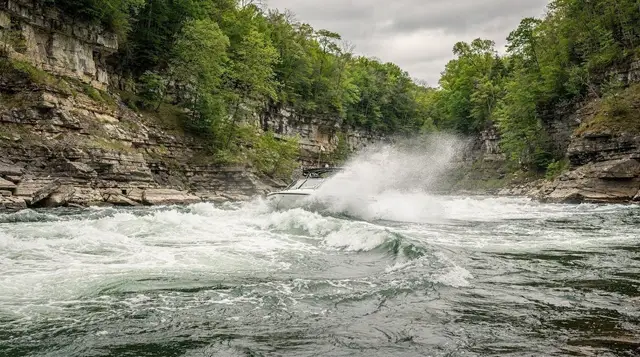
The Niagara River drains the four upper Great Lakes, a watershed of roughly 684,000 square kilometres. When snow melts across that basin through March and April, a larger volume of water works its way down the river and over the crest of both the Horseshoe Falls and the American Falls. Spring is typically when the flow is at its annual high point, and it shows — the mist plume is thicker, the roar carries further, and the Horseshoe Falls in particular can look genuinely different from how it appears in a dry August.
It’s worth being straight about one thing: what you’re watching is not entirely natural. Under the 1950 Niagara Diversion Treaty between Canada and the United States, a minimum flow is guaranteed over the crest during daylight tourist hours in season, with the rest of the river’s water diverted to hydroelectric stations on both sides. Spring’s high snowmelt volumes mean there’s more water to go around even after diversion, which is part of why the visual difference is real. For the full mechanics of the treaty, the flow numbers, and how the three falls compare, see Niagara Falls explained.
The reopening pattern, attraction by attraction
Niagara Parks and the operators on the American side don’t run on a fixed switch-flip date. Each attraction reopens once its own maintenance, safety inspection, and staffing are ready, and a late-melting winter or a cold snap in early April can push things back. The table below gives a general sense of sequencing based on how the season typically unfolds — treat every date as approximate and confirm directly with the operator before you plan a trip around any single attraction.
| Attraction | Side | Typical reopening window | Notes |
|---|---|---|---|
| Niagara City Cruises | Canadian | generally early-to-mid April | poncho tours resume once the boats clear winter maintenance |
| Maid of the Mist | American | generally April | same pattern as the Canadian boats, separate operator |
| White Water Walk | Canadian | generally April | boardwalk needs to be reinstalled after winter |
| Whirlpool Aero Car | Canadian | generally April, sometimes later | weather-dependent, can slip into May after a hard winter |
| Cave of the Winds (full deck) | American | generally spring | boardwalks are rebuilt from scratch each year; the Ice Experience upper platform runs through winter instead |
| Journey Behind the Falls | Canadian | year-round | the lower outdoor platform is the part that’s seasonal |
| Table Rock viewpoint | Canadian | year-round | free, open every day of the year |
| Niagara Glen trails | Canadian | year-round, but icy in early spring | check footing conditions after a cold snap |
The pattern is consistent even if the dates aren’t: anything requiring a boardwalk to be rebuilt, a boat to come out of dry dock, or a cable car to pass inspection is going to lag behind the free, permanent viewpoints. If your whole trip is built around one specific ride or tour, that’s the piece to double-check first, not last.
Planning around a date that isn’t fixed yet
The single most useful thing to do before booking a spring trip is separate what you can count on from what you can’t. Table Rock, Queen Victoria Park, and the free viewpoints on both sides of the border are open every day of the year, whatever the calendar says. Journey Behind the Falls runs year-round too, just without its lower platform until the ice clears.
What isn’t guaranteed on any given date in early-to-mid April is the White Water Walk, the Whirlpool Aero Car, or a full Cave of the Winds deck. If you’re travelling in the first half of April specifically to ride one of those, check the operator’s own reopening notice within a couple of weeks of departure, not months out. By the last week of April into May, most years have everything running, but “most years” is doing real work in that sentence — it isn’t every year.
Boat tours are usually the safest of the seasonal group to plan around because operators tend to publish firm start dates once winter maintenance wraps up. See what to expect from the Maid of the Mist and what to expect from Niagara City Cruises for what the ride itself is like once it’s running, or Maid of the Mist versus Niagara City Cruises if you’re choosing a side. If your trip lands before either tour has reopened, boat tour season and winter alternatives covers what’s worth doing instead.
A half-day guided option built around the falls themselves sidesteps a lot of this uncertainty, since the operator adjusts the stops to whatever is actually open that week. The From Toronto: Niagara Falls day tour and the Toronto: Niagara Falls day tour both run on this kind of flexible itinerary, which takes the guesswork off your plate rather than the reverse.
Wine country in bloom — briefly
Niagara-on-the-Lake and the escarpment wine region generally show blossom on the fruit trees and early growth in the vineyards sometime in late April into May, though the exact week is entirely weather-dependent and shifts from one year to the next. This guide isn’t the place for tasting routes, which wineries to book, or how a driver-led day works — that detail lives in the Niagara wine region page and the dedicated day trip to Niagara-on-the-Lake and wine country guide.
The short version for spring planning purposes: it’s a legitimate reason to extend a trip by a day, it photographs well, and it’s a different kind of scenery from the falls themselves, but don’t build a single-purpose trip around catching blossom on an exact date.
What the weather actually does
April and May are the two most weather-unstable months of the Niagara Falls calendar. Early April mornings can sit close to freezing, and a late-season flurry isn’t unusual in the first couple of weeks. By late May, afternoon highs are commonly in the low 20s Celsius, with genuinely warm, sunny days mixed in throughout the month. The catch is that the swing between those two states can happen inside a single week — a cold, grey Tuesday followed by a mild, clear Saturday is a normal spring pattern here, not an anomaly.
Practically, that means layers matter more in spring than in any other season on this site. A waterproof outer shell earns its keep both against rain showers and against the mist off the falls, which is genuinely wet regardless of air temperature. The ponchos handed out on the boat tours and at Cave of the Winds are fine for the mist itself, but they’re not warmth — if the forecast is cool, wear something underneath that can handle it.
For the season-by-season temperature and precipitation comparison, see Niagara Falls month by month weather; for how spring stacks up against the other three seasons for a first-time visit, see best time to visit Niagara Falls.
Crowds and cost
Spring is one of the two genuinely quiet windows at Niagara Falls, along with late fall. April in particular sees noticeably shorter lines at whatever is open, easier parking on the Canadian side, and hotel rates that sit well below the summer peak. May starts to fill in as the weather warms and school groups increase, but it’s still calmer than a July or August weekend.
The trade-off is straightforward: fewer crowds, but a shorter list of confirmed-open attractions in early spring specifically. If your priority is a quiet trip and you’re flexible about which attractions you actually get to, April rewards that flexibility. If you have one specific ride or tour you’re set on, May is generally the safer bet, since most years have the full seasonal lineup running by then.
For photographers, the higher water flow and the changeable light — clear one hour, dramatic storm clouds the next — make spring a genuinely good window, covered in more depth in best times to photograph the falls.
A realistic spring day
A single day works well in spring precisely because you’re not trying to squeeze in every seasonal attraction — some of them may not be running yet. Anchor the day around what’s guaranteed: Table Rock and the Horseshoe Falls viewpoint, Journey Behind the Falls, and a walk along the Niagara Parkway while the trees along the river are just starting to leaf out. If the boat tours have reopened by your travel dates, add one of those as the afternoon highlight. See one day at Niagara Falls for a full hour-by-hour version of this kind of day.
For a livelier way to cover ground once the weather cooperates, the Niagara Falls: e-bike tour gets you along the river and parkway faster than walking without needing a car, which suits the unpredictable spring weather — you can cover more ground on a good-weather day and cut a route short on a cold one. If you want both the daytime views and the evening illumination in a single outing once the falls are lit after dusk, the day and night Niagara Falls combo tour covers both without doubling back.
Crossing the border in spring
Spring is a good moment to see both sides, because the viewpoints on each bank are free and always open, whatever is or isn’t running. You need a passport in both directions. Visitors from visa-exempt countries need an ESTA to enter the United States, and the Canadian eTA only applies if you arrive in Canada by air. The practical details are in crossing the border at Niagara, and Niagara Falls on foot across the Rainbow Bridge is the simplest way to do it without a car. If you can’t decide which bank to spend your single day on, Canada versus the USA side of Niagara Falls lays out the trade-offs.
Remember that the two sides use different currencies, the Canadian dollar and the US dollar, and that Ontario adds 13 % HST at the till while Niagara County adds a sales tax of roughly 8 %. Prices shown on one side are not comparable to the other until you convert them.
Spring on the American side
The Niagara Falls State Park, opened in 1885 and the oldest state park in the United States, keeps its paths and viewpoints open all year, so a walk past the American Falls and across to Goat Island works even in a cold first week of April. The mist is heaviest in spring, when the flow is high, so the viewing platforms near the Bridal Veil Falls can be slick and wet. Wear shoes with grip. The Niagara Gorge trails below the falls can stay icy or muddy after a cold snap, so check the footing before you commit to the descent, and see Niagara Gorge trails on the USA side for the routes.
When it rains
Spring rain is common, and a grey day does not have to end your plans. The falls are impressive in low cloud, and the mist makes the umbrella argument moot, since a hooded shell does more. For indoor options and ideas that suit a wet afternoon, see rainy day Niagara Falls. If a cold front arrives after the first reopenings, remember that a closed boat or a closed walkway is a seasonal fact, not a failure of your plan, and the fixed viewpoints are still there.
Booking around uncertainty
The general rule for a spring trip: book what’s guaranteed to be open in advance if it has limited capacity, and leave the seasonal, weather-dependent pieces flexible until closer to your dates. A guided day tour with a fixed departure, like the From Toronto: Niagara waterfalls day tour, is worth locking in early since transport and a knowledgeable guide are useful regardless of which individual attractions happen to be running that week. For ticketed, capacity-limited attractions that are already confirmed open, see book ahead or buy on site for which ones are worth reserving versus which can be bought at the gate.
Whatever you plan, check the actual reopening notices from Niagara Parks and the American-side operators within two to three weeks of your trip, not when you first start planning it months out. A hard winter, a late thaw, or an equipment issue can all push a date back, and no guide — including this one — can promise you a specific calendar day this far in advance.
Seasonal experiences on GetYourGuide
Verified deep-linked GetYourGuide tours. Book through these links and we earn a small commission at no cost to you.
GetYourGuide does not provide a product photo for this activity — the image shows the meeting point, photographed by us.